
In a BB (bulk blend) fertilizer production line, there is a piece of equipment often relegated to a “supporting role”: the multiple-silo, single-weigh static batching system. In this setup, multiple silos discharge materials sequentially into a single weigh hopper; the weight is recorded after each addition, and the entire batch is released only once all components have been weighed. While its primary task appears to be simple weighing, the actual accuracy of this process is not determined by the weighing system alone. There is an often-overlooked causal link connecting the compost turners—such as windrow turners or large-wheel turners—used in the fermentation bays to the fundamental precision limits of the entire BB fertilizer production line.
The advantage of a multiple-silo single-weigh static batching system lies in “static weighing.” Because readings are taken only when the material in the hopper is stable, the sensors are subjected to a constant load, unaffected by fluctuations in conveyor speed or the impact of falling material. This allows for a very narrow margin of error in the mix ratio. However, this advantage relies on a hidden prerequisite: the physical properties of the material entering the silos must be consistent. If a single batch of material contains both dry and wet components—leading to inconsistent flow rates—the resulting fluctuations in feed speed will introduce errors during the weighing stage. In other words, while the scale itself may be accurate, the rhythm of the material feed is not.
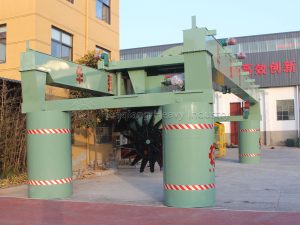
The root of the problem lies upstream, in the fermentation phase. As organic material sits in a fermentation bay for an extended period, the material at the bottom becomes compacted under its own weight, creating a high-moisture zone where the moisture content can be significantly higher—often by more than ten percentage points—than that of the surface layer. When this material (dry on top, wet at the bottom) enters the batching silos, the dry material flows out quickly, while the wet material flows more slowly. This causes the actual proportions of the mixture to shift from one batch to the next. The periodic turning of the material—performed by a fermentation compost turner—is designed specifically to eliminate these spatial variations. By bringing the compacted material from the bottom to the surface and folding the drier surface material into the interior, the turner ensures that the moisture content throughout the entire bay remains uniform. The more uniform the turning and aeration process, the more “manageable” the material becomes when it enters the batching/mixing stage.
Different types of compost turners are suited to different operational environments. Windrow turners operate by straddling open-air windrows; they require no fermentation bays, entail lower initial investment, and offer high site flexibility—making them ideal for small-to-medium-scale production lines. However, they are limited in terms of turning depth and are highly susceptible to weather conditions. Large wheel compost turners, by contrast, offer greater working widths and deeper turning capabilities, designed for industrial-scale fermentation facilities. A single unit can process hundreds of tons per day, serving production lines with an annual output of over 10,000 tons—though this comes at the cost of higher equipment investment and energy consumption. Ultimately, both types share a single objective: to ensure that the material discharged from the fermentation process falls within a precise, narrow range regarding moisture content and the degree of decomposition.
Consequently, the uniformity of the blend in a bulk-blend (BB) fertilizer production process—and the overall consistency of the final product—are fundamentally determined by the performance of the compost turner within the fermentation bay. While the batching system acts as the “gatekeeper” for precision, the condition of the material that reaches this gatekeeper is dictated by the preceding fermentation stage. If, during equipment selection, the focus remains solely on the accuracy of weighing scales or the rotational speed of the mixer—while overlooking how the turning process shapes the material’s physical properties—the stability of the entire production line will be compromised from the very source.