
For large-scale organic fertilizer plants with an annual output of over 50,000 tons, choosing a continuous, high-yield, and automated production line is crucial. Among various granulation processes, rotary drum granulation, with its outstanding advantages of large single-machine capacity, high granule sphericity, and stable continuous operation, has become the preferred solution for large-scale production. This article will analyze the core equipment and process characteristics of large-scale rotary drum granulation production lines.
Continuous Operation, High Yield, and Automation: The Three Pillars of Large-Scale Production
Large-scale organic fertilizer production lines aim for 24-hour uninterrupted operation. The rotary drum granulator uses a variable frequency speed-regulating motor, which can automatically adjust the drum speed according to the feed rate. A single machine can achieve an hourly output of 8-15 tons. Combined with front and rear buffer silos and an automatic control system, the entire line does not require frequent start-ups and shutdowns. In terms of automation, the DCS distributed control system can monitor key parameters such as raw material ratio, granulation temperature, and drying hot air from the central control room. Only 2-3 operators are needed, a reduction of 60% compared to traditional production lines.
Rubber/Stainless Steel Liners and Automatic Scraping: Organic fertilizer raw materials have a certain degree of stickiness, easily forming “scratches” that accumulate on the inner wall of the drum, affecting the granulation effect. Our rotary drum granulator uses either rubber or 304 stainless steel linings. Rubber linings are elastic, preventing material adhesion, and are easy to replace and cost-effective, making them suitable for processing organic materials such as livestock and poultry manure. Stainless steel linings are corrosion-resistant and have a smooth surface. Combined with the automatic scraping device inside the drum—a set of scrapers rotating with the drum—it removes adhering materials from the inner wall in real time, ensuring the drum remains clean and the granulation rate remains stable at over 85%.
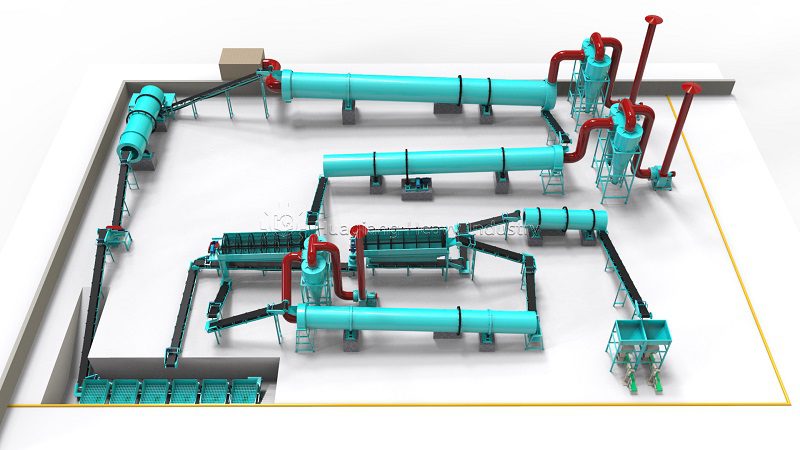
Steam-Assisted Granulation Process: The organic fertilizer rotary drum granulator uses a steam-assisted agglomeration process. After the material enters the drum, low-pressure steam (0.2-0.4 MPa) is evenly sprayed from the steam nozzles, softening and plasticizing the particle surface. Driven by the rotation of the drum, the material falls in a waterfall-like manner, with small particles acting as cores, continuously adsorbing surrounding powder and gradually growing larger. The addition of steam not only improves the granulation rate (by 15-20 percentage points compared to without steam), but also reduces the material’s dependence on moisture, making the granulation process more controllable.
Suitable System Configuration for Large-Scale Plants
A complete large-scale rotary drum granulation production line, in addition to the rotary drum granulator, requires an automatic batching system, a rotary dryer, a rotary cooler, a drum screen, and an automatic packaging machine. After batching and mixing, the raw materials enter the granulator. The exiting granules (moisture content 20%-25%) enter the dryer, where the hot air temperature is controlled at 80-120℃ to reduce the moisture content to below 15%. The cooler then cools the material to ambient temperature via counter-current flow. The screen separates 2-5mm qualified granules, while unqualified granules are returned to the granulator. The entire line is compactly designed with smooth material flow, and the comprehensive energy consumption per ton of product is approximately 20-25 kWh.
From chicken manure fermentation feed to commercial organic fertilizer granules, the rotary drum granulation production line supports large-scale production in large factories with its continuous, stable, and efficient performance.
The rotary drum granulation production line is the engine of large-scale organic fertilizer manufacturing, but its success depends on the quality of the upstream fermentation. The initial decomposition of raw materials like livestock manure relies on effective fermentation composting turning technology. For large-scale facilities processing thousands of tons of material, a large wheel compost turner or a windrow composting machine is often the workhorse for open-air windrows. For more controlled, intensive processing, trough-type aerobic fermentation composting technology is employed, utilizing a trough-type compost turner or a robust chain compost turner that moves along fixed rails. These machines function as a highly efficient agriculture waste compost fermentation machine. The choice between a windrow composting machine and a trough-type compost turner depends on the specific site, scale, and environmental requirements. The consistent, mature compost produced by these technologies is the ideal feedstock for the rotary drum granulation production line. The synergy between the composting phase and the granulation phase is critical: a well-managed fermentation composting turning technology process ensures a uniform, stable input for the high-capacity rotary drum granulator, enabling it to operate at peak efficiency and produce the high-quality, spherical granules that define premium organic fertilizer.