
During equipment acceptance, manufacturers and users typically focus on a few hard metrics: production capacity, power, granule strength, and mixing uniformity. While these targets are often met during on-site acceptance testing, actual production frequently reveals issues such as reduced output, granule pulverization, microbial culture death, and nutrient fluctuations. The reason lies in the fact that acceptance testing measures “static indicators,” whereas actual production tests “dynamic stability.”
Double-roller extrusion granulation: Acceptance tests measure strength, while production tests roller shell longevity and material consistency. During acceptance, the double-roller press granulator is run using prepared, uniform powdered material; granule strength exceeds 30N, and capacity matches the nameplate specifications. However, the true challenge of this technology lies in continuous operation. Under high pressure, roller shells undergo continuous wear—pattern depths gradually shallow from 2–3mm, causing the granulation rate to slowly drop from 80% to below 60%. Acceptance tests do not involve continuous 8-hour runs, nor do they challenge the equipment with actual raw materials characterized by fluctuating moisture content or uneven particle size. Once in production, even slight changes in raw materials lead to roller slippage, loose material cakes, and a surge in recycled material, inevitably causing output to “falter.”
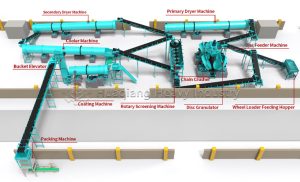
BB fertilizer production lines: Acceptance tests measure the Coefficient of Variation (CV), while production tests resistance to segregation and long-term accuracy. During acceptance, mixing granules of similar sizes for a few minutes yields a CV ≤ 5%, appearing satisfactory. In actual production, however, differences in particle size and specific gravity between urea and potash lead to segregation—where uniformly mixed materials re-stratify during conveying and packaging. While a multiple-silo, single-weigh static batching system may achieve ±0.2% accuracy during acceptance, long-term operation leads to sensor zero-point drift, pneumatic gate delays, and bin bridging, causing accuracy to quietly deteriorate. Acceptance testing cannot detect these “chronic ailments.” Bio-organic fertilizer granulation: Acceptance testing focuses on the pelletization rate, whereas actual production hinges on the survival rate of the microbial strains. During acceptance testing for bio-organic fertilizer production lines and granulation systems, disc granulators can achieve pelletization rates exceeding 90% with well-rounded granules; however, the survival rate of functional microbes is not assessed at this stage. Bio-organic fertilizer production requires temperatures to remain at or below 55°C throughout granulation and at or below 60°C during drying. While temperatures might barely meet standards during the processing of one or two test batches, continuous production introduces issues such as frictional heat generation on the granulation disc and uneven hot-air distribution in the dryer. These factors can cause localized overheating, leading to massive microbial die-off and downgrading the product to ordinary organic fertilizer. Ultimately, regardless of how high the pelletization rate is, the product is considered a failure if the viable microbe count falls short of standards.