
A peculiar phenomenon often occurs in fertilizer packaging: bags from the same batch, formula, and packaging scale vary in appearance—some are plump and rigid, while others are loose and limp. Since the packaging scale measures weight—and every bag meets the weight requirement—why is there such a stark difference in appearance? The issue lies not with the packaging machine itself, but with the bulk density of the granules. This invisible metric quietly influences packaging volume, flow within storage bins, and the end-user’s application experience.
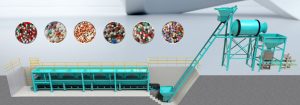
The bulk density of blended fertilizer is largely dictated by the particle sizes of the raw materials. The NPK Blending Fertilizer Production Line is a purely physical mixing process. The NPK blending machine and the NPK bulk blending machine mix granules such as urea, ammonium phosphate, and potassium chloride according to the formula. Consequently, the volume of the material decreases for the same weight, making the bag appear deflated. Conversely, if particle sizes are compatible but the mixing is uneven, localized fluctuations in bulk density will cause the bag’s appearance to vary—sometimes bulging, sometimes sagging. Therefore, blending lines require raw material particle size differences to be controlled within ±0.5 mm, the coefficient of variation (CV) for mixing uniformity to be ≤5%, and the granule breakage rate to be kept under 0.5%. Only when bulk density is stable can packaging volume remain consistent.
For double-roller extrusion granulation, bulk density is determined by roller pressure and the subsequent crushing process. Double-roller press granulators compress powdered material into dense sheets under high pressure, which are then crushed and screened into granules. The roller gap, extrusion pressure, and material moisture content collectively determine the density of the compacted material (or “cake”): a narrow gap and high pressure result in a dense cake and high granule bulk density, whereas a wide gap and low pressure yield a looser cake and lower granule bulk density. The screening and material recycling stage of the roller press granulation production line is equally critical: if the recycle ratio is too high, fine powder undergoes repeated compaction, causing fluctuations in granule bulk density; conversely, if the ratio is too low, oversized granules contaminate the final product, leading to a drop in bulk density. A stable production line requires maintaining the recycle ratio between 30% and 50%, ensuring roller surface pattern wear does not exceed two-thirds of the original depth, and keeping material moisture content stable at 8%–15%.
Fluctuations in bulk density also impact downstream processes. Granules with low bulk density exhibit poor flowability in storage silos and are prone to bridging; furthermore, the increased volume of the same mass of material places higher demands on packaging bag strength. During transport, bags with low bulk density are more easily crushed, and uneven stress on the granules leads to pulverization. In the case of blended fertilizers, bulk density fluctuations exacerbate segregation—where lighter granules rise to the top and heavier ones settle at the bottom—further amplifying inconsistencies in the packaged product.