
Fertilizer production lines are often visualized as a straight sequence: mix, then granulate, then package. However, in actual operation, if equipment units are rigidly connected, a brief stoppage or a fluctuation in processing speed in any single unit can trigger a domino effect, bringing the entire line to a halt. What truly ensures stable line operation is the presence of those often-overlooked “buffer bins.”
In NPK blending fertilizer production lines, the primary role of the buffer bin is to decouple processing rates. Blended fertilizers typically use a batch mixing process, meaning discharge from the mixer is intermittent and occurs in batches, whereas packaging machines require a continuous, steady feed. If the mixer were connected directly to the packaging scale, the packaging machine would be overwhelmed during mixer discharge, yet starved of material while the mixer was waiting. Placing a buffer bin between them allows the mixer to discharge at full capacity while the packaging machine draws material at its own pace; consequently, the efficiency of the entire line is no longer constrained by its slowest link. These bins are usually equipped with anti-segregation baffles to minimize material residence time, preventing particle stratification caused by vibration or drop height.
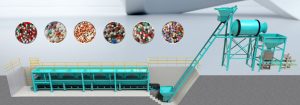
In roller press granulation lines, the role of the buffer bin is even more critical. Roller press granulation is a continuous extrusion process, and the double-roller press is extremely sensitive to feed continuity. If powdered material were discharged in batches directly from the mixer into the granulator’s hopper, material levels would fluctuate wildly—causing overload and current spikes in the extrusion zone when levels were high, and idling or accelerated roller wear when levels were low. By installing a buffer bin upstream of the granulator—combined with a variable-frequency screw feeder and a level sensor—the material level can be stabilized within the 60%–80% range. This allows the granulator to operate under a constant load, resulting in more consistent particle density and strength.
However, bigger is not necessarily better when it comes to buffer bin capacity. If the capacity is too small, it fails to provide a buffering effect; if it is too large, the material remains in the bin for an extended period, increasing the risk of moisture absorption and caking—particularly with formulations containing urea or nitrate nitrogen. Standard designs typically size buffer silos based on 15–30 minutes of downstream consumption; this capacity is sufficient to absorb upstream batch fluctuations without causing excessive material buildup.
From a process perspective, a buffer silo is not merely a storage vessel but a regulator that synchronizes production line pacing. It enables intermittent and continuous equipment to operate in concert, allowing downstream processes to smoothly absorb upstream fluctuations. When selecting equipment, rather than focusing solely on the specifications of granulators or mixers, it is more effective to first calculate the cycle time differences across stages; only then should one determine the optimal placement and size of the buffer silo. The stability of a production line often hinges on these “invisible” points of integration.