
While the focus of fertilizer production lines often centers on granulators and packaging machines, the stable operation of the entire line is frequently determined by the “upstream processes” of fermentation turning and ingredient proportioning. Although these steps do not affect the appearance of the final product, they directly determine whether the material decomposes evenly and whether nutrient levels are precisely achieved.
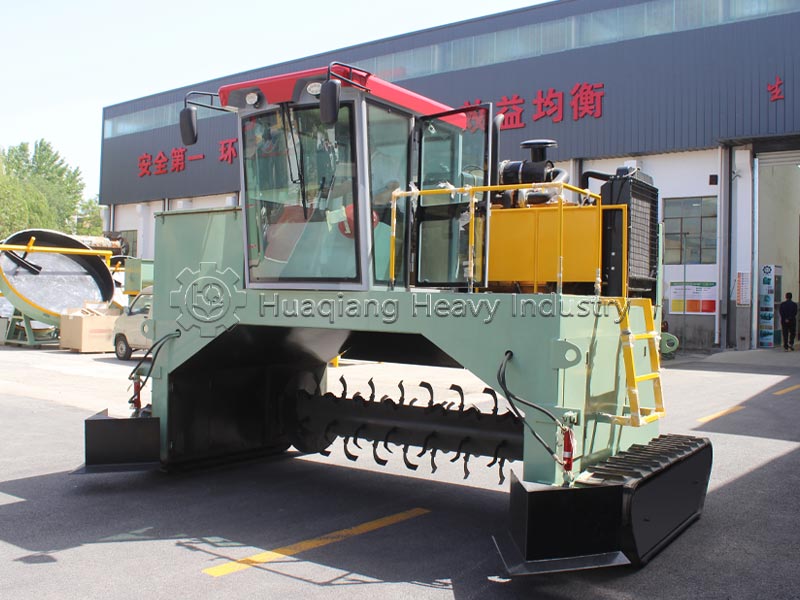
The choice of turning equipment depends on the fermentation method. Channel-style fermentation demands high turning depth and uniformity; hydraulic compost turning machines, driven by hydraulics, offer deep turning capabilities and robust overload protection, making them ideal for this method. Windrow fermentation eliminates the need for fermentation channels; windrow compost turning machines utilize crawler tracks for excellent terrain adaptability and require lower investment, making them suitable for small-to-medium-scale operations. Large-wheel compost turning machines are powerful tools for large-scale production; featuring large-diameter turning wheels, a single unit can process hundreds of tons daily, making them suitable for factories with annual outputs exceeding 10,000 tons. “Fermentation compost turning machine” serves as a general term encompassing all these types.
The precision of the proportioning system determines the success of the BB fertilizer mixing process. The BB fertilizer mixing process involves proportioning, mixing, and packaging, with proportioning serving as the starting point for accuracy. A multiple-silo, single-weigh static batching system is suitable for mixing 3 to 8 types of materials; raw material silos discharge sequentially into a single weigh hopper, where materials are weighed statically one by one before being conveyed together. Because each ingredient is weighed while completely stationary—unaffected by conveyor belt speed fluctuations—proportioning errors can be controlled within ±0.2%. Compared to dynamic continuous proportioning, static batching sacrifices continuous production speed in exchange for batch precision.
In short, compost turning manages the “state of the material,” while proportioning ensures “nutrient precision.” Inadequate pile turning leads to uneven moisture content and inconsistent decomposition, resulting in mold adhesion and low pelletization rates during subsequent granulation; similarly, inaccurate ingredient proportioning causes nutrient deviations that exceed tolerance limits, forcing the entire batch to be reprocessed. While these issues may appear distinct, they collectively determine the production line’s operating costs and product quality compliance. Regarding content strategy, creating technical pages centered on long-tail keywords—such as “hydraulic vs. windrow compost turning machine” and “static batching system accuracy”—and using FAQ structured data markup allows search engines to display technical summaries directly in search results, thereby enhancing the visibility of specialized content.