
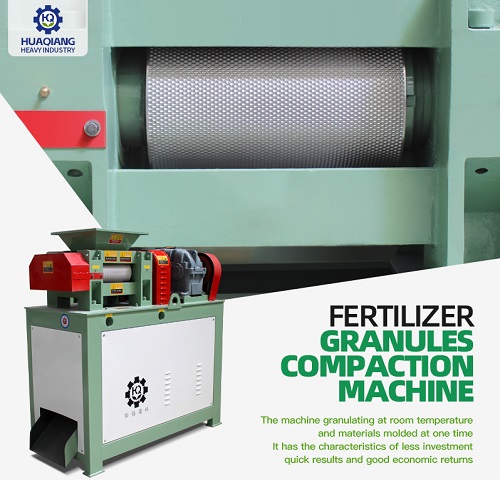
The pressure setting in roller press granulation directly determines the flake strength, fine powder circulation volume, and equipment lifespan. Typical operating pressures for roller presses of potash fertilizer and inorganic salts are approximately 30-50 kN/cm². If the pressure is too low, the flakes are brittle and easily broken, causing downstream crushing processes to break them into fine powder instead of granules, increasing the fine powder circulation volume. If the pressure is too high, it accelerates roller wear and increases energy consumption. Pressure is not a fixed value that is “the higher the better”; it needs to be continuously adjusted according to material temperature, particle size distribution, and moisture content.
I. The Closed Loop of Pressure—Flake Strength—Fine Powder Circulation
The core logic of roller press granulation is a closed loop: fine powder is compacted into flakes under high pressure in the roller gap; after crushing and granulation, the flakes are screened to obtain qualified granules; the undersized fine powder re-enters the roller press. Pressure is the “first driving force” in this closed loop. When pressure is insufficient, the bonding force between particles within the sheet is weak. Upon entering the impact crusher, instead of breaking into particles, it disintegrates into fine powder. This fine powder, after screening, re-enters the circulation, reducing the ratio of fine powder to fresh salt, further weakening the feed density for the next compaction, creating a vicious cycle—the quality yield may fall below 20%, leading to overload of the roller press. Excessive pressure is also not a solution: excessive linear pressure accelerates roller surface wear, and the energy consumption of the hydraulic system and drive motor increases simultaneously. Furthermore, sheet strength does not increase linearly with pressure; beyond a reasonable range, marginal benefits diminish sharply. Therefore, the 30-50 kN/cm² window is not simply a “recommended value,” but rather a balance line drawn between sheet strength, fine powder yield, and equipment load.
II. The Hidden Impact of Roller Concave Wear
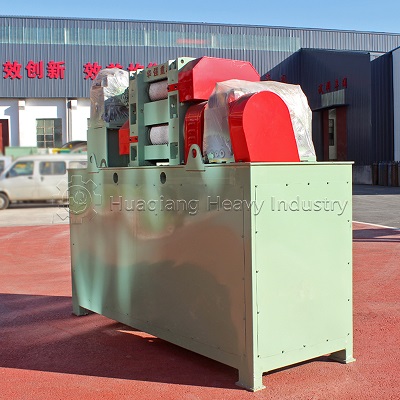
Roller wear is a gradual and hidden variable that subtly alters the actual pressure distribution. During roller press operation, material is concentrated and compressed in the center of the roller surface. The wear rate in the center is faster than at the ends, gradually forming a concave profile. Once a concave shape forms, the distribution of the roller gap in the width direction is no longer uniform: the gap in the middle is larger, and the gap at both ends is smaller. The result is that the sheet is thicker in the middle and thinner on the sides; the thicker areas are insufficiently compacted and weak, while the thinner areas are easily over-crushed during crushing. The operator sees no change in the hydraulic gauge pressure, but the actual effective pressure on the material has already distorted along the roller width direction. This wear is “difficult to detect until the roller loses stability.” The solution is to incorporate the roller surface condition into regular inspections: check the roller surface for pits, scratches, or annular grooves every shift, regularly measure the roller surface profile, and restore flatness through welding while the concave shape is still shallow, rather than waiting until the sheet quality deteriorates across the board before stopping the machine and replacing the roller. Adding an iron removal device before feeding and controlling the uniformity of feeding can also slow down the process of concave wear.
III. Control of Fine Powder Recycled Ratio
Fine powder recycled ratio is an “invisible control variable” in the closed loop of roller granulation. If the remixing ratio is too low, the fine powder in the roller gap will not be enough to fill the grooves on the roller surface, resulting in air retention, unstable flakes, and excessive fine powder after crushing. If the remixing ratio is too high, the fresh material will be diluted, reducing compaction and squeezing out effective production capacity due to increased circulating load. The remixing ratio in roller granulation is usually controlled between 0.3:1 and 0.5:1, and the remixing ratio is recommended to be stable at 20%–30%. The key is “stability”: fluctuating remixing ratios will change the particle size distribution and bulk density entering the roller press, making it difficult to achieve stable granulation even with precise pressure settings. Operationally, the undersize fine powder should be mixed with fresh material in a fixed ratio, rather than being remixed in large quantities at once. Simultaneously, the circulation volume should be monitored. If the remixing ratio consistently exceeds 0.5:1, it indicates that the pressure or roller gap matching has deviated, and the flake strength and crushing process should be checked, rather than continuing to rely on “remixing more” to maintain output.
IV. FAQ: Should I adjust the pressure or add binder first if the strength of the roller-pressed granules is insufficient?
Q: The roller-pressed granules are weak and brittle. Should I increase the pressure first or add binder first?
A: First, confirm whether the pressure falls within the corresponding window for the material, then evaluate the binder. Pressure is the “main load-bearing parameter” of roller granulation. If the current linear pressure is significantly lower than the typical range of 30-50 kN/cm², or if the roller gap is too large, resulting in insufficient compaction density, increasing the pressure or narrowing the roller gap is the most direct adjustment direction. However, there are limits to increasing the pressure: beyond the reasonable range, the strength increase is limited, while roller wear and energy consumption increase simultaneously, and the risk of equipment overload also increases. When the pressure is already within the window and the granules are still loose, the problem often turns to the material itself—too low moisture content (dry roller pressing usually requires moisture ≤5%), excessively coarse fine powder particles, or uneven distribution will all limit the conversion of pressure into strength. In this case, adding an appropriate amount of binder (such as bentonite, starch, etc., the amount added is usually controlled at 3%-8%) or adjusting the raw material moisture to 3%-5% is more effective than continuing to “hard press”. The judgment order is: first check if the pressure gauge and roller gap match the material; then check the moisture content and particle size; and finally, use the binder. Pressure is the skeleton, and the binder is the filler; the order cannot be reversed.
V. Applying the Pressure Window Across Equipment and Production Lines
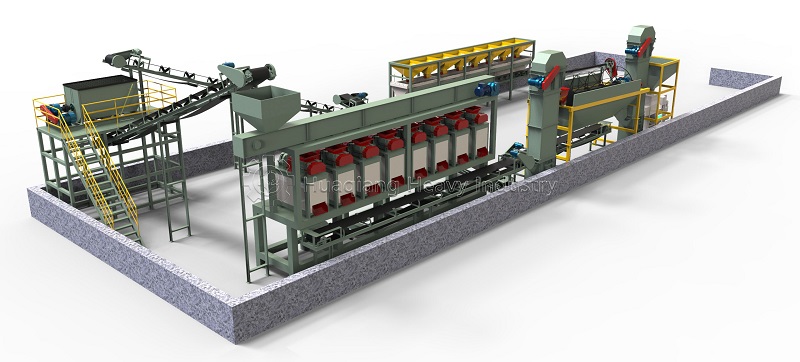
The 30-50 kN/cm² window should be understood as a process boundary for fertilizer granules compaction, not as a number tied to one machine model. On a roller press granulator production line, the pressure setting must be coordinated with roller gap, fine powder recycle ratio, and crushing/screening configuration; in an npk fertilizer production process, the same logic applies when the formulation and moisture vary. Whether the equipment is a double roller press granulator or a broader fertilizer compactor, pressure control should be validated by flake strength and fine powder circulation rather than by gauge reading alone. This is how the pressure boundary becomes transferable across different roller-press configurations and raw material systems.
Pressure control in roller granulation essentially involves maintaining a dynamic match between “linear pressure, roller gap, and material state.” 30-50 kN/cm² is the baseline window for potash fertilizer and inorganic salts. Insufficient pressure must prevent uncontrolled fine powder circulation, while excessive pressure must prevent accelerated roller surface wear. By incorporating roller concave wear into routine inspections, stabilizing the fine powder remix ratio at 20%-30%, and checking pressure before considering the binder when strength is insufficient, these three actions can transform roller granulation from an inconsistent process into a repeatable and stable one.