
Organic fertilizer granulation is a crucial process for transforming well-rotted powdery materials into regular granules. Different processes have varying requirements for raw material characteristics and equipment parameter control, directly affecting granule strength, particle size distribution, and finished product qualification rate. This article will systematically analyze the key technical points and parameter control methods of four mainstream processes: wet granulation, dry extrusion, disc agglomeration, and drum agglomeration.
Wet Granulation: Steam and Rolling Synergy
Wet granulation is mainly used in drum granulators, and its core lies in steam conditioning and rolling agglomeration. The material moisture content needs to be controlled at 20%-25%, steam pressure at 0.2-0.4 MPa, drum rotation speed at 12-18 r/min, and inclination angle at 2°-4°. Steam softens and plasticizes the granule surface, causing them to continuously absorb surrounding powder and grow larger during rolling. The granulation rate can reach 85%-90%, with high sphericity, suitable for large-scale continuous production. Consequences of uncontrolled parameters: Excessive moisture content leads to material adhesion and blockage; insufficient moisture content reduces pelletizing rate; excessive rotation speed results in short particle residence time and poor roundness.
Dry Extrusion: Direct Forming under High Pressure
Roller extrusion granulation is a dry process, requiring no water or steam. Raw material moisture content must be ≤8%, fineness ≥80 mesh, roller pressure 10-25MPa, roller speed 10-20r/min. Under high pressure, the material undergoes plastic deformation, increasing particle density by 1.5-3 times, and compressive strength can reach 20-30N. Pelletizing rate is over 95%, with particles appearing as flat spheres or pillow shapes. Key control points are: insufficient pressure results in loose particles; excessive pressure leads to accelerated roller wear; insufficient fineness results in rough particle surfaces; excessive moisture content causes material to stick to the rollers.
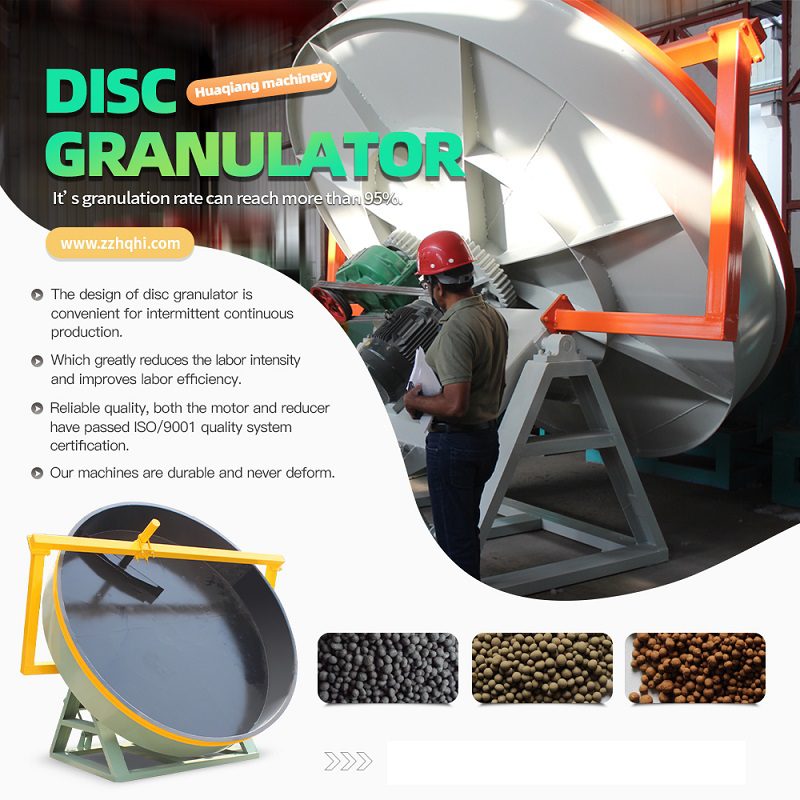
Disc Granulation: Flexible and Adjustable Small-Scale Solution
Disc granulators use a rotating inclined disc to agglomerate materials into pellets. The tilt angle is adjustable from 35° to 55°, the rotation speed is 10-20 r/min, and the material moisture content is 20%-25%. A larger tilt angle results in shorter particle residence time in the disc and smaller particle size; a faster rotation speed increases centrifugal force, leading to denser particles. The granulation rate is 80%-85%, and the particle diameter is flexibly adjustable from 1-5 mm. This process has low investment and intuitive operation, making it suitable for small- to medium-scale operations and frequent formula changes. A common problem is excessive material moisture causing severe material adhesion to the bottom of the disc, requiring timely adjustment of the water spray volume and cleaning of the scraper.
Techniques for Improving Particle Strength, Particle Size, and Qualification Rate: To improve particle strength, dry extrusion can appropriately increase roller pressure or increase raw material fineness; wet granulation requires controlling the moisture content after drying to ≤5% and cooling to ambient temperature. To control particle size distribution, disc granulation can be achieved by adjusting the tilt angle and rotation speed; drum granulation requires matching the return material ratio of the screening machine. The key to improving the qualification rate lies in return material balance—returning the screened fine powder and oversized particles to the raw material in a certain proportion to maintain system stability. Generally, a return material ratio of 20%-30% is recommended.
Common Granulation Problems and Solutions: Loose granules are often caused by excessively dry raw materials or insufficient pressure (dry process) or low moisture content (wet process). Remedies include adjusting humidity, increasing pressure, and increasing steam volume, respectively. Brittle granules are often caused by over-drying or insufficient cooling. The moisture content after drying should be controlled to around 5%, and cooling to ambient temperature should be ensured. Equipment blockage is commonly caused by excessively wet materials or excessively long fibers. Raw material pretreatment should be strengthened, the upper limit of moisture content should be controlled, and a screening and impurity removal device should be added before the granulator. Rough granule surfaces indicate insufficient grinding fineness; the raw material needs to be sieved through an 80-mesh screen.
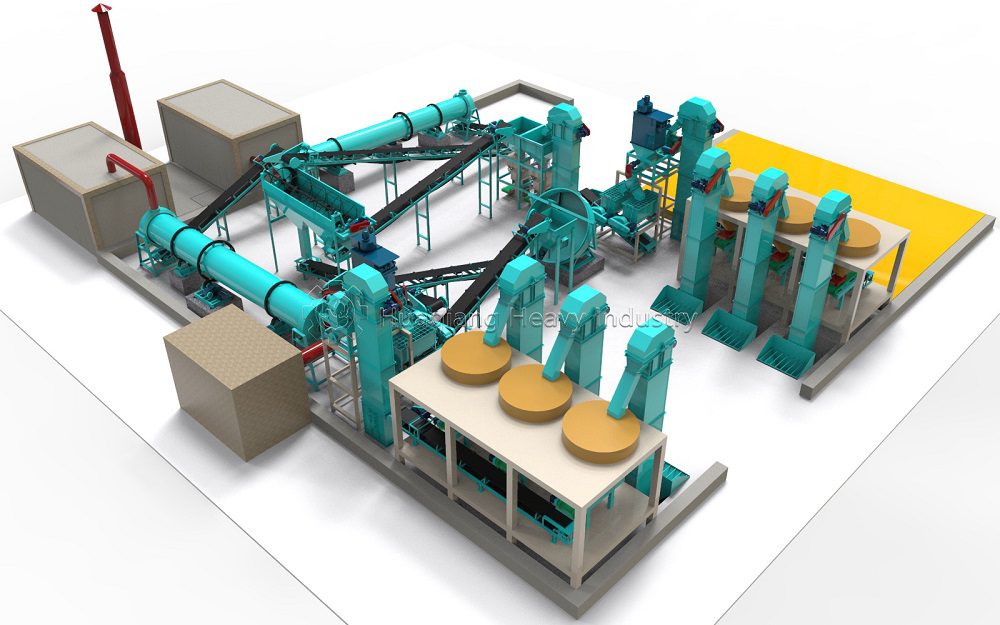
From the flexible adjustment of discs to the dry high-pressure of rollers, from the steam agglomeration of drums to the die extrusion of flat dies, each granulation process has its optimal application scenario. Mastering the core parameters and precise control will steadily improve the quality of your organic fertilizer granules.
The detailed analysis of four granulation processes forms the core knowledge base for selecting the right organic fertilizer production equipment. The journey to high-quality granules begins with organic fertilizer raw material processing equipment, such as a half-wet material crusher machine, which prepares the fermented compost to the ideal particle size. This prepared material is then ready for the shaping stage, the essence of organic fertilizer production granulation. Within the organic fertilizer granulator series, a wide array of technologies exists. For producing high-quality, spherical granules, a complete organic fertilizer disc granulation production line is a classic and effective choice, representing a key part of organic fertilizer production granulation equipment. For operations seeking a compact, efficient solution, a new type two in one organic fertilizer granulator can combine the final stages of conditioning and initial granulation. The selection guide—comparing disc, drum, and roller press machines—provides a framework for matching the granulator’s capabilities to the specific production scale, raw material properties, and desired final product characteristics. Understanding the unique strengths of each technology in the organic fertilizer granulator series is essential for building a production line that transforms organic waste into a consistent, high-value granular product efficiently and cost-effectively.