
On fertilizer production lines, the material produced by granulators does not directly become the finished product. It contains a mixture of fine powder, oversized particles, and qualified particles of varying sizes. The vibrating screen is the key equipment for solving this problem. Through the high-frequency vibration of multiple layers of screens, it precisely separates the material into oversize, middle, and undersize materials, corresponding to “large particle re-crushing,” “finished product packaging,” and “fine powder return,” respectively. This article analyzes the irreplaceable quality control role of the vibrating screen from three perspectives: powder removal, large particle interception, and graded packaging.
I. Powder Removal: Ensuring a Clean Finished Product
A certain amount of fine powder (particle size smaller than the target lower limit) is inevitably generated during granulation and conveying. If this powder mixes into the finished product, it will cause three major hazards: first, it easily absorbs moisture and clumps after packaging; second, dust is dispersed during application, causing nutrient loss and environmental pollution; and third, it clogs the discharge port of fertilizer application machinery.
Screening Principle: The lower screen of the vibrating screen (8-12 mesh, 1.5-2.5mm aperture) intercepts fine powder below the screen and returns it to the granulator for reuse via a chute. For organic fertilizers or high-nitrogen compound fertilizers, the powder is often sticky, and ordinary screens are prone to clogging. In this case, a bouncing ball type or ultrasonic vibrating screen should be used, utilizing high-frequency vibration and ball impact to automatically clean the mesh.
Effect Indicators: In qualified finished products, the proportion of powder smaller than the target particle size should be ≤3%. By adjusting the vibration frequency (usually 800-1200 rpm) and tilt angle (4°-8°), the screening efficiency can reach over 95%.
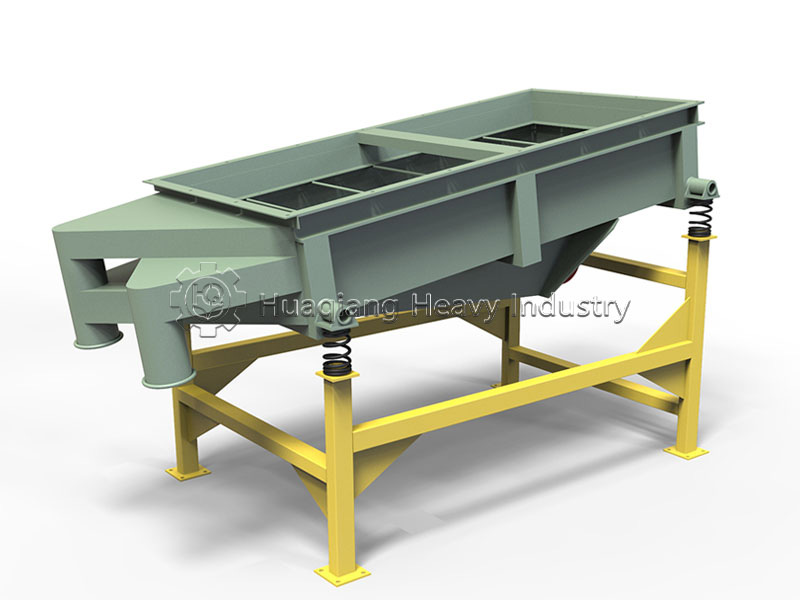
II. Intercepting Large Particles: Preventing Quality Accidents Granulators occasionally produce oversized particles (such as clumps, conjoined particles, and particles exceeding the upper limit in diameter). If not removed, these large particles will seriously affect product uniformity: large particles separate from normal particles within the packaging, leading to uneven nutrient distribution within the same bag of fertilizer; during application, large particles may clog the fertilizer applicator turntable or fertilizer discharge pipe. Screening Scheme: The upper screen (4-6 mesh, 3.5-5mm aperture) separates oversized particles, which are then crushed by a chain or hammer mill and returned to the granulation system along with the undersize powder. For wet granules produced by drum granulation, large particles are often softer and can be gently crushed using a roller crusher to avoid over-pulverization.
Safety Margin: The aperture of the upper screen should be set to the upper limit of the target particle size + 0.5mm. For example, if the required finished product size is 3-5mm, the upper screen should have a 4.5mm aperture to ensure that all particles larger than 4.5mm are intercepted.
III. Grading and Packaging: Precisely Matching Market Demand Different crops and application methods have different requirements for fertilizer particle size. A vibrating screen, combined with multi-stage screens, can separate materials into 2-3 particle size grades for separate packaging or sale.
Typical Grading Scheme: Grade 1 Finished Product (2-3mm): Suitable for foliar spraying or seedbed fertilizer.
Grade 2 Finished Product (3-5mm): General-purpose base fertilizer, top dressing. Grade 3 Finished Product (5-8mm): Deep fertilization for fruit trees and forest trees.
Implementation: A double- or triple-layer vibrating screen is used, with each layer having a different mesh size. Materials of different particle sizes after screening enter their respective buffer bins through independent discharge ports, and are then packaged separately by a packaging scale. This grading strategy can increase the added value of the product by 20%-30%.
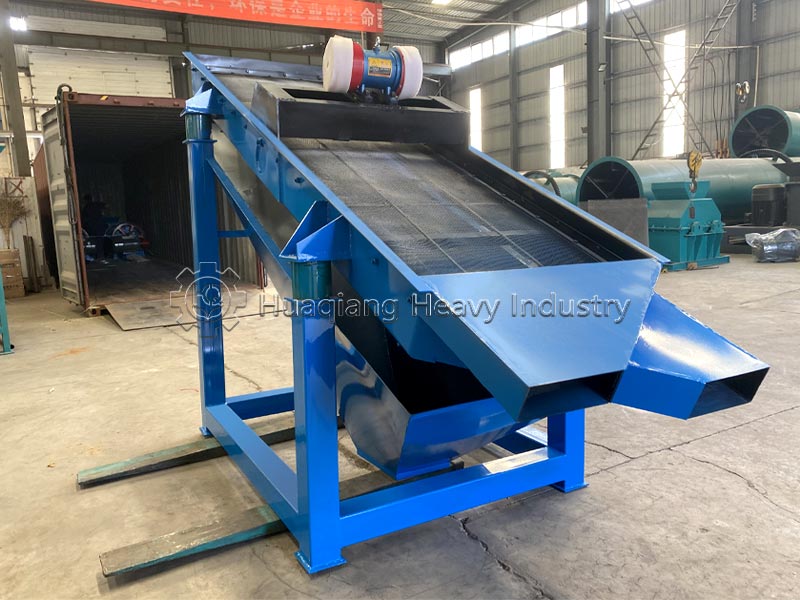
Online Adjustment: The amplitude and frequency of the vibrating screen can be adjusted to adapt to materials with different humidity levels and viscosities. For example, in humid weather, the frequency should be appropriately reduced (800 rpm) and the amplitude increased (5mm) to prevent screen clogging.
The vibrating screen is far more than a simple separator—it is the definitive quality gate that ensures every finished granule meets market expectations. As a core piece of fertilizer production machine technology, it works in perfect synergy with upstream fertilizer granulator machine systems (whether a rotary drum, disc, or poultry manure pellet machine) to remove fines and oversized particles, delivering only uniform, well‑graded material. This precise classification is essential not only for conventional bagged products but also for advanced bulk blending (BB) fertilizer line operations, where uniform particle size and density are prerequisites for preventing segregation during blending and transport. After screening, the qualified fractions are fed directly to an automatic fertilizer packaging machine, ensuring dust‑free, consistent bags without oversize or powder contamination. In practice, the fertilizer vibrating screen also enhances overall line efficiency: fines are returned to the granulator, oversize is crushed and recycled, and the main product stream maintains a narrow size distribution—reducing caking, improving flowability, and boosting customer satisfaction. For producers, investing in a high‑performance screening system pays off through reduced downtime, fewer customer complaints, and the ability to offer multiple grade sizes for different crops and application methods. In short, the vibrating screen is the silent guardian of product quality, and when integrated with modern granulation, blending, and packaging equipment, it completes a production line that delivers consistent, premium fertilizer—from poultry manure to high‑tech BB blends.
Summary: Vibrating screens play the role of “quality police” in fertilizer production. They remove powder to ensure flowability, intercept large particles to maintain product consistency, and grade and package to improve market adaptability. Without this screening process, even the best granulation technology cannot produce commercially viable products. For any fertilizer plant, a vibrating screen is one of the auxiliary equipment with the highest return on investment. We specialize in the research and development and manufacturing of vibrating screening equipment for fertilizer production lines, providing integrated solutions for powder removal, large particle interception, and multi-level grading and packaging—with a screening efficiency of ≥95%, ensuring that every bag of your fertilizer has uniform particle size and top-quality commercial properties, making it the quality gatekeeper with the highest return on investment on the production line.