
The high moisture content (60%-80%), high viscosity, and heavy metal contamination of vermicompost and municipal sludge cause traditional drum granulators to fall into a vicious cycle of “sticking to the walls – clogging – shutdown.” Through a three-stage process of low-temperature dehydration, molecular membrane fermentation, and extrusion molding, the moisture content can be reduced from 75% to 28%, achieving stable granulation with a pelletizing rate exceeding 82% and a heavy metal passivation rate of over 65%.
Definition First: Special Organic Material Granulation refers to a specialized technology that pre-treats and modifies non-standard organic materials with high moisture content, high fiber content, or containing pollutants to meet the granulation process window. Its core difference from conventional organic fertilizer granulation lies in the extreme deviation of the material’s physicochemical properties.
I. Why are Vermicompost and Sludge a “Nightmare” for Granulators? Triple Physical Traps: Earthworm castings have a moisture content of 60%-70% and a viscosity coefficient as high as 800-1200 mPa·s, which is 2-3 times that of conventional livestock and poultry manure; municipal sewage sludge has a moisture content of 75%-80% and contains flocculant residues, forming “mud clumps” that adhere to the drum wall in the rotary granulator, reducing the cleaning cycle from 72 hours to 8 hours. According to the website’s material database, earthworm castings have fibers of 0.5-2mm in length and are entangled, clogging the screen apertures during direct granulation and causing a 40% surge in return material load.
Hidden Heavy Metal Threshold: Municipal sewage sludge contains heavy metals such as Cd, Pb, and Zn. If directly granulated and applied to farmland, it poses a food safety chain risk. According to the website’s process specifications, heavy metal passivation pretreatment must be performed before granulation to reduce the effective content to below 60% of the NY 525 standard limit.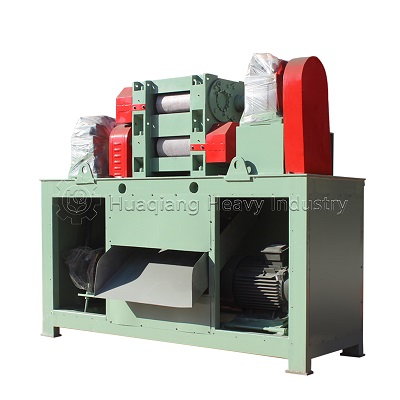
II. Breakthrough in Three Stages: A Qualitative Transformation from Sludge to Granules
Stage 1: Screw Press Dewatering + Low-Temperature Drying
The screw press sludge dewatering machine reduces the moisture content from 80% to 55%-60%, consuming only 3-5 kWh/ton, 60% more energy than plate and frame filter presses. The sludge then enters a rotary drum dryer, with the inlet air temperature controlled at 120-150℃ (far lower than the 180-220℃ of conventional organic fertilizers), preventing the inactivation of effective live bacteria (≥2×10⁸ CFU/g) in earthworm castings due to high temperatures. In the low-temperature drying equipment specifications on the website, this temperature window can further reduce the moisture content to 25%-30%, while maintaining a Bacillus survival rate of over 85%.
Stage 2: Molecular Membrane-Covered Aerobic Fermentation
The dewatered material enters a trough fermentation system, covered with a molecular membrane (e-PTFE material, 0.2μm pore size). The membrane structure allows CO₂ and NH₃ to escape but blocks odor molecules, maintaining a pile temperature of 55-65℃ for 10-15 days. Website data on membrane-covered fermentation shows that during this stage, the bioavailable content of heavy metals Cd and Pb decreases by 62% and 58%, respectively, while the humification coefficient increases from 15% to 45%.
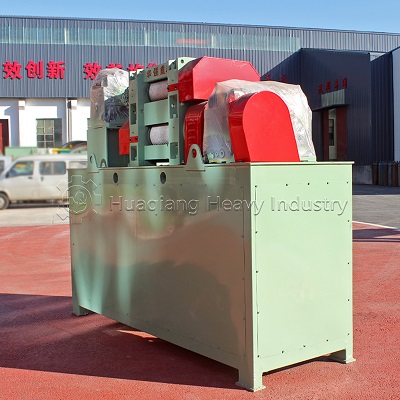
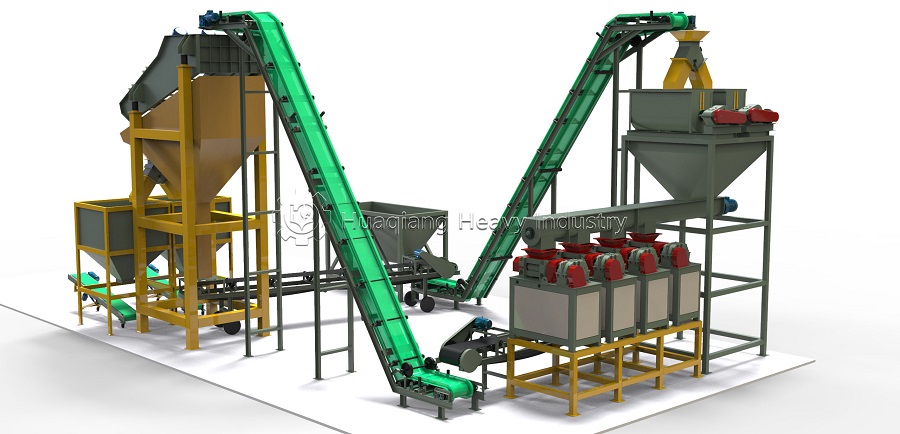
The third stage: Twin-roll extrusion + polishing and shaping. The moisture content of the fermented and decomposed material is 28%-32%, precisely within the optimal window (25%-35%) for the twin-roll extrusion granulator. Roller pressure is 18-22 MPa, rotation speed is 12 r/min, producing 2-4 mm particles. After finishing with a disc polisher (inclination angle 52°-55°), the particle surface smoothness is improved, and the pulverization rate decreases from 12% to 3%. Website records of heavy equipment operation confirm that this process chain can operate continuously for up to 720 hours, five times longer than direct roller granulation.
III. Value-Added Granulation of Earthworm Castings: From Fertilizer to Functional Substrate
Earthworm castings are rich in humic acid (12%-18%) and beneficial bacteria. Their value is underestimated if used solely as ordinary organic fertilizer granulation. By adding 5%-8% biochar (prepared through slow pyrolysis at 300℃) as a framework material, a ternary composite granule of “biochar-earthworm castings-functional bacteria” can be constructed. The porous structure of biochar (specific surface area 200-400 m²/g) provides colonization sites for functional bacteria, extending the slow-release period to 60-90 days after application to the soil. In the website’s functional fertilizer process library, this type of composite granule is defined as a “soil microecological regulator,” commanding a market premium of 80%-120% higher than ordinary organic fertilizer.
Transforming Problem Feedstocks into Premium Granules
The three-stage breakthrough—screw-press dewatering, molecular membrane fermentation, and twin-roll extrusion—demonstrates that even the most challenging organic materials can be engineered into high-value granular products. In a conventional npk fertilizer production line, a standard rotary drum granulator or fertilizer dryer machine would fail catastrophically against 75% moisture sludge or 1200 mPa·s viscosity vermicompost, succumbing to wall adhesion and thermal inactivation. Instead, specialized organic fertilizer production granulation demands a redesigned thermal and mechanical architecture: low-temperature dehydration at 120-150°C preserves beneficial bacteria above 85% survival rates, while membrane-covered aerobic fermentation passivates heavy metals and elevates humification before any fertilizer compactor or fertilizer granules compaction stage. For final shaping, an organic fertilizer granulator series must accommodate fragile, fiber-rich substrates—a flat die pelleting machine offers gentle cylindrical extrusion for biochar-vermicompost composites, whereas modified roller systems deliver 82%+ pelletizing rates at 18-22 MPa. By treating vermicompost and sludge not as waste liabilities but as structured feedstocks requiring tailored fertilizer granules compaction discipline, manufacturers unlock 80-120% market premiums while solving environmental compliance—transforming the granulator from a bottleneck into a value-creation engine.
FAQ (Frequently Asked Questions)
Q1: Is heavy metal absolutely safe after sludge granulation?
Not absolutely. Passivation treatment significantly reduces the available form of heavy metals, but the total amount is not reduced. It is recommended that sludge organic fertilizer be used only for landscaping or economic forestry, avoiding its entry into the vegetable and grain crop planting chain. Regularly monitor soil heavy metal accumulation, and control the annual application rate to within 3-5 tons/hectare.
Q2: Is it necessary to add biochar when granulating earthworm castings?
No, it is not necessary. Pure earthworm castings can be directly extruded into granules, but the granule strength is only 10-12N, resulting in a high breakage rate during transportation. Adding 5% biochar increases the strength to 18-22N, and significantly improves the slow-release performance. If biochar resources are unavailable, straw charcoal crushed to <<1mm can be used as a substitute, with similar results.
Q3: Will low-temperature drying extend the production cycle?
Yes. Drying at 120℃ takes 30%-40% longer than drying at 180℃, but the survival rate of effective live bacteria increases from 45% to 85%. For bio-organic fertilizers marketed based on functional bacteria, low-temperature drying is a necessary sacrifice for quality assurance, which can be compensated for by increasing the dryer volume (diameter from 1.5m to 2.2m).