
When selecting equipment, fertilizer plants habitually compare production capacity, power, and price, yet often overlook a parameter that is both fundamental and critical: raw material moisture content. This seemingly ordinary physical indicator is, in fact, an invisible watershed that directly determines which process route is physically feasible. The NPK blending line, the dry extrusion route (represented by the roller press granulator line), and the wet agglomeration route (using the organic fertilizer disc granulator) each correspond to vastly different moisture content windows; choosing the wrong window makes every subsequent processing step problematic.
The NPK blending fertilizer production line (comprising NPK blending machines and bulk blending machines) has the narrowest and most unique moisture content window: it requires raw materials to be pre-dried, finished granules with a moisture content typically below 2%. This line involves no addition or removal of moisture; materials like urea, diammonium phosphate (DAP), and potassium chloride arrive from upstream plants as qualified granules, and the line performs only precise weighing and gentle mixing. A multi-bin static weighing system keeps batching errors within ±0.2%, while twin-shaft paddles facilitate low-speed convective mixing—causing granules of varying densities to repeatedly exchange positions—resulting in a mixing uniformity coefficient of variation consistently below 5%.
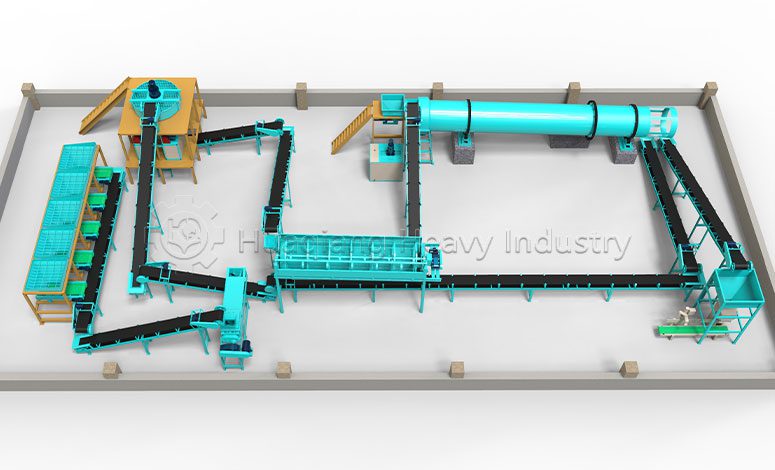
The moisture content window for the roller press granulator production line lies at the opposite end of the spectrum: input moisture must be controlled below 5%, and feed particle size must not exceed 0.6 mm. Two high-strength rollers rotating toward each other compress dry powder into dense sheets at ambient temperature. The bonding force between particles arises from natural molecular-level attractions—such as van der Waals forces, adsorption, and crystal bridge connections—without the addition of a single drop of water or any increase in temperature throughout the process. This dry granulation route eliminates the drying and cooling systems required for wet granulation, reducing overall energy consumption by 30% to 50% compared to wet processes. However, the operating window is extremely narrow: if the moisture content falls outside the 5%–8% range, the material slips between the rollers, resulting in uneven sheet thickness, excessive particle size fluctuation, and a sharp decline in granule strength consistency.
The disc granulator offers the widest and most “forgiving” moisture content window, achieving optimal pelletization when the material’s moisture content is between 25% and 35%. The disc inclination angle is adjustable between 35° and 55°; under the combined influence of gravity, centrifugal force, and friction, the material tumbles and agglomerates. Fine particles accumulate in layers—much like a rolling snowball—to gradually increase in size, achieving a pelletization rate of over 90%.