
In compound fertilizer production, one of the most troublesome processes isn’t granulation, but crushing. Production line return material, large lumps that fail the screening test, and finished products that agglomerate after storage… these hard and tough materials are simply inaccessible to ordinary hammer crushers, which are prone to jamming and hammer breakage. The chain plate crusher was developed precisely for this purpose.
Handling Agglomerated Material: A Major Obstacle in Compound Fertilizer Production
In compound fertilizer production lines, these scenarios generate large, difficult-to-handle materials:
Screening Return Material: After granulation and screening, coarse particles exceeding 4-6mm in diameter need to be returned for further crushing and processing. This material has already undergone one drying cycle and has high hardness.
System Shutdown Cleaning: During short production line shutdowns, residual material dries and agglomerates on the inner walls of the equipment, forming hard lumps.
Finished Product Agglomeration: Packaged fertilizer stored in warehouses for a period of time may agglomerate due to moisture absorption or pressure, requiring crushing before handling.
When ordinary crushers encounter this type of material, either the hammers wear out rapidly or the rotor gets jammed by large pieces, causing motor overload and shutdown. The chain plate crusher, however, uses a unique chain-hammer combination structure specifically designed to solve this problem.
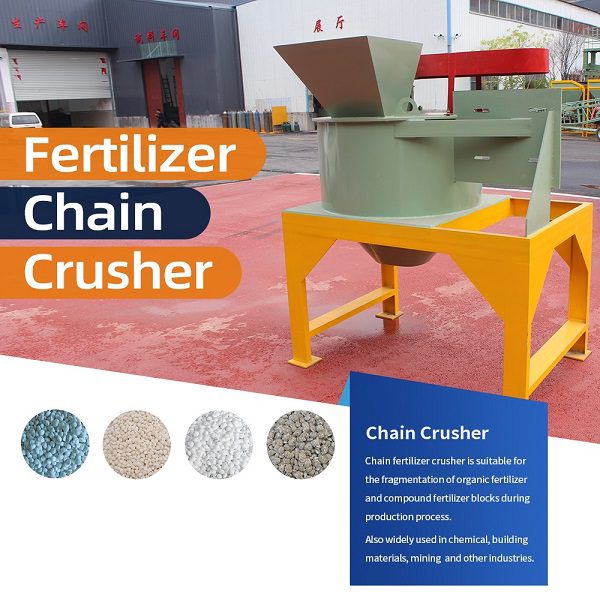
Structure and Principle: Chain First, Hammers Follow
The internal structure of the chain plate crusher differs significantly from that of a conventional hammer crusher: A high-strength, wear-resistant chain is suspended at the inlet: When large pieces of material fall from the feed inlet, they are first driven by the high-speed rotating chain sprockets, the chain whipping the material surface. For large pieces that are not severely agglomerated, the chain impact alone can break them up; for hard large pieces, the chain will crack their surface.
Heavy-duty hammers are installed in the lower section: The initially crushed material falls into the crushing chamber and is subjected to strong impact from the hammers mounted on the rotor, being thrown against the fixed impact plates. Through repeated impact, shearing, and grinding, the material is finally crushed into particles smaller than 10mm.
The bottom features a perforated screen plate: controlling the output particle size, allowing sized particles to pass through and be discharged, while larger particles remain in the chamber for further crushing.
This two-stage “extraction followed by crushing” mechanism allows the equipment to handle both softer, agglomerated materials and harder, dried lumps.
Applicable industries: Fertilizer, building materials, mining. The robust structure of the chain crusher extends its application range far beyond the ordinary fertilizer industry:
Compound fertilizer production lines (core application): Crushing large return lumps, dried agglomerated materials, and hard particles produced by urea-based formulations. Typical processing capacity is 10-50 tons/hour.
Building materials industry: Crushing medium-hardness lumpy materials such as gypsum board, limestone, and coal gangue.
Mining and metallurgy: Crushing medium-to-low hardness ores, slag, and sintered lumps.
In compound fertilizer applications, it is typically installed after the screening machine—coarse material from the screen falls directly into the chain crusher, is crushed, and then returned to the batching or regranulation system via an elevator.
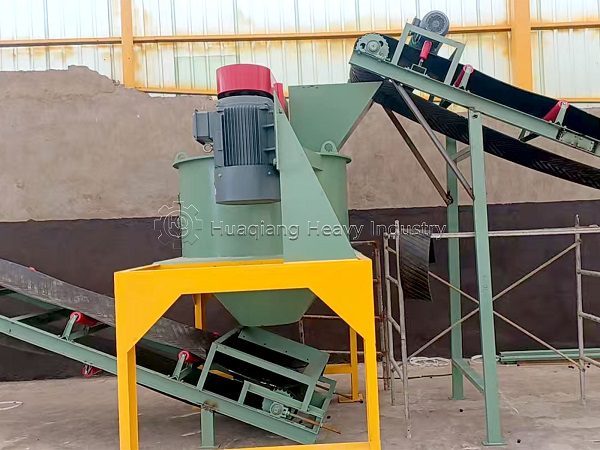
Two core advantages: Durability and strong crushing force
Outstanding durability: Both the chain and hammers are made of high-manganese steel or high-chromium cast iron, with a hardness of HRC55-60. Under normal conditions of processing compound fertilizer return materials (without metal impurities), the chain life is approximately 3-6 months, and the hammer life is approximately 6-12 months. Compared to ordinary hammer crushers, the replacement cycle of wearing parts is more than doubled.
Strong crushing force: Capable of handling agglomerated materials with a diameter of up to 200mm without jamming. Motor power varies from 15-90kW depending on the model, and the crushing ratio (maximum feed size/output size) can reach 10:1.
A reliable chain plate crusher can transform the return material processing stage of your compound fertilizer production line from “frequently jammed” to “unimpeded,” significantly improving the overall line operating rate.
The chain plate crusher is essential for handling hard, agglomerated return material in compound fertilizer lines. Its two-stage “chain-first, hammers-follow” mechanism can handle lumps up to 200mm without jamming. While crushers are critical for post-granulation processing, the upstream fermentation composting turning technology is equally vital for organic-based fertilizers. For organic fertilizer production, the choice of turning equipment—a large wheel compost turner (or large wheel compost turning machine) for open-air windrows, a trough-type compost turner for controlled environments, or a windrow composting machine for flexible operation—directly impacts the quality of the fermented material. A trough-type aerobic fermentation composting technology system with a dedicated turner is ideal for controlled, continuous production. The agriculture waste compost fermentation machine is the core of this process, ensuring proper aeration and temperature control to produce well-rotted material. After successful composting, the mature material is ready for a disc granulation production line. The chain crusher is then used downstream to crush oversized granules or agglomerated material. For compound fertilizer lines, the chain crusher ensures that return material is efficiently processed, improving overall line uptime. Its durable construction (high-manganese steel chains and hammers, HRC55-60) offers a replacement cycle 2x longer than ordinary hammer crushers. Processing capacity: 10-50 t/hour. Crushing ratio: up to 10:1. Understanding the distinct roles of upstream fermentation technology and downstream crushing equipment is key to building an efficient, reliable fertilizer production line.