
In the production of high-concentration NPK compound fertilizer (total nutrients ≥45%), the choice of granulation process directly affects product quality, production costs, and return on investment. Currently, the two main technical routes—roller granulation (double roller extrusion granulator) and drum granulation (rotary drum granulator)—differ significantly in principle, energy consumption, and finished product characteristics. This article compares and analyzes four core parameters to help manufacturers make a reasonable selection.
I. Moisture Requirements
Roller Press Granulation: This is a dry process, requiring almost no water or steam addition. The material moisture content only needs to be controlled at 2%-4%, and even dried powder can be used directly. This is highly advantageous for high-concentration formulations (especially materials with high urea content and high hygroscopicity), avoiding the increased drying burden caused by adding extra water.
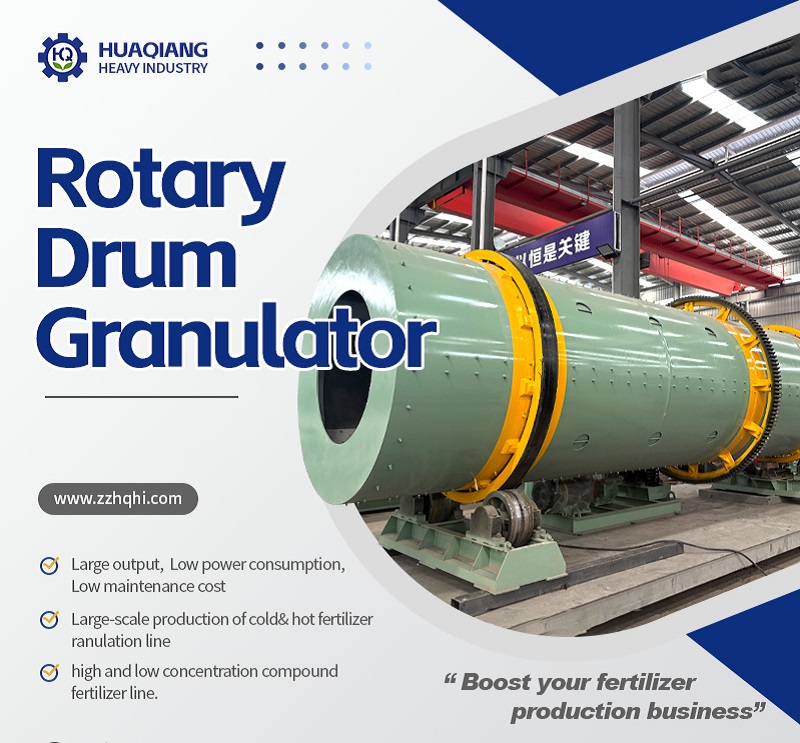
Drum Granulation: Relies on steam or water spray to form a liquid phase. The material needs to reach a moisture content of 4%-6% to agglomerate into granules. High-concentration NPK contains a high urea content, which significantly increases the material’s viscosity after adding water, making it prone to sticking to the walls. Furthermore, subsequent drying requires removing more moisture, increasing energy consumption.
Conclusion: Roller granulation has lower moisture requirements and is more suitable for high-concentration, heat-sensitive formulations.


II. Granulation Rate
Roller granulation: Material is extruded into flakes by rollers, then crushed and granulated. The primary granulation rate is typically 85%-95%. Unformed fine powder can be directly returned to the extruder, resulting in almost no waste. However, the granules are irregular lumps or flat round shapes, with lower roundness compared to drum granulation.
Drum granulation: Relies on material rolling and agglomeration, with a primary granulation rate generally of 60%-75%. A large amount of returned material (25%-40%) needs to be crushed and returned to the system, increasing the circulating load and equipment wear. However, drum granulation produces round, smooth-surfaced granules with better marketability.
Conclusion: Roller granulation has a higher granulation rate and less returned material, but the granules are not as round as those produced by drum granulation.
III. Energy Consumption
Roller Press Granulation: The main energy consumption comes from the power consumption of the extrusion motor (approximately 15-25 kWh/ton). No steam boiler or high-temperature drying is required (natural air drying or low-temperature drying is possible). The overall energy consumption per ton of product is approximately 60%-70% of that of the rotary drum process.
Roller Drum Granulation: Requires a boiler to supply steam (0.3-0.5 MPa), and subsequent drying requires a hot air furnace (coal/gas/biomass). The energy consumption per ton of product is equivalent to approximately 25-35 kg of standard coal, and electricity consumption is approximately 10-15 kWh/ton. The overall energy cost is significantly higher than the roller press process.
Conclusion: Roller press granulation is significantly more energy-efficient, especially suitable for areas with cheap electricity and limited steam supply.
IV. Equipment Investment
Roller Press Granulation: The core equipment consists of a double-roller extruder, crusher, and screening machine. The system is compact and does not require large thermal equipment such as boilers, dryers, or coolers. A production line with an annual output of 50,000 tons requires an equipment investment of approximately 500,000-800,000 RMB (depending on the level of automation). Rotary drum granulation: Requires a steam-powered rotary drum granulator, rotary dryer, rotary cooler, hot air furnace, boiler, and dust removal system. It involves a lot of equipment and occupies a large area. For the same production capacity, the equipment investment is 1.2-2 million RMB, 2-3 times that of the roller pressing process.
Conclusion: Roller pressing has a low investment threshold and is suitable for small and medium-sized fertilizer plants or investors with limited budgets.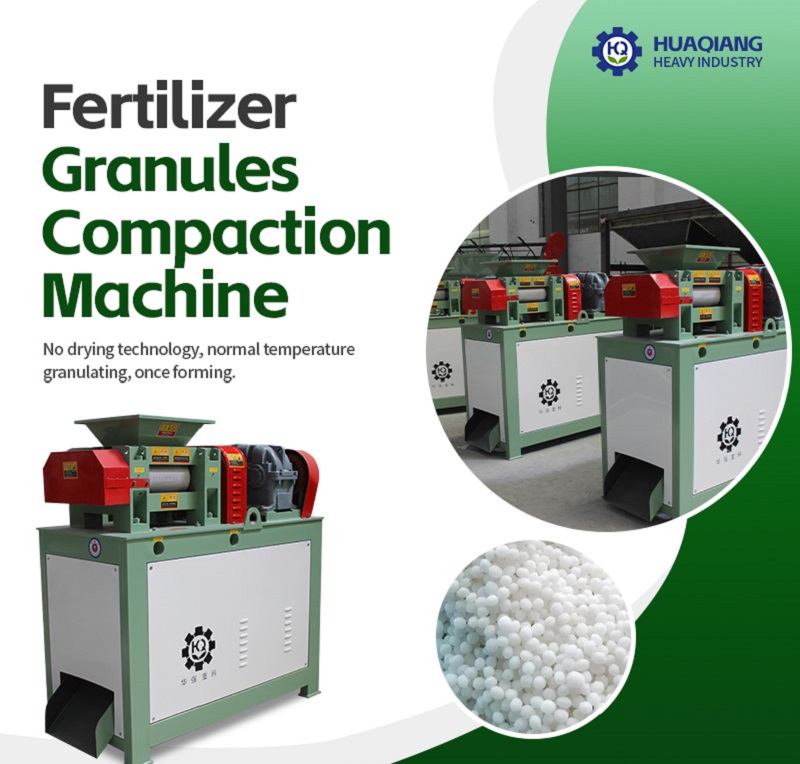
Comprehensive Selection Recommendations:
Prioritize roller pressing: Suitable for producing high-concentration NPK (e.g., 25-10-10, 20-10-15), plants without steam boilers, focusing on energy conservation and low investment, and where particle roundness requirements are not high (e.g., fertilizers for field crops).
Prioritize rotary drum granulation: Requires smooth and glossy particle appearance, products positioned in the high-end cash crop market, existing steam heat sources, and the ability to accept higher investment and energy consumption.
Ultimately, the choice between roller press and drum granulation is not about which technology is superior, but about which best aligns with your product positioning, energy resources, and investment strategy. For high‑concentration NPK formulations where fertilizer granules compaction is the priority, a fertilizer compactor (roller press) delivers unmatched efficiency—low moisture, minimal recycle, and energy savings, making it an ideal core for a compact npk fertilizer production line. Conversely, when premium appearance and rounded particles are demanded for high‑value crops, the rotary drum granulator remains the proven workhorse, often combined with a disc granulator machine or other fertilizer granulator machine to fine‑tune sphericity. No matter which route you choose, modern fertilizer production machine technology allows seamless integration with downstream systems—an automatic fertilizer packaging machine ensures dust‑free bagging, and if you produce blends, a bulk blending (BB) fertilizer line can be added to combine different granules without segregation. In practice, many plants adopt a hybrid strategy: roller compaction for base granulation followed by a polishing step, balancing low operating cost with acceptable appearance, while sharing drying, screening, and conveying systems. The key is to evaluate your raw material properties, target market, and available utilities, then design a complete production train where every piece of equipment—from compactor to granulator, from dryer to packer—works in harmony. With the right selection, you can achieve both economic efficiency and product excellence, ensuring your NPK fertilizer stands out in a competitive market.
In actual production, some companies also use a “roller pressing + polishing” combination process: roller pressing is used to form the granules, followed by a cylindrical polishing machine, balancing low energy consumption and good appearance. We specialize in the research and development and manufacturing of complete production lines for high-concentration NPK compound fertilizers. Both roller granulation and drum granulation technologies can be customized. From low-investment energy-saving solutions to high-end rounded granule production lines, our professional team will tailor the selection to your needs, ensuring your investment precisely matches market demands.