
In NPK compound fertilizer production, roller extrusion granulation, with its unique advantages of no drying required, room temperature forming, and one-time forming, is becoming an ideal processing method for high-nitrogen, high-phosphorus, and high-potassium formulations. Compared with traditional drum granulation, it eliminates the steam conditioning and drying processes, reducing energy consumption by 40%-60%, while avoiding the damage of heat-sensitive nutrients caused by high temperatures. This article will systematically analyze the core principles, key parameters, and quality control points of roller extrusion granulation.
Roller Extrusion Granulation Principle: High-Pressure Forming at Room Temperature
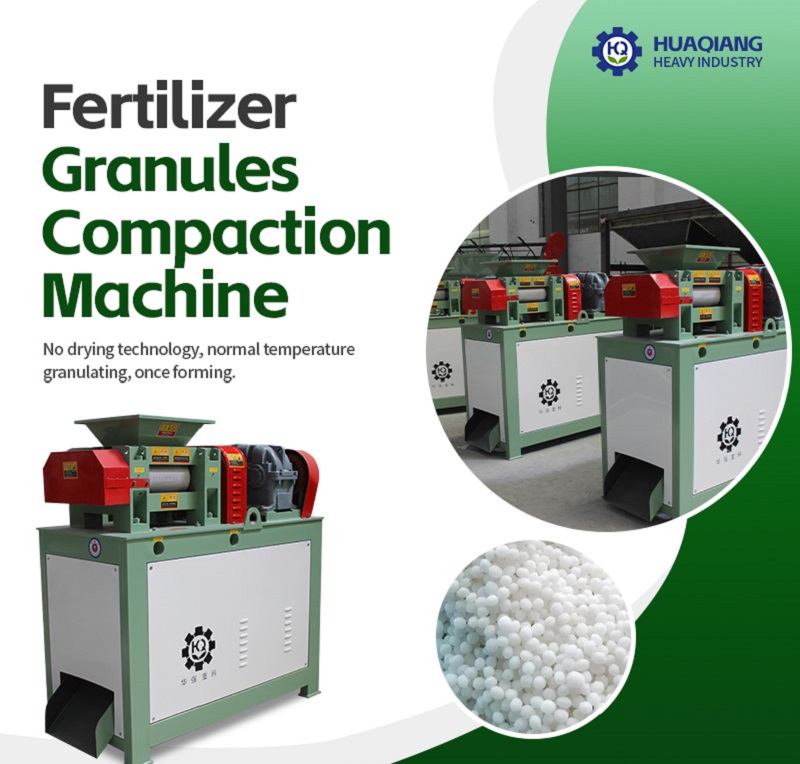
The core of roller extrusion granulation lies in “dry compaction.” Material (moisture content ≤5%, fineness 80-120 mesh) is fed between two counter-rotating rollers via a forced feeding screw. The roller surfaces are decorated with precisely engraved grooves. Under high pressure of 10-25 MPa, the material particles are compressed to 1/2-1/3 of their original volume, resulting in plastic deformation. The intermolecular distance decreases, and van der Waals forces and crystal bridging effects tightly bind the particles together. The compacted material exits the roller gap in flake or pillow shape, and after crushing and screening, the finished granules are obtained. The entire process requires no added water or binder, and no subsequent drying, truly achieving one-step forming from powder to granules.
Three core parameters: Pressure, Speed, and Gap
Pressure is the primary parameter determining granule strength. The hydraulic system can be steplessly adjusted according to the characteristics of the raw material. For easily formed materials (such as ammonium sulfate), 10-15 MPa is sufficient, while for difficult-to-compact materials (such as phosphate rock powder), 20-25 MPa is required. Too low a pressure results in loose granules, while too high a pressure increases energy consumption and accelerates roller wear. Roller speed affects the residence time of the material between the rollers, generally controlled at 10-20 r/min. Too high a speed leads to insufficient filling and uneven granule density, while too low a speed reduces production capacity. Roller gap determines granule thickness, typically set at 0.5-2 mm. A larger gap results in thicker granules and correspondingly higher compressive strength, but also increases the proportion of returned material.
Particle Strength and Uniformity Control
Particle strength is a core indicator of product quality. Roller extrusion can produce particles with a compressive strength of 15-30N, far exceeding the 10-15N of drum granulation. Key control points include: raw material fineness must be ≥80 mesh; excessively coarse material results in insufficient particle bonding; feeding must be continuous and uniform, as interruption of feeding will cause a sudden drop in pressure; the hydraulic system must have automatic pressure compensation to cope with fluctuations in raw material hardness. Particle uniformity depends on the precision of the roller grooves and the screening process. Our rollers use precision engraving technology, with groove size deviation ≤±0.05mm. Combined with multi-layer screen grading, the particle size deviation of the finished product can be controlled within ±0.3mm.
Return Material Circulation System: The Key to Closed-Loop Production
The granulation rate of roller extrusion is approximately 85%-95%. Unformed fine powder and oversized particles need to be returned to the system for reprocessing. The return material system consists of a bucket elevator, a buffer silo, and a quantitative feeder, which uniformly mixes unqualified materials back into the raw material in a proportional manner. Properly controlling the return ratio (generally 20%-30%) is crucial: excessive return increases system load, while insufficient return wastes raw materials. Modern equipment often employs online detection and automatic proportioning technology to monitor the return amount in real time and dynamically adjust the return ratio to ensure stable system operation.
Applicable formulations: Covers high-nitrogen, high-phosphorus, and high-potassium formulations. The roller extrusion process is highly adaptable to NPK formulations. High-nitrogen formulations (e.g., 25-10-5) have high urea content, requiring a moisture content of ≤3% to prevent moisture absorption and roller sticking; high-phosphorus formulations (e.g., 12-24-12) have hard phosphate rock powder, requiring increased roller pressure to 20-25 MPa and the use of wear-resistant roller surface coatings; high-potassium formulations (e.g., 15-15-25) have hygroscopic potassium chloride, suggesting the addition of 0.5%-1% anti-caking agent to the raw materials and shortening the mixing time. In actual production, the same equipment can quickly switch between different formulations by adjusting pressure, speed, and return ratio.
From dry powder to high-strength granules, roller extrusion granulation, with its simple process, efficient molding, and stable quality, has become an important technological route for NPK compound fertilizer production. Mastering the control logic of the three main parameters—pressure, speed, and gap—will enable your production line to achieve lower energy consumption and higher output.
The roller extrusion granulation process is a key example of fertilizer granules compaction, distinct from the wet agglomeration of a rotary drum granulator. As a fertilizer compactor, the double roller press granulator is the core of a dry npk fertilizer production line. This technology is a significant part of the modern npk fertilizer manufacturing process. It’s important to distinguish this from a pure blending operation. A dedicated npk bulk blending machine physically mixes granular components, producing a final product without any granulation. That process does not involve a fertilizer compaction machine. In contrast, a full-scale granulation line includes a fertilizer compaction machine to create dense, uniform granules. The double roller press granulator offers distinct advantages: it handles dry raw materials (moisture ≤5%), eliminates the need for drying, and produces high-strength granules. The key parameters—pressure, speed, and gap—must be precisely controlled for different formulations (high-nitrogen, high-phosphorus, high-potassium). The choice between a pure blending line using an npk bulk blending machine and a full granulation line using a fertilizer compaction machine is strategic. Blending offers the lowest-cost entry point, while granulation provides superior product physical properties and is the key to advanced npk fertilizer manufacturing process.