
Many assume that roller press granulation is simply a matter of “compressing powder into granules”—as if applying enough pressure could turn any material into high-quality granules. In reality, the opposite is true: the success or failure of such a production line rarely hinges on the rollers themselves, but rather on whether the material meets three specific prerequisites before entering the press. The operational limits of a fertilizer roller press are defined by these three conditions; if any one of them is not met, no amount of pressure will yield acceptable granules.
The first prerequisite is the moisture content window. Roller press granulation is a “dry” process—no water is added, and no heat is applied. The bonding force between particles emerges naturally under high pressure through intermolecular forces. However, this process is extremely sensitive to moisture; the feed material typically must have a moisture content below 5%. If the moisture content is too high, the material will slip between the rollers, resulting in unevenly thick compressed sheets that produce an excessive amount of “fines” (powder) during the subsequent crushing stage. Conversely, if the moisture content is too low, the material becomes too free-flowing to form a continuous, stable layer within the roller gap, leading to inconsistent “nip” (intake) conditions. This moisture window is not merely a suggestion found in an equipment manual; it is a fundamental requirement for a stable granulation process. Consequently, the dehydration controls implemented during the upstream stages—fermentation, pulverization, and drying—are essentially preparatory steps to satisfy this critical condition.
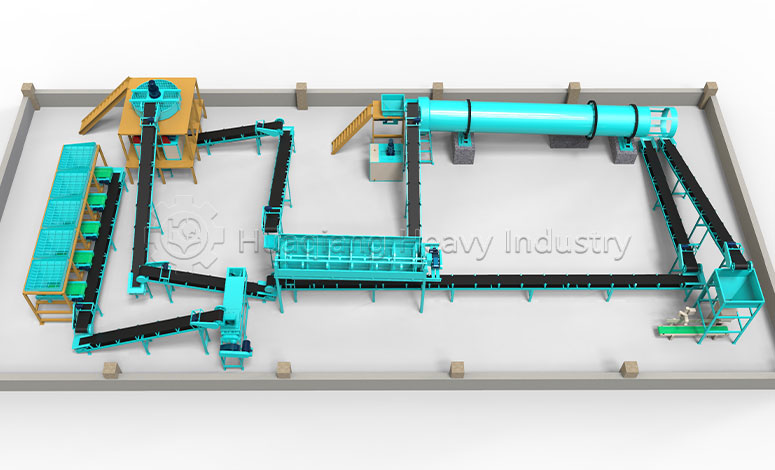
The second prerequisite concerns particle size and feeding stability. A complete roller press granulation line typically includes feed metering, forced feeding, roller pressing, crushing/screening, and a closed-loop system for recycling material. Yet, the feeding stage is often the most vulnerable part of the entire line. The feed material must have a particle size of no more than 0.6 mm, with a narrow particle size distribution. If a mixture of coarse particles and fine powder is fed into the system, the rollers will struggle to “bite” the material consistently. This causes the density of the compressed sheets to fluctuate, which in turn leads to poor uniformity in the strength of the final, crushed granules. The core challenge in the production technology of double-roller press granulators does not lie in the pressing action itself, but rather in the prerequisite of consistently feeding homogeneous powder material into the gap between the rollers. If the feed is unstable, every subsequent process step will suffer the consequences of these fluctuations.
A third prerequisite concerns the condition of the roller surfaces and the management of wear parts. The patterned surface of the rollers directly determines the material’s “bite” (intake capability) and the resulting granule density. As these patterns are wear parts, they inevitably degrade over time. Once worn, the rollers’ ability to grip the material diminishes; consequently, the density of the compacted sheet—and the resulting granule strength—decreases under the same hydraulic pressure. This degradation occurs gradually, and operators often only become aware of the issue after an increase in customer complaints. Incorporating the inspection of roller surface wear into a routine maintenance schedule is far more cost-effective than replacing the entire set of rollers after a failure has already occurred.