
The crusher controls the particle size of raw materials within the granulation process window, directly determining the pelleting rate and granule strength. For every 1mm increase in particle size deviation, the pelleting rate of a drum granulator decreases by 8%-12%, and the return material load increases by 15%. By matching with chain, hammer, or semi-wet material crushers, the fineness of the raw materials can be stabilized within the 40-60 mesh range, establishing a physical basis for subsequent batching and granulation.
Definition First: Fertilizer raw material pre-crushing refers to the process of reducing lumpy, fibrous, or crystalline raw materials to the target particle size using mechanical force. Its output particle size directly determines the subsequent mixing uniformity and granulation liquid phase distribution.

Why is the crusher the hidden lever of production line efficiency?
How does uneven particle size destroy granulation quality? NPK compound fertilizer granulation requires raw material fineness concentrated between 40-60 mesh (0.25-0.4mm). When urea or ammonium phosphate particles are too large (>2mm), sufficient nucleus density cannot be formed in the drum granulator, causing the pelletizing rate to drop from 85% to below 60%. According to production line operation data, increased return material circulation due to excessive particle size increases the heat load of the drying section by 18%, resulting in an annual increase in natural gas consumption of approximately 25,000 m³.
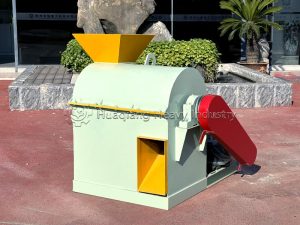
Machine Selection: The Boundary Between Chain, Hammer, and Semi-Wet Crusher Chain crushers are suitable for brittle raw materials with a moisture content of <<15% (such as phosphate rock powder and ammonium bicarbonate), with a rotor speed of 1400-1800 r/min and an adjustable screen aperture of 8-10 mm. Hammer crushers are suitable for fibrous raw materials (such as straw and rice husks), with a speed of 2800-3200 r/min, but their energy consumption is 40% higher than that of chain crushers. For livestock and poultry manure with a moisture content of 25%-40%, a semi-wet material crusher is the only option. Its double-layer blade structure can crush the material to below 3mm without clogging the screen.
The Critical Point Between Particle Size and Energy Consumption
Over-crushing (<<80 mesh) can improve mixing uniformity, but the crusher’s power consumption increases exponentially—when the target particle size decreases from 10mm to 3mm, the energy consumption per ton jumps from 3.5kWh to 8.2kWh.
Crushing Precision as the Foundation of Granulation Quality
The crusher is not merely a size-reduction device—it is the hidden lever that determines whether the entire downstream granulation circuit operates at design capacity or bleeds energy through excessive return material. In a modern organic fertilizer production equipment ecosystem, the journey from raw biomass to market-ready granule begins with robust organic fertilizer raw material processing equipment: a precision half-wet material crusher machine handles high-moisture manure at 25%-40% without screen clogging, while a high-speed fertilizer cage crusher pulverizes brittle mineral feedstocks to the 40-60 mesh sweet spot where nucleus density and liquid-phase distribution converge for optimal pelletizing. For NPK operations, matching chain or hammer crushers to material brittleness and fiber content stabilizes particle size within ±0.5mm deviation, preventing the 8%-12% pelleting rate collapse that oversized feedstock triggers in drum granulators. This pre-granulation discipline directly supports the organic fertilizer granulator series downstream: a new type organic fertilizer granulator achieves 93%+ compaction rates when fed uniformly crushed substrate, while an organic fertilizer disc granulation production line produces spherical granules with the surface smoothness and structural integrity demanded by premium horticulture markets. Ultimately, treating crushing not as a commodity preprocessing step but as a precision-tuned granulation enabler transforms raw material variability from a production liability into a quality-controlled variable, delivering the pelleting rate, granule strength, and energy efficiency that define competitive fertilizer manufacturing.

III. FAQ (Common Questions)
Q1: Is a larger screen aperture for the crusher always better?
No. Excessively large apertures lead to uneven particle size, reducing the subsequent pelleting rate; excessively small apertures result in a surge in energy consumption and reduced output. It is recommended to select the aperture based on the granulator’s feed requirements. Typically, NPK inorganic raw materials are controlled at 8-10mm, and organic fertilizer fiber raw materials at 3-5mm.
Q2: Does the crushed material need to immediately enter the mixing process?
It is recommended to enter the mixing process within 2 hours after crushing. After crushing, the specific surface area of the material increases. If stored for a long time, moisture-absorbing materials such as urea will re-agglomerate, leading to decreased flowability during batching and an increase in dynamic weighing error to over ±1.5%.
Q3: Can a single crusher process both NPK inorganic raw materials and organic fertilizer raw materials simultaneously?
Mixing is not recommended. Inorganic raw materials have high hardness (Mohs hardness 3-5), which will accelerate the dulling of the blades in a semi-wet crusher; the high-moisture fibers of organic fertilizer will clog the screen of a chain crusher. While specialized configuration increases initial investment, overall maintenance costs can be reduced by more than 60%, and capacity loss due to material changes and cleaning is avoided.