
In the final stage of fertilizer production, packaging is often considered a secondary process characterized by “labor-intensive and low-tech content.” However, with rising labor costs and stricter environmental controls on dust emissions, automated fertilizer packaging systems are shifting from “optional” to “mandatory.” This article will quantitatively analyze the specific impact of automated packaging on Return on Investment (ROI).
What is an Automated Fertilizer Packaging System?
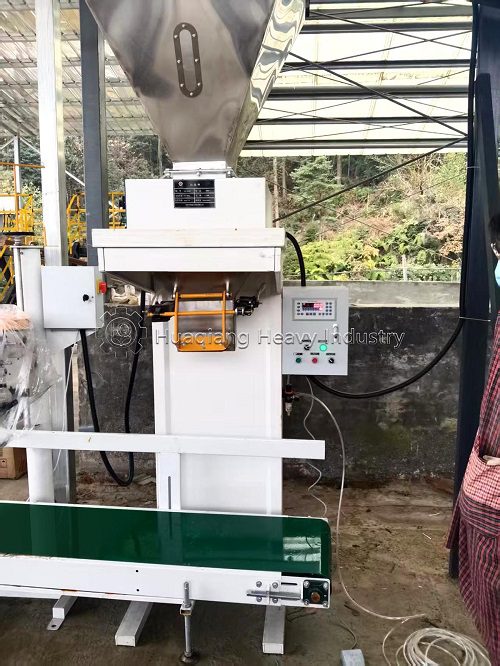
An automated fertilizer packaging system refers to a complete set of equipment integrating automatic weighing, automatic filling, automatic sealing, and automatic palletizing functions. It typically includes a screw weigher or belt weigher, an automatic bagging machine, a sewing/heat sealing machine, a robotic palletizer or high-level palletizer, and a central control system. Its core value lies in replacing manual labor with machinery to complete repetitive, high-intensity packaging operations.
How Does Automated Packaging Affect ROI?
The formula for calculating ROI is: (Annual Net Income ÷ Total Investment) × 100%. Automated packaging systems alter the relationship between the numerator (revenue) and denominator (investment) through the following four pathways:
2.1 Direct Reduction in Labor Costs
Data Comparison:
Traditional semi-automatic packaging line (including manual bagging, manual weighing correction, and manual palletizing): Requires 6-8 operators per shift (based on 8 hours and 15 tons/hour capacity).
Fully automatic packaging line (automatic bagging + robotic palletizing): Requires only 1-2 inspectors.
ROI Contribution: Based on labor costs in central China, a single production line can save approximately 250,000-400,000 RMB in labor costs annually (6 people × monthly salary of 5,500 RMB × 12 months). This is the most direct and certain source of benefit from automated packaging.
2.2 Raw Material Savings Due to Improved Packaging Accuracy
The dynamic accuracy of traditional manual weighing or semi-automatic scales is typically between ±0.5% and ±1.0%. For a single 50kg bag of compound fertilizer, a deviation of ±0.25kg equates to a 0.5% error.
Positive deviation (overweight): Equivalent to giving away 0.25kg of fertilizer per bag free of charge, resulting in considerable annual losses.
Negative deviation (underweight): Risks of customer complaints and penalties from regulatory authorities.

Modern automated packaging systems employ dual sensors and intelligent drop compensation algorithms, stabilizing accuracy within ±0.1%-±0.2% (i.e., an error of ±50-100g per 50kg bag). Compared to semi-automatic lines, automated packaging can reduce raw material waste by 0.3%-0.8% annually. Based on an annual production of 50,000 tons, this equates to saving 150-400 tons of raw materials, approximately 200,000-500,000 yuan.
2.3 Capacity Release and Off-Peak Electricity Use
Automated packaging lines can operate continuously 24 hours a day, unrestricted by manual shifts. During peak demand seasons, off-peak electricity can be fully utilized for packaging operations (electricity prices are typically 40%-50% lower than peak electricity prices).
For example, a production line with an hourly output of 15 tons could save approximately 30,000 to 50,000 yuan in electricity costs annually by shifting two hours of packaging work from daytime to nighttime (based on a price difference of 0.3 yuan per kilowatt-hour and 300 operating days per year).
III. Investment Structure and Payback Period
Investment Scope:
Upgrading from semi-automatic to fully automatic packaging line (including automatic weighing, automatic bagging, sewing, and robotic palletizing):600,000-1,200,000 RMB (depending on capacity and brand)
Constructing a new production line with a fully automatic system:An additional investment of approximately 400,000-700,000 RMB compared to a semi-automatic line.
Annual Comprehensive Return (taking an annual production of 50,000 tons as an example):**
Labor savings:300,000 RMB
Raw material savings:300,000 RMB
Environmental protection/compliance:100,000 RMB (conservative estimate)
Peak-hour electricity usage:40,000 RMB
Total:Approximately 740,000 RMB
Static Investment Payback Period = Increased Investment ÷ Annual Comprehensive Return = 400,000-700,000 RMB ÷ 740,000 RMB/year ≈ 0.5-1.0 years
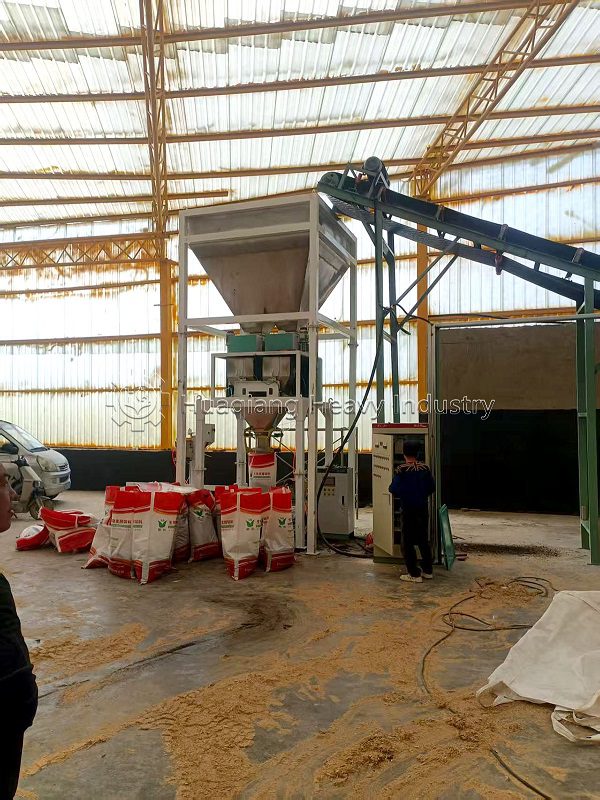
Even with a more conservative return estimate (considering only labor and raw material savings), the payback period is within 1.0-1.5 years. Within the equipment’s 5-8 year lifespan, the ROI can reach 500%-800%. IV. Practical Selection Recommendations Before deciding to introduce an automated packaging system, please evaluate the following conditions: Annual Production Capacity: Annual production capacity ≥ 20,000 tons (or single-shift packaging capacity ≥ 60 tons) is recommended; otherwise, the investment payback period may exceed 2 years. Product Category: Automation efficiency can be fully utilized for single or a few product varieties. If product variety changes frequently (>3 times per day), a quick-change model (such as servo-driven weighing hopper or quick-release bag clamp) should be selected. Packaging Specifications: Mainstream 40kg and 50kg woven bags have good compatibility; small packages (≤10kg) or non-standard bag types require customization, increasing investment by 30%-50%. According to the supporting solutions provided by Huaqiang Heavy Industry, many customers who upgraded from semi-automatic to fully automatic packaging not only saw significant improvements in packaging efficiency and accuracy but also gained a clear advantage in environmental inspections and customer audits. With labor costs continuing to rise, automated packaging has become one of the definite means to improve the ROI of fertilizer production lines.
Packaging Automation as the Final Profit Lock
The 500%-800% ROI and sub-18-month payback of automated packaging systems validate what forward-thinking manufacturers already recognize: the fertilizer packing machine is not a peripheral accessory but the final precision instrument that secures every dollar invested upstream. In a modern npk fertilizer line, this automation layer integrates seamlessly with the thermal chain—the fertilizer dryer machine and fertilizer cooler machine stabilize granule moisture and temperature before the rotary drum screening machine classifies product, ensuring only specification-grade material reaches the bagging station. For roller press granulator production line operations, where dry compaction produces dense, low-dust granules, automated weighing and sealing preserve the hardness and integrity achieved through mechanical pressing, preventing caking during storage and transport. In a bio organic fertilizer production line, hermetic sealing with nitrogen flushing extends microbial shelf life, transforming viable bacteria retention into a marketable quality guarantee. The entire value chain—from fertilizer raw material processing machinery and equipment through fermentation, granulation, drying, and cooling—culminates at the packaging station, where ±0.1% gravimetric accuracy converts process excellence into commercial premium. Manufacturers that treat packaging automation as the capstone investment, rather than a discretionary upgrade, capture the full margin potential of their production infrastructure while building the operational resilience required for 2026’s labor-scarce, regulation-intensive market environment.