
Working Principle: High-Speed Chain Impact, Breaking Particles into Powder
The chain crusher is a specialized crushing equipment used in organic fertilizer production to handle high-moisture, high-fiber materials. Its core principle is not complex: a motor drives the main shaft to rotate at high speed, and several wear-resistant chains mounted on the main shaft swing rapidly, generating a powerful impact force. After the material enters the crushing chamber through the top feed inlet, it first violently collides with the high-speed rotating chains and is broken into small pieces; these small pieces are thrown against the inner wall of the casing, bounce back, and collide with the chains again.
This process is repeated several times during the descent, and the material is gradually refined under the cyclical impact of “chain-inner wall-chain,” finally exiting from the bottom discharge outlet. Because chain crushers typically use a screenless or large-aperture screen design, the output particle size is generally below 3 mm, which can directly meet the feeding requirements of the granulation process.
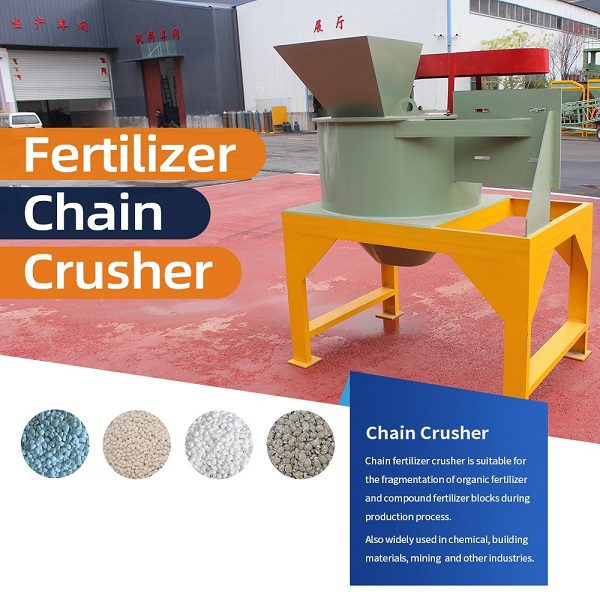
Structural Features: Specifically Designed for Wet and Sticky Materials
The chain crusher’s structural design fully considers the characteristics of organic fertilizer raw materials.
Vertical Cylinder Structure: Most chain crushers adopt a vertical layout, with materials falling vertically and transported using gravity. Some improved crushing cylinders have a diameter that gradually increases from top to bottom. This design effectively reduces material adhesion to the cylinder wall, solving the industry pain point of clogging caused by high-moisture materials.
High-Strength Chain Assembly: The chain is the core working component, typically forged from high-manganese alloy steel or 65Mn spring steel, with a hardened surface treatment achieving a hardness of HRC55 or higher, providing both wear resistance and impact resistance. The chain is fixed to the main shaft by specially designed chain heads. Some patented technologies employ a “smaller at the front, larger at the back” tapered self-locking structure, completely solving the problem of loosening and falling off traditional bolt fixing methods.
Anti-stick Lining: The inner wall of the machine casing is lined with polypropylene or stainless steel plates, which have a low coefficient of friction, are corrosion-resistant, prevent material adhesion, and facilitate cleaning.
Quick-Opening Inspection Door: A quick-opening inspection door is located on the side of the machine, allowing operators to easily inspect chain wear and clean the chamber.
Core Advantages: The Nemesis of High-Moisture Materials
Chain crushers are highly favored in the organic fertilizer industry, primarily due to the following advantages:
Strong Adaptability to High-Moisture Materials:It can handle materials with a moisture content of 20% to 50%, whether it’s fresh manure just removed from the pit or wet material after fermentation, it can be directly crushed without clogging. This characteristic is unmatched by dry-process equipment such as hammer crushers.
Prevents Material Adhesion and Easy Cleaning:The polypropylene lining and stepped crushing chamber design prevent material from adhering to the cylinder wall during crushing. Even if a small amount of residue remains, it can be quickly cleaned by opening the inspection door.
Controllable Operating Costs:Although the chain is a wear part, the high-quality alloy chain has a service life of over 500 hours, and replacement is simple. The overall structure is simple, with few potential failure points, resulting in a relatively long maintenance cycle.
Low Noise and Low Dust:The operating noise is typically below 75 decibels. Combined with a negative pressure dust removal system, it effectively improves the operating environment.
Maintenance Points: Chain Tension and Wear Inspection
Daily maintenance of a chain crusher is not complicated, but several key points require attention:
Chain Tension: Regularly check the chain tension, maintaining a deflection of 10 to 15 mm. Too loose a chain will reduce crushing efficiency, while too tight a chain will accelerate wear on the chain and bearings.
Wear Inspection: Before starting the machine each shift, observe the wear of the chain and chain head through the inspection door. Replace the chain immediately if it becomes noticeably thinner, deformed, or the chain head becomes loose.
Lubrication Maintenance: Regularly lubricate bearings and transmission parts (lithium-based grease is recommended), and check every 200 hours of operation.
Prevent Foreign Objects from Entering the Machine: Before feeding material, ensure that no stones, metal, or other hard objects are mixed in, otherwise it can easily cause chain breakage or main shaft deformation. It is recommended to install a screen or magnetic separator at the feed inlet.
Shutdown Cleaning: After each operation, the machine should be run idle for 1-2 minutes to drain the material from the chamber. If necessary, open the inspection door to clean any residue to prevent the material from hardening and clogging after drying.
The chain crusher is a vital piece of organic fertilizer raw material processing equipment, specifically designed for high-moisture, high-fiber materials. Its unique vertical structure and high-strength chain assembly make it the nemesis of wet and sticky feedstocks. After crushing, the material, with a particle size below 3mm, is perfectly prepared for the next stage. This prepared powder is then ready for the granulation stage, the essence of organic fertilizer production granulation. Within the organic fertilizer granulator series, several options exist. For producing high-quality, spherical granules, a complete organic fertilizer disc granulation production line is a classic and effective choice. For operations seeking a compact, efficient solution, a new type two in one organic fertilizer granulator can combine the final stages of conditioning and initial granulation. The integrated system of organic fertilizer production equipment relies on the chain crusher to provide a consistent, uniform feedstock. Its ability to handle materials with moisture content up to 50% without clogging makes it indispensable. The key to its longevity is proper maintenance: checking chain tension, preventing foreign objects, and regular lubrication. When combined with a disc granulator or a two-in-one granulator, the chain crusher ensures that the entire production line, from raw material to finished granule, operates smoothly and efficiently.
Chain crushers, with their excellent adaptability to high-moisture and high-fiber materials, have become an indispensable pretreatment equipment in organic fertilizer production lines. When selecting a model, focus on the chain material, lining material, and ease of maintenance. In daily maintenance, adhere to the three principles of “frequent inspection, prevention of foreign objects, and proper lubrication” to ensure long-term stable operation of the equipment.