
The drying process in NPK fertilizer production is a major energy consumer. By precisely controlling the hot air temperature and humidity, optimizing the drum tilt angle, and introducing variable frequency drive technology, manufacturers can significantly reduce energy consumption and prevent pulverization caused by over-drying. This article aims to explore the core process parameters for improving drying thermal efficiency, helping factories achieve cost reduction and efficiency improvement while ensuring the physical properties of the granules.
Core Technical Logic of the Drying Process
The drying process directly affects the finished appearance and storage stability of the fertilizer. Insufficient drying can easily lead to clumping during storage; while over-drying will damage the internal structure of the granules, resulting in decreased hardness.
Thermal Control and Material Balance
At a production scale of 10 tons/hour, the heat source input of the dryer must be linked in real time with the moisture content of the material. By installing an online microwave moisture sensor, the system can automatically adjust the combustion efficiency of the furnace or the hot air flow rate according to the moisture content of the feed. If you have already selected a high-pressure roller press granulator specification during the granulation stage to ensure particle density, then in the subsequent drying stage, you should appropriately slow down the drying curve and utilize a moderate temperature difference to promote the gradient migration of moisture from the inside to the outside, avoiding surface cracking of the particles.
Optimization Scheme to Improve Heat Exchange Efficiency
The key to improving drying efficiency lies in increasing the coverage density of the “material curtain.” By installing optimized lifters inside the drum, you can ensure that the material is evenly distributed in the hot air zone during drum rotation, maximizing the gas-solid contact area. In addition, installing a waste heat recovery device to re-inject the dried hot air into the preheating stage is a direct way to reduce energy costs.
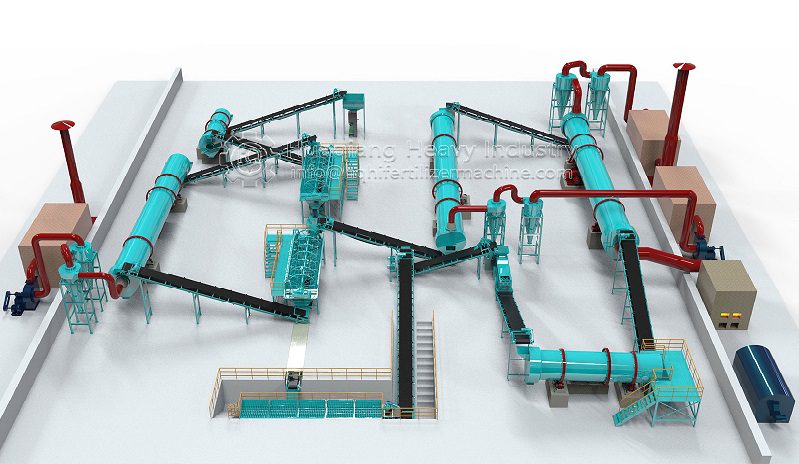
Key Optimization Parameter List
Inlet Air Temperature Control: It is recommended to control the inlet hot air temperature between 120°C and 150°C to avoid high temperatures causing decomposition of some raw material chemical components.
Drum Speed Adjustment: Use frequency converter control to adjust the speed in real time according to daily output fluctuations, maintaining the filling rate within the golden range of 15%-20%.
Cylinder Inclination Angle: A tilt angle of 1.5° to 2.5° is recommended to ensure sufficient residence time for the material in the drying zone.
Exhaust Gas Humidity Threshold: The relative humidity of the exhaust gas should be controlled below 60% to prevent condensate from flowing back into the finished product area.
Technical Risks and Management Recommendations: The most common risk in the drying process is “material sticking to the wall,” which is usually caused by excessive feed moisture or localized overheating. To mitigate this risk, it is recommended to install a buffer screening device at the drum feed inlet to filter out clumped wet material. Simultaneously, a high-negative-pressure induced draft fan must be configured for dust removal and exhaust in the drying system to ensure that the drying chamber maintains negative pressure at all times, reducing dust spillage and potential explosion risks.
Thermal Efficiency as the Foundation of NPK Competitiveness
The 15-20% energy savings achieved through optimized drying parameters are not isolated operational gains—they are the thermal cornerstone of scalable NPK compound fertilizer production capacity. In a modern integrated plant, the fertilizer dryer machine must be architected as a dynamic heat exchange module, working in concert with upstream fertilizer granulation technology to ensure that granules enter at optimal density and exit at precisely controlled moisture without structural damage. For organic substrate processing, advanced fermentation composting turning technology pre-conditions raw materials to ≤45% moisture before they reach the dryer, reducing thermal load and shortening the drying curve. By maintaining inlet air at 120-150°C, drum filling at 15-20%, and exhaust humidity below 60%, manufacturers prevent both wall adhesion and over-drying pulverization. Waste heat recovery further decouples energy costs from throughput growth. Ultimately, treating the dryer not as a passive evaporation vessel but as an actively controlled thermal precision instrument transforms drying from the plant’s largest energy liability into a competitive advantage—delivering granules with the hardness, stability, and appearance required for premium market positioning.
Frequently Asked Questions (FAQ): What causes cracks on the surface of the particles after drying?
This is usually because the drying rate is too fast (rapid temperature rise), leading to excessive water loss from the particle surface and excessive internal pressure. It is recommended to lower the temperature of the first drying zone and increase the length of the dryer to achieve slow dehydration.
How to determine if the drying effect has reached the optimal balance point? The optimal balance point is characterized by a finished product moisture content maintained between 1.0% and 1.5%, and the temperature difference between the exhaust gas and the material at the tail end of the dryer not exceeding 10°C, indicating that thermal energy utilization has reached its limit.
How can production capacity be increased without replacing the dryer?
This can be achieved by optimizing the shape of the internal lifting plates to increase gas-solid contact efficiency, or by installing a hot air distributor in the pre-drying section to make the heat flow distribution more uniform, thereby processing more material with the same energy consumption.