
In fertilizer production, not all orders are in the “ten thousand tons” volume. Laboratory formulation testing, customized fertilizers for small farms, new product trial production… these scenarios require a flexible, efficient, and trouble-free granulation machine. The disc granulator was designed for this purpose.
Simple Structure, Intuitive Operation
The disc granulator consists of a shallow, tilted disc and a drive unit. Material is added from above and rotates within the disc, while a suitable amount of liquid (water, steam, or binder solution) is added via a spray system. Under the combined action of centrifugal force, friction, and gravity, the moist fine powder adheres and compacts layer by layer, like a snowball, eventually growing into uniform spherical granules. When the disc tilt angle and rotation speed are properly matched, qualified granules will automatically discharge over the edge of the disc.
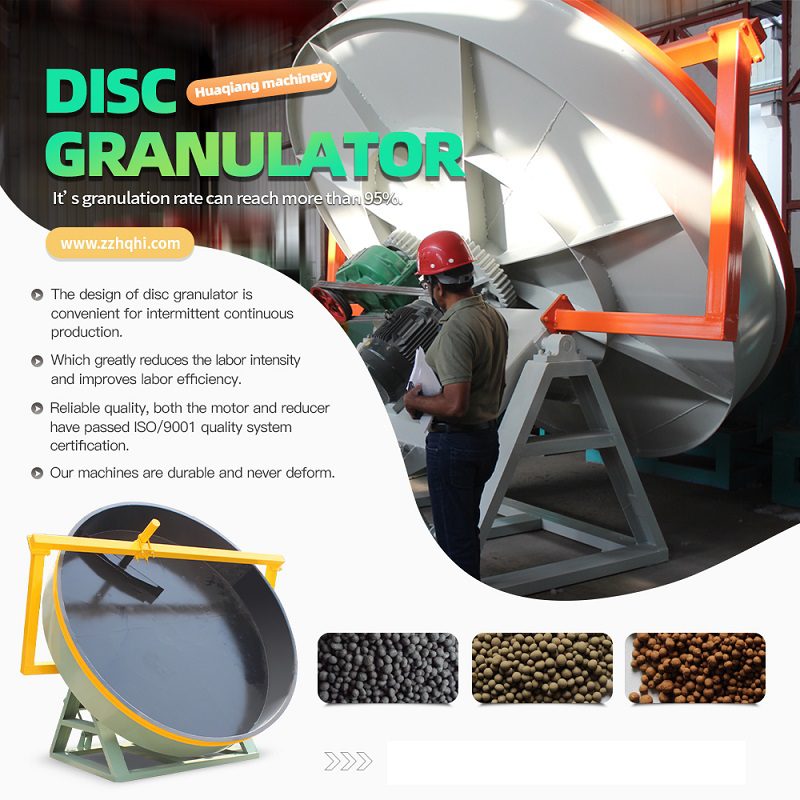
Three adjustable parameters:
Disc tilt angle (35°-55°):The smaller the angle, the longer the particles stay in the disc, resulting in larger particle sizes.
Spindle speed (typically 10-25 rpm):The higher the spindle speed, the greater the centrifugal force on the particles, resulting in denser surfaces.
Spray volume:Controlled by a manual valve or automatic flow meter, directly affecting pelletizing speed and the risk of roller sticking.
Two operating modes:Intermittent production and continuous production.
This is a unique advantage of the disc granulator compared to other granulation equipment.
Mode 1:Intermittent production (suitable for small batches and multiple formulations)
Operation method:A batch of dry powder is added at once, and granulation is carried out while spraying liquid. Once the particles reach the target size, the tilt angle is significantly increased to release all the material.
Single batch capacity:From 50 kg to 2 tons (depending on disc diameter).
Advantages:Simple production changeover; the disc surface can be cleaned with a high-pressure water gun, avoiding cross-contamination.
Typical scenarios:Fertilizer plant formulation trials, self-made fertilizers for planting bases, and contract manufacturing services.
Mode 2:Continuous production (suitable for large-scale orders)
Operation method:Dry powder and spray liquid are added continuously, simultaneously… Finished granules continuously overflow from the edge of the disc. The dynamic balance of materials within the disc is maintained by adjusting the feed rate and spray speed.
Production Stability: Requires experienced operators to maintain constant material layer thickness and moisture.
Advantages: Eliminates the auxiliary time of frequent feeding and discharging; single unit can achieve an hourly output of 3-5 tons.
Typical Scenarios: Mass production of conventional compound fertilizers and organic fertilizers.
Two Major Advantages: Labor Saving and High Efficiency
Labor Saving: One disc granulator requires only one operator to monitor feeding and adjust parameters, reducing labor costs by approximately 60% compared to manual pelletizing or traditional roller granulation.
High Efficiency: Fast pelleting speed; material stays in the disc for only 3-8 minutes on average, resulting in a short conversion cycle from dry powder to finished product. The one-time pelleting rate can reach 70%-85%, with minimal return material.
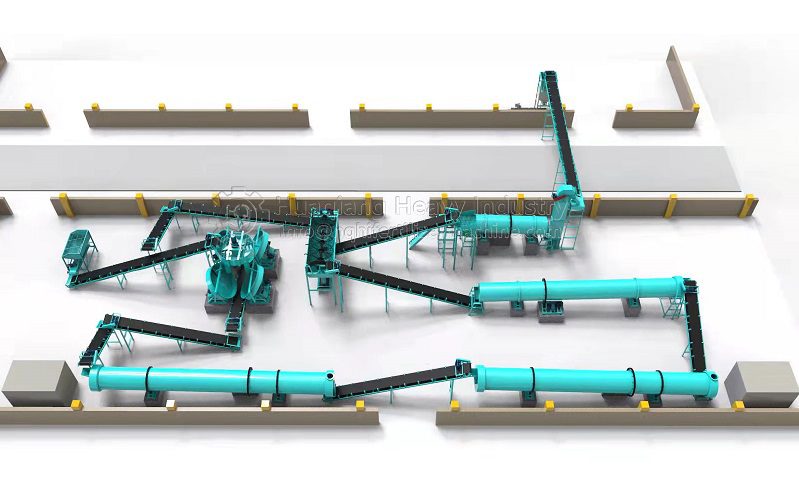
Suitable Raw Materials: Both organic and compound fertilizers are suitable.
Compound Fertilizers: Potassium chloride, ammonium sulfate, diammonium phosphate, and urea can all be mixed according to the formula and granulated, especially suitable for producing balanced formulas such as 15-15-15. Note that the urea content should not exceed 30%, otherwise it will easily stick to the granulator.
Organic fertilizer: Pure organic material after fermentation and crushing (moisture content ≤25%). A small amount of bentonite can be added to improve pelleting. Pure organic fertilizer granules have slightly lower strength, making them suitable for producing slow-release fertilizers for landscaping.
Organic-inorganic compound fertilizer: Premixing the two in a certain proportion before granulation allows the organic matter to improve the soil while ensuring the content of readily available nutrients.
When choosing a disc granulator, consider two main points: disc diameter (1.2m, 1.5m, 1.8m, 2.2m; the larger the diameter, the higher the batch capacity) and material (stainless steel discs are used for compound fertilizers, while carbon steel with an anti-corrosion coating can be used for organic fertilizers).
The disc granulator’s simple structure, intuitive operation, and two flexible operating modes (intermittent for small-batch, multi-formulation production; continuous for mass production) make it an ideal choice for laboratory trials, customized fertilizers, and new product development. As a member of the organic fertilizer granulator series, it complements a new type organic fertilizer granulator (wet continuous granulation) for higher efficiency. For a complete organic fertilizer disc granulation production line, the disc granulator is the core, supported by a half-wet material crusher machine for raw material preparation.
Together, this organic fertilizer production equipment and organic fertilizer raw material processing equipment transform fermented manure and other organic waste into high-quality, spherical granules. For a dedicated bio organic fertilizer production line, the disc granulator’s gentle granulation process helps preserve microbial activity. The disc granulator’s unique ability to switch between intermittent and continuous modes offers unparalleled flexibility, making it a valuable tool for any organic fertilizer production equipment setup. Whether you need a small batch for a planting base or continuous production for large orders, the disc granulator delivers with labor-saving and high-efficiency performance.