
What is a Mobile windrow composting machine?
A mobile windrow composting machine is a self-propelled aerobic fermentation device that can move freely in open-air or indoor windrow composting machine yards. Unlike trough compost turners that rely on fixed tracks, mobile compost turners straddle the windlass or move along its side, using high-speed rotating cutter rollers or drums to break up, mix, and throw the material backward. Its core advantages are that it requires no civil engineering, has strong site adaptability, and low investment threshold, making it particularly suitable for small to medium-sized organic fertilizer production projects with ample land but limited budgets.
Structural Differences Between Self-Propelled and Towed Types
Self-propelled compost turners integrate a power system, a walking system, and a turning system, allowing for operation by a single operator. Their turning width is typically 2 to 3 meters, and the turning depth is 1.2 to 1.8 meters. They can process 200 to 500 cubic meters of material per hour, suitable for daily processing scales of 20 to 100 tons. Powered by a 60-120 kW diesel engine, the tracked or wide-tire walking mechanism exerts low ground pressure, making it less prone to getting stuck even on soft stacks with a moisture content of 65%. Self-propelled equipment costs between $20,000 and $50,000, making it the preferred option for farms and cooperatives.
Towed compost turners lack their own power source and require a tractor to pull them and provide the power take-off shaft for turning. They have a narrower turning width (1.5 to 2.5 meters), but a simpler structure, lower maintenance costs, and a price only 40-60% of the self-propelled type (approximately $8,000 to $20,000). The disadvantages of the towed option are a large combined turning radius (8-10 meters) and the need for a tractor during turning operations, making it suitable for small farms that only need occasional turning.
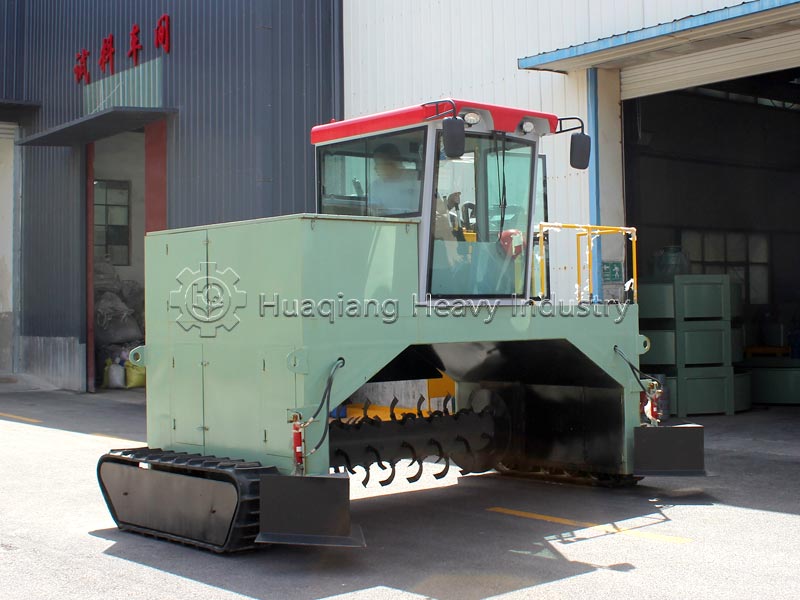
Cutter Roller Design and Turning Uniformity Turning uniformity is a core indicator of equipment performance and directly depends on the cutter roller structure. The roller-type compost turner features spirally arranged blades or toothed plates welded to its surface. During rotation, it throws material upwards from the bottom, reaching a height of 1.0 to 1.5 meters, dispersing the material in the air and ensuring full contact with oxygen. The toothed roller type uses individual turning teeth arranged in a V-shape or trapezoidal pattern, providing stronger penetration of high-fiber materials (such as straw compost) and reducing the risk of entanglement. Both designs require wear-resistant alloy blades—when processing livestock manure, the blade lifespan is typically 800 to 1200 hours; after wear, they need to be replaced on one or both sides to extend their service life.
A simple method to judge the uniformity of turning is to measure the temperature distribution of the compost pile before and after turning. Before turning, the temperature difference between the center and edge of the cross-section of the stack can be 15 to 20 degrees Celsius; after one thorough turning, the temperature difference should be reduced to within 5 degrees Celsius.
III. Power Matching and Operating Efficiency The power requirements of the compost turner are positively correlated with its processing capacity. Approximately 25 to 35 kilowatts of power are required per meter of turning width. A machine with a turning width of 2.5 meters is recommended to have a power output of 60 to 80 kilowatts. The travel speed is typically set at 5 to 15 meters per minute—too fast a speed will result in insufficient turning depth and uneven material mixing; too slow a speed will reduce daily processing capacity. At a turning depth of 1.5 meters and a travel speed of 10 meters per minute, a 2.5-meter wide machine can process approximately 225 cubic meters per hour, equivalent to processing a standard windrow measuring 50 meters long, 2.5 meters wide, and 1.5 meters high in one day.
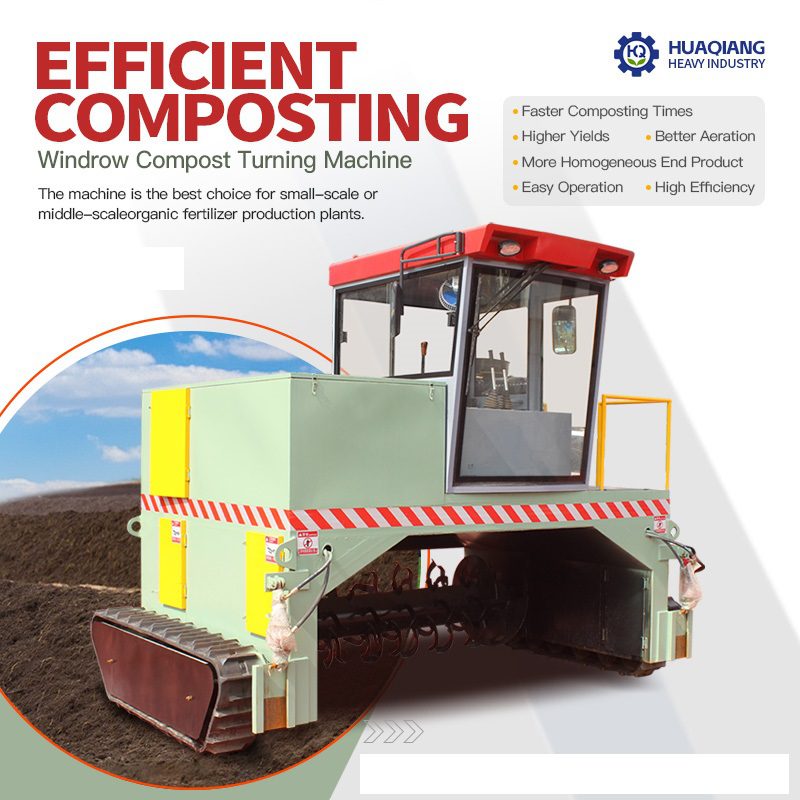
Matching Windrow Dimensions with the Turner: The mobile windrow turner must be precisely matched to the windrow dimensions. The ideal cross-section of the windrow is trapezoidal or triangular: base width 2.5 to 3.5 meters, top width 0.8 to 1.2 meters, and height 1.2 to 1.8 meters. When the stack height exceeds the maximum working depth of the compost turner, the material at the bottom cannot be effectively turned, creating an anaerobic dead zone. When the stack width exceeds the design span of the compost turner, unturned material will remain on both sides. It is recommended to determine the cross-section of the stack before selecting a compost turner, and then choose a model with a turning width and turning depth that are 10% to 15% larger than the cross-section parameters.
In summary, the fermentation composting turning technology embodied by the mobile windrow composting machine represents a practical and scalable solution for modern organic waste management. By integrating a robust power system, precision cutter roller design, and matched windrow dimensions, these machines significantly enhance the composting process for animal manure, ensuring uniform oxygen distribution and accelerated decomposition. For poultry operations, the chicken manure fertilizer machine variant effectively addresses high-moisture, high-fiber feedstock challenges, transforming waste into nutrient-rich organic fertilizer. The animal manure compost turner not only reduces labor intensity but also optimizes the fertilizer production process by maintaining ideal temperature and moisture profiles throughout the aerobic cycle. Whether selecting a self-propelled or towed configuration, operators should prioritize blade wear resistance, power-to-width matching, and site adaptability. Ultimately, the self propelled compost production machine stands out as the preferred choice for farms and cooperatives seeking cost-effective, high-efficiency organic fertilizer manufacturing with minimal civil engineering investment.
We offer a full range of self-propelled and towed compost turners, and can customize the cutter roller configuration and power matching scheme free of charge according to your stack size and processing scale, helping you achieve efficient aerobic fermentation with zero civil engineering investment.