
In organic fertilizer production, fermentation of a single raw material often fails to achieve ideal results—livestock and poultry manure has a high nitrogen content but insufficient carbon source, easily producing ammonia volatilization; agricultural waste such as straw and rice husks has a high carbon content but lacks nitrogen, resulting in a long fermentation cycle. Mixing the two for fermentation to achieve a balanced carbon-nitrogen ratio has become a standard process for large-scale organic fertilizer production. However, the complexity of the characteristics of the mixed raw materials places higher demands on the turning equipment. This article analyzes the equipment adaptation and process optimization techniques for mixed fermentation of livestock and poultry manure and agricultural waste.
Core Requirements of Mixed Fermentation: Balanced Carbon-Nitrogen Ratio and Uniform Oxygen Supply
The core of mixing livestock and poultry manure (e.g., chicken manure C/N 5-10, pig manure C/N 10-15) with agricultural waste (straw C/N 60-80, rice husk C/N 70-100) lies in adjusting the overall carbon-nitrogen ratio to the ideal range of 25-30:1. Studies have shown that a mixture of 45% agricultural waste, 25% livestock and poultry manure, and 30% auxiliary materials yields the best fermentation results. The mixed material needs to be turned and tossed to ensure even oxygenation—uneven turning will cause denser manure particles to sink, forming anaerobic zones, while lighter straw will float on the surface and fail to decompose, leading to a prolonged fermentation cycle and nutrient loss.
Adjusting Turning Equipment Parameters for Different Mixing Ratios
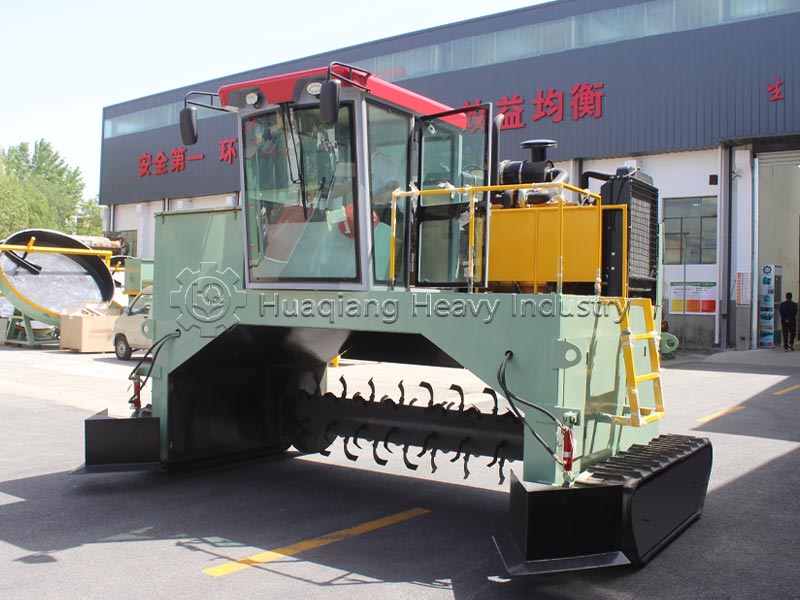
The turning parameters for the mixed materials need to be dynamically adjusted based on the proportion of livestock and poultry manure. When the manure proportion is high (>50%), the material has high moisture content and high viscosity, making it prone to clumping and compaction. In this case, the turning frequency needs to be increased—studies show that turning every two days achieves the best degradation effect, with optimal pH, moisture content, and C/N ratio. The turning depth should be controlled at 1.2-1.5 meters to prevent bottom compaction. A low to medium speed (100-150 r/min) is recommended to avoid material splashing.
When the proportion of fibrous raw materials such as straw is high (>60%), the material is loose but has high resistance. The turning frequency can be increased to once every 3-4 days, but the turning depth needs to be increased (1.5-1.8 meters) to ensure thorough mixing of the bottom material. The rotation speed needs to be increased to 180-220 r/min, using the impact force of the blades to cut long fibers and promote material refinement.
Raw Material Processing Equipment Matching Techniques
Successful mixed fermentation begins with raw material pretreatment. A chain crusher can crush straw and rice husks to 2-5cm; excessively long fibers are prone to tangling in the equipment. A semi-wet material crusher can process fresh manure with a moisture content of 25%-30%, refining the material to below 5mm. The crushed raw materials are then uniformly mixed in a horizontal mixer according to the specified ratio to avoid stratification during fermentation, where “manure piles up like manure, and straw piles up like straw.” The mixing time is recommended to be 5-8 minutes, until the material is uniform in color and free of lumps.
Optimization of the Turning Process in Mixed Fermentation
The turning process must be matched to the fermentation stage of the mixed raw materials. During the high-temperature period (55-65℃), turn the compost every 2 days to ensure sufficient oxygen and uniform temperature; during the cooling period, turn it every 5-7 days to reduce heat loss. An Egyptian study showed that using a kinematic parameter of 35 (corresponding to higher turning intensity) and turning every 7 days can shorten the composting cycle of rice straw and livestock manure to 10 weeks.
Pay attention to the moisture content of the materials during turning. For compost piles with a high manure content, moisture evaporates quickly in the later stages of fermentation; this can be addressed by spraying water during turning to bring the moisture content to 55%-60%. For compost piles with a high straw content, the surface layer needs to be compacted during turning to reduce moisture loss.
Customized Mixed Fermentation Equipment Solutions
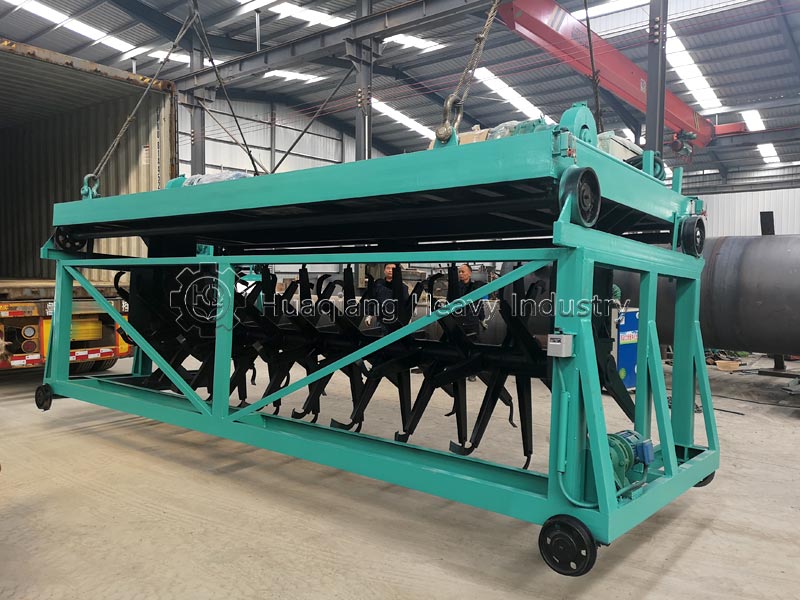
For the specific needs of mixed fermentation of livestock manure and agricultural waste, our company offers a series of equipment selection solutions. Large wheeled compost turners with a spiral blade design can lightly cut the straw while turning, making them particularly suitable for mixed raw materials with a fiber content of 30%-50%. The trough-type compost turner comes standard with a leachate collection system and variable frequency speed control, precisely adapting to mixed fermentation scenarios with a high moisture content of manure. It is equipped with a semi-wet material crusher and a twin-shaft mixer, achieving seamless integration from raw material processing to composting and fermentation.
The success of mixed fermentation hinges on the precise application of fermentation composting turning technology. For mixtures with a high proportion of manure, a large wheel compost turner provides the power to handle high-moisture, viscous material. For mixes with a high proportion of straw, a trough-type compost turner offers controlled aeration and leachate management. A flexible windrow composting machine can also be adapted for these mixed feedstocks. These machines function as an efficient agriculture waste compost fermentation machine. After successful fermentation, the mature compost becomes the ideal feedstock for a bio-organic fertilizer production line for pig manure or a general organic line. The material then enters the granulation stage, where a disc granulation production line can shape it into uniform, high-quality granules. The key to successful mixed fermentation is not just the equipment, but the correct parameter adjustments for the specific mixing ratio. When the manure proportion is high, increase turning frequency; when the straw proportion is high, increase turning depth and speed. Mastering the synergy between raw material pretreatment, equipment selection, and process optimization is what transforms this blend of “manure and straw” into a stable, nutrient-balanced, and high-quality organic fertilizer.