
The Fertilizer Mixing Challenges Faced by Small Farms
For most small family farms, cooperatives, or planting bases, purchasing commercial compound fertilizers is costly and difficult to accurately match the actual needs of the soil and crops. Using their own or nearby organic fertilizer sources (such as well-rotted chicken manure, cow manure, and straw compost) in combination with single-element chemical fertilizers for on-site mixing is an economical and practical option. However, how to quickly and evenly mix the sticky, wet organic materials with powdered fertilizer is a real challenge faced by many small farm owners. Large industrial mixers are expensive, occupy a large area, and require three-phase power, making them unsuitable for small-scale use. Portable horizontal mixers are designed to solve this problem.
Equipment Features: Compact and Flexible, Plug and Play
The portable horizontal mixer is structurally similar to the industrial horizontal mixer, also using a U-shaped cylinder with an internal spiral mixing belt design, but it has been adapted for the use of small farms in several ways: Mobility: The bottom of the equipment is equipped with heavy-duty casters or small tires, two of which have braking functions. The mixer can be easily pushed to the raw material storage area, fermentation shed, or fertilization site like a wheelbarrow, eliminating the need for manual material handling.
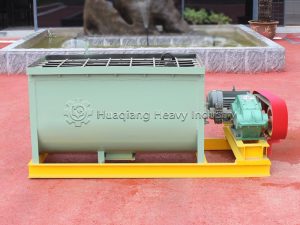
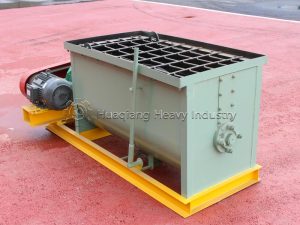
Single-phase motor drive: Most portable models are equipped with a 2.2 to 4 kW single-phase 220V motor, which can be directly plugged into a standard household or agricultural socket, eliminating the need for a three-phase meter or frequency converter, significantly lowering the electricity barrier.
Compact size: A single batch processing capacity is typically 50 to 200 liters (approximately 50 to 150 kg), sufficient for the fertilization needs of small plots in a single operation. The overall length is kept under 1.2 meters, and the width is approximately 0.6 meters, minimizing the use of valuable farm tool shed space.
Easy operation: A large-opening feeding port is located at the top of the cylinder, and a manual discharge gate is fitted at the bottom. Simply press the start button after powering on to begin mixing. After 2 to 4 minutes, pull the discharge handle to allow the mixed fertilizer to fall directly into the collection bin or wheelbarrow below.
How to Ensure Uniform Mixing
Although portable horizontal mixers are small, with proper operation, they can thoroughly mix organic materials and fertilizers:
Pay attention to the feeding sequence: It is recommended to add dry powdered fertilizers (such as urea, superphosphate, and potassium sulfate) to the drum first, start the machine and stir for half a minute before adding the wet organic materials. This ensures the fertilizer powder is evenly dispersed at the bottom of the drum, preventing clumping after adding the wet materials.
Control the filling rate: The drum should not be overfilled; it is best to just cover the mixing shaft (approximately 40%-60% of the drum volume). Overfilling will increase stirring resistance and may cause the motor overload protection to trip.
Extend the mixing time appropriately: Due to the limited stirring power of small-power motors, for organic materials with high fiber content (such as straw compost), the mixing time can be extended to 5-6 minutes. During this time, the machine can be stopped, the top cover opened, and the material at the edges can be stirred with a shovel to aid mixing.
Maintenance and Safety Precautions
After each use, promptly clean the inner wall of the drum and the mixing shaft of any residual material to prevent hardening and drying. The residue can be washed with a high-pressure water gun (ensure the motor area is covered for waterproofing) or scraped off with a shovel. Regularly check the welds of the mixing auger for cracks and the casters for looseness. The motor should be installed in a dry, well-ventilated area, avoiding rain and moisture.
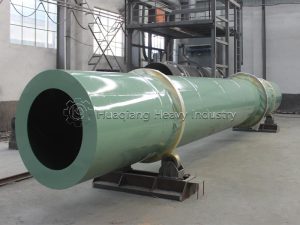
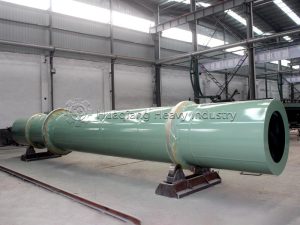
The portable horizontal mixer is a practical solution for small farms, but for larger-scale production, a complete bio organic fertilizer production line or npk fertilizer line is required. For a roller press granulator production line, a roller press compacts the material into dense, high-strength granules. The post-granulation finishing steps are universal. The granules are stabilized in a fertilizer dryer machine and fertilizer cooler machine, classified by a rotary drum screening machine, and finally sealed by a fertilizer packing machine. For producers creating complex blends, an npk blending machine can be integrated to precisely add mineral nutrients. A disc granulator is another option for producing spherical granules. The portable mixer, while small, demonstrates the core principles of mixing: proper feeding sequence, filling rate control, and appropriate mixing time. These same principles apply to large-scale industrial mixers. For small farms, this portable device bridges the gap between manual mixing and full-scale production. It allows for the on-site blending of local organic materials with purchased fertilizers, creating customized blends that match specific soil and crop needs. This flexibility, combined with its low cost and ease of use, makes it an essential tool for sustainable, small-scale agriculture.
For family farms or small cooperatives producing several hundred kilograms to one or two tons of fertilizer per day, a portable horizontal mixer may be more “efficient” than any large piece of equipment—because it is truly affordable, portable, and ready to use simply by plugging it in.