
Equipment Introduction and Applicable Scenarios
The windlass compost turner is a core piece of equipment in aerobic composting processes for handling organic materials such as livestock and poultry manure, straw, and sludge. It piles materials into trapezoidal windlasses, relying on the rotating and throwing action of turning wheels or rollers to achieve turning, oxygenation, and displacement of the pile. Compared to trough compost turners, the biggest advantage of windlass compost turners is that they do not require the construction of fixed fermentation troughs and can operate on hardened ground, making them particularly suitable for small and medium-sized farms, seasonal composting sites, or areas with irregular terrain.
Operation Guidelines: Four Steps to Master Correct Usage
Step 1: Site and Pile Preparation. The work site should be a hardened concrete or graded crushed stone surface, flat and with a slight drainage slope. The pile cross-section should ideally be trapezoidal, with a base width of 2.5 to 3.5 meters, a top width of 1.0 to 1.5 meters, and a height of 1.2 to 1.5 meters. A material pile that is too wide or too high will increase the load on the compost turner and reduce the turning effect; one that is too narrow or too low will affect the equipment efficiency.
Step Two: Pre-start Inspection. Before each operation, check the tire or track air pressure, hydraulic oil level, and wear of the turning wheel teeth. Ensure there are no stones, steel bars, or other hard objects in the material pile, as these may damage the turning teeth. After starting, let it idle for 1 minute to observe whether the turning wheel rotates smoothly and without any abnormal noises.
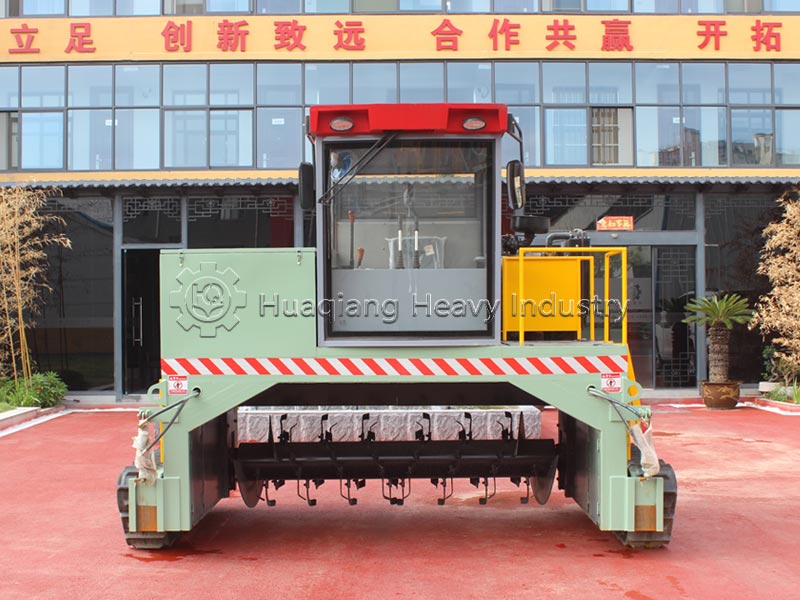
Step Three: In-operation Control. Assume the compost turner over the material pile, aligning the turning wheel with the center line of the pile. Advance at a speed of 5 to 10 meters per minute, controlling the turning wheel speed at 200 to 400 revolutions per minute. Too high a speed will result in uneven material distribution, while too slow a speed will reduce efficiency. During operation, pay attention to the turning depth, ensuring thorough mixing of the surface and bottom materials.
Step Four: Frequency and Cycle. During the initial fermentation stage (first 5-7 days), it is recommended to turn the compost pile every 1-2 days; during the high-temperature period, this can be extended to every 2-3 days; and during the later ripening stage, turn it 1-2 times per week. Each turning can lower the pile temperature by 5-10℃ and reduce the moisture content by 2-5%.
Capacity Selection: Matching Production Scale The processing capacity of a windrow compost turner mainly depends on the turning width, travel speed, and pile parameters. Small and medium-sized models (turning width 2-2.5 meters) can process 150 to 250 cubic meters per hour, suitable for an annual production scale of 1000-3000 tons of organic fertilizer; medium-sized models (turning width 3 meters) can process 300 to 400 cubic meters per hour, suitable for an annual production capacity of around 5000 tons; large self-propelled models (turning width 4-6 meters) can process 500 to 800 cubic meters per hour, suitable for large-scale production of over 10,000 tons per year.
The windrow compost turner is a versatile agriculture waste compost fermentation machine. After successful composting, the mature material becomes the ideal feedstock for a bio organic fertilizer production line or an npk fertilizer line. For a roller press granulator production line, a roller press compacts the material into dense, high-strength granules. The post-granulation finishing steps are universal. The granules are stabilized in a fertilizer dryer machine and fertilizer cooler machine, classified by a rotary drum screening machine, and finally sealed by a fertilizer packing machine. The windrow turner’s operation guidelines—site preparation, pre-start inspection, in-operation control, and frequency/cycle—are key to producing consistent, high-quality compost. Proper pile dimensions, turning speed, and turning wheel RPM ensure thorough aeration and mixing. The capacity selection must match the production scale: from small models (150-250 m³/h) for 1000-3000 t/year to large self-propelled models (500-800 m³/h) for over 10,000 t/year. For small farms, a towed model offers an economical entry point. The windrow turner’s flexibility—no fixed infrastructure required—makes it ideal for seasonal or variable production. Its ability to process chicken, pig, and cow manure, each with specific adjustments, makes it a cornerstone of sustainable agriculture. The key is to balance equipment investment with the benefits of replacing manual labor, ensuring efficient and cost-effective organic waste recycling.
When selecting a windrow compost turner, you should consider your daily processing capacity and the size of your compost pile. If you have ample space but limited funds, you can choose a towed model, which has a slower travel speed but is more economical. The key is to find a balance between equipment investment and the benefits of replacing manual labor.