
Windlass Fermentation Process: Windlass composting is a process in which organic materials are piled into long, narrow stacks for aerobic fermentation. The stacks are typically 2-4 meters wide at the base, 1-2 meters wide at the top, and 1.2-1.8 meters high, with the length adjustable from tens to hundreds of meters depending on site conditions. The materials are stored in the open air or in a shed, relying on periodic turning to provide oxygen and regulate temperature and moisture.
The key advantage of windlass fermentation is that it eliminates the need for fixed fermentation tanks. With just a hardened site, a forklift is used to stack the materials into windlasses, and the windlass turner can begin operation. The fermentation cycle is generally 15-30 days, during which the stack is turned 5-10 times depending on temperature changes. After fermentation, the material is screened and further processed to become organic fertilizer.
Compared to trough fermentation, windlass technology requires lower equipment investment and starts up faster, making it particularly suitable for users with fluctuating production scales or unpredictable site conditions.
Portable and Flexible Operation: The most significant feature of the windrow turner is its mobility and flexibility. The equipment is typically tractor-tethered or self-propelled tracked, requiring no rails or fixed infrastructure. A medium-sized windrow turner is approximately 2.5-3.5 meters wide, allowing easy access to narrow spaces or movement between multiple windrows.
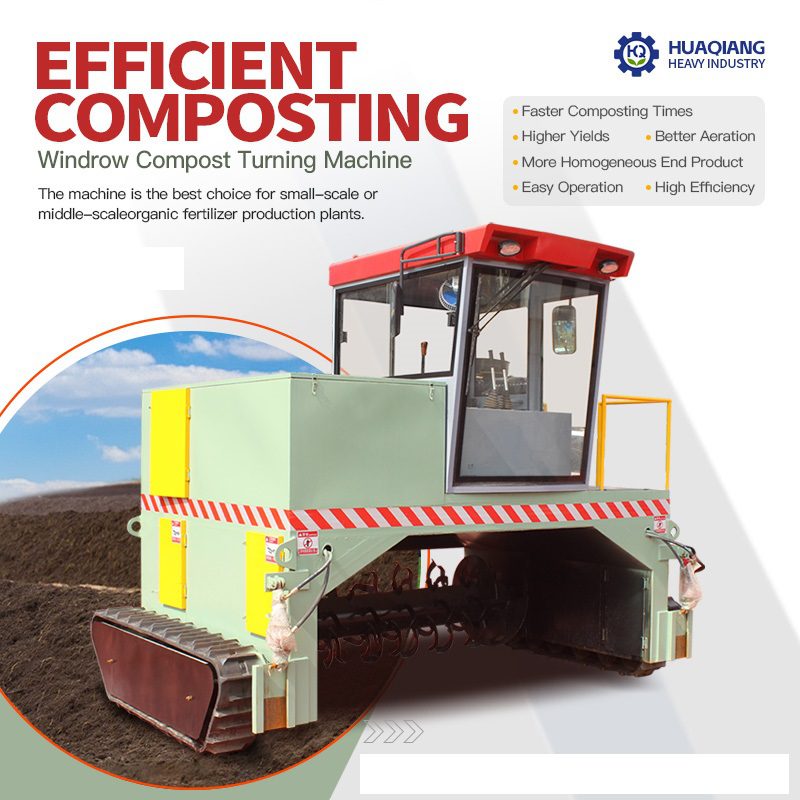
During operation, the turner straddles the windrow, with rotating turning rollers or discs picking up material from the bottom and scattering it backwards, while the equipment moves slowly forward. A single pass completes the turning of the entire windrow, with a typical travel speed of 5-15 meters per minute. When encountering turns or changing work areas, self-propelled models can turn around on the spot, while tractor-tethered models rely on a tractor for mobility.
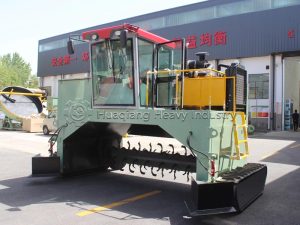
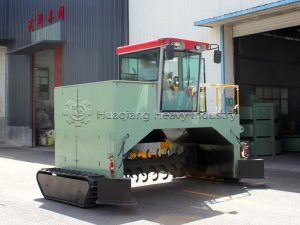
The practical benefits of this flexibility include: the number of windrows can be increased or decreased according to raw material supply; fermentation sites are not limited to regular shapes and can be arranged according to local conditions; the equipment can be moved between different plant areas, with one machine serving multiple production sites. This flexibility is particularly important for seasonal organic fertilizer plants (such as those operating in conjunction with crop straw processing cycles).
Suitable for processing chicken, pig, and cow manure. The windrow compost turner is adaptable to various livestock and poultry manures, but there are some operational differences depending on the manure source:
Chicken Manure:Chicken manure has a high nitrogen content and high moisture content (usually 70%-80%), easily producing ammonia during fermentation. When processing chicken manure, it is necessary to add auxiliary materials such as straw and rice husks to adjust the carbon-nitrogen ratio and moisture content. The windrows should not be too high (around 1.2 meters), and the turning frequency should be appropriately increased (once every 1-2 days) to facilitate ammonia dissipation and oxygen supply.
Pig Manure:Pig manure has a fine texture and high moisture content, easily becoming compacted and leading to oxygen deficiency when fermented alone. It is recommended to mix it with loose auxiliary materials such as sawdust and mushroom residue before stacking. When turning, ensure that the heavy, sticky material at the bottom is fully turned to the surface. The width of the windrows can be appropriately narrowed to 2-2.5 meters to facilitate thorough processing by the turner.
Cow Manure:Cow manure has a high fiber content and moderate moisture content (about 80%), making it one of the most suitable raw materials for windrow fermentation. Cow manure piles have a loose, well-aerated structure, making them less prone to compaction. The turning frequency can be reduced to once every 2-3 days. Temperature rises steadily during fermentation, resulting in a high organic matter content after decomposition.
Regardless of the manure source being processed, windrow compost turners require temperature monitoring and moisture control. It is recommended to observe the material’s condition during turning. If excessive dust is present, spray water as needed; if the material is too wet and compacted, increase the turning frequency and add dry additives. With systematic management of fermentation and turning technology, windrow compost turners can help small and medium-sized farms and organic fertilizer plants achieve resource utilization of manure at a lower cost.
The windrow fermentation process is a classic application of fermentation composting turning technology. A windrow composting machine (often a self propelled compost production machine or a tractor-towed unit) is the core equipment for this open-air method. This contrasts with a trough-type compost turner which operates within fixed channels. A large wheel compost turner is another option for large-scale windrows, offering immense power and span. Windrow fermentation’s key advantage is its flexibility; it requires no fixed infrastructure and can easily adapt to changing production scales. The windrow composting machine functions as a versatile agriculture waste compost fermentation machine. It is particularly suitable for processing a variety of livestock manures—chicken, pig, and cow—each with specific operational adjustments. After successful composting, the mature material becomes the ideal feedstock for a disc granulation production line. The choice between windrow and trough fermentation is a strategic decision. Windrow offers lower investment and greater flexibility, ideal for smaller operations or variable sites. Trough fermentation provides a more controlled environment, better odor control, and consistent production, suitable for larger, continuous operations. Understanding the distinct strengths of each fermentation composting turning technology—from the mobile windrow turner to the stationary trough system—is essential for building an efficient, compliant, and high-quality organic fertilizer production system.