
Low pelletizing rate in disc granulators? Check These 5 Parameters First
Low pelletizing rate in disc granulators is one of the most common problems encountered in production. When the pelletizing rate drops significantly (e.g., below 70%), don’t rush to suspect equipment malfunction. First, systematically check the following 5 key parameters: tilt angle, rotation speed, water spray, feed rate, and material moisture content. The vast majority of pelletizing rate problems stem from mismatches in these parameters.
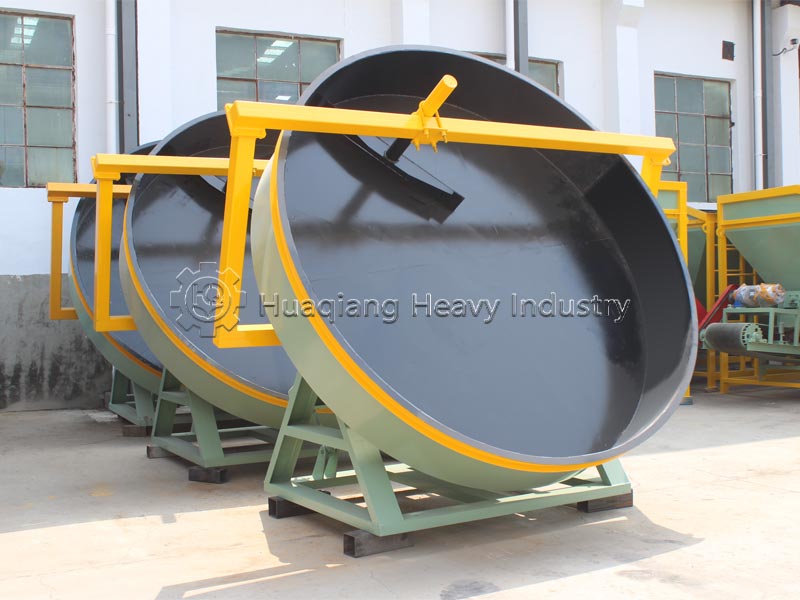
Disc Tilt Angle
The disc tilt angle determines the residence time and rolling trajectory of the material within the disc. If the tilt angle is too large (>50°), the material residence time in the disc is too short, causing it to slide out of the disc before it can adhere, resulting in a low pelletizing rate and small particles. If the tilt angle is too small (<30°), the material accumulation layer is too thick, causing excessively large particles, uneven particle size, and excessive large particles. It is recommended that the tilt angle of the organic fertilizer granulation pan be controlled between 40° and 50°, ensuring a stable material flow within the pan without premature overflow. Adjustments should be made in increments of 2°–3°, observing changes in pellet formation before further fine-tuning.
Pan Rotation Speed Rotation speed determines the magnitude of centrifugal force and the intensity of material tumbling. Too low a speed results in insufficient material tumbling, preventing effective powder bonding and leading to a low pelleting rate; too high a speed results in excessive centrifugal force, causing material to be thrown to the pan’s edge without forming a flow, resulting in loose, weak pellets. It is recommended to control the speed at 50%–60% of the critical speed (typically 10–15 rpm). When adjusting the speed, the material flow within the pan should be observed simultaneously—ideally, the pan surface should exhibit a clear stratification phenomenon of “large particles in the inner layer and fine powder in the outer layer.”
Water Spray Volume and Position Water spraying is a crucial trigger for pelleting and also the most difficult variable to control precisely. Insufficient water spray will prevent the powder from forming a sufficient water film, resulting in low pelleting rate and excessive dust. Excessive water spray will cause the material to become sticky, pelletize too quickly, produce oversized particles, and even become muddy. It is recommended to use atomizing nozzles, dynamically adjusting the water spray volume according to the feed rate and the dryness/wetness of the material, aiming for a consistency where the material in the pan “clumps together when squeezed but crumbles easily upon light touch.” The water spray should be directed towards the annular area between the center and edge of the pan (i.e., the most active area of material flow), avoiding direct spraying onto the pan surface to prevent localized over-wetting.
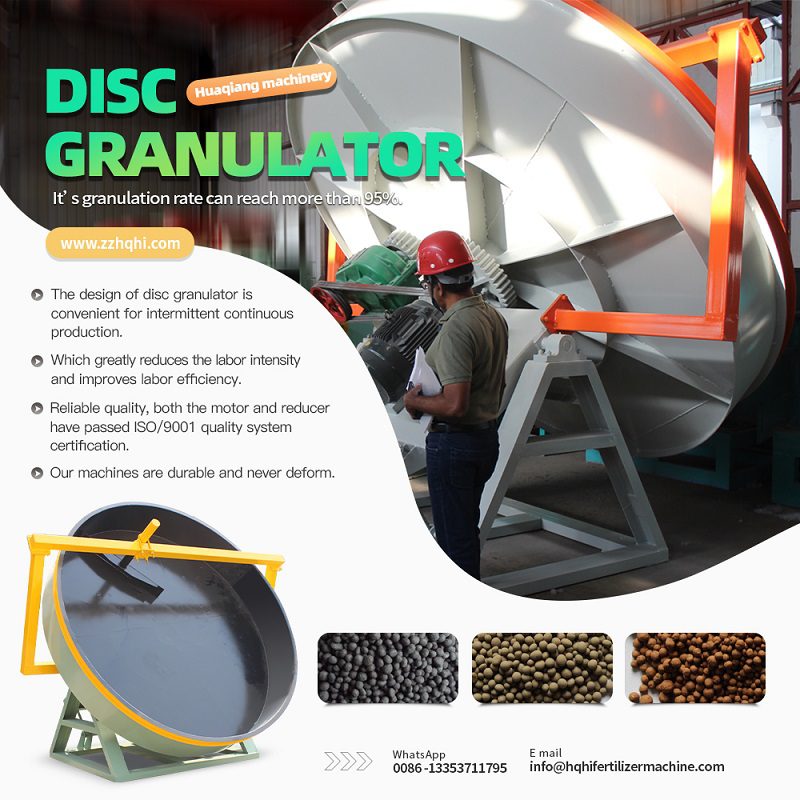
Feed Rate The feed rate determines the thickness of the material layer in the pan and the production load. Insufficient feed results in a thin layer, insufficient rolling friction and collision opportunities for particles, leading to low pelleting rate and insufficient output. Excessive feed results in a thick layer, insufficient material tumbling, uneven mixing of fine powder and coarse particles, and large particle size differences. It is recommended to maintain a stable feed flow rate, with the material layer thickness controlled at 10–20 cm. Adjustments should follow the principle of small, frequent, and gradual adjustments.Material Moisture Content
This is the most basic yet easily overlooked parameter. Low moisture content (<25%) results in a lack of liquid film adhesion on the powder surface, making pelleting difficult; high moisture content (>35%) leads to excessive viscosity, causing pelleting to occur too quickly and particles to easily clump together. Ideally, the moisture content entering the tray should be controlled between 30% and 35%. Each time materials are changed or there are seasonal variations, the material moisture content should be tested first, and adjustments should be made if necessary by pre-adding water or adding dry powder for return.
Comprehensive Troubleshooting Recommendations
When the pelleting rate is low, it is recommended to adjust the following steps in order: first, measure the moisture content → then adjust the water spray volume → then adjust the tilt angle → fine-tune the rotation speed → finally stabilize the feed rate. If the pelleting rate still does not improve after adjusting the above five parameters, consider mechanical factors such as scraper wear and tray liner aging. Usually, through systematic troubleshooting and fine-tuning, the pelleting rate can be stabilized at a normal level of 85%–95%.