
Why is a Disc Granulator the Preferred Choice for Small-to-Medium-Scale Production Lines with Limited Budgets?
For small-to-medium-scale fertilizer production lines with limited budgets, the disc granulator is the preferred choice because it precisely meets the three essential needs of SMEs: low investment threshold, low operating costs, and simple operation and maintenance. Compared to other granulation equipment such as rotary drum granulators and roller extrusion granulators, the disc granulator strikes the optimal balance between “sufficient” and “cost-effective.”
Extremely Low Investment Threshold, No Pressure for Startups
The disc granulator has a simple structure, and the equipment investment is far lower than other mainstream granulation equipment. A small disc granulator costs approximately 15,000–30,000 RMB per unit, while a medium-sized model costs approximately 50,000–100,000 RMB. In contrast, a rotary drum granulator typically requires an investment of 80,000–200,000 RMB per unit, and with the addition of supporting steam systems, drying equipment, etc., the total investment can reach 300,000–1,000,000 RMB. In terms of equipment procurement alone, disc granulators save 30%–50% of investment costs compared to drum granulators. For small and medium-sized organic fertilizer plants, rural cooperatives, or start-up agricultural and livestock enterprises with an annual output of 10,000–30,000 tons, this difference directly determines whether the project can be successfully launched.
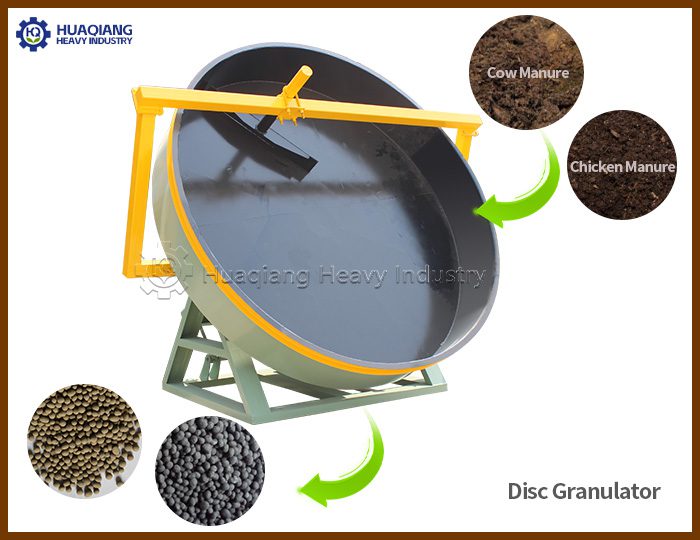
Low Operating Costs and Considerable Long-Term Returns Disc granulators use a room-temperature wet granulation process, eliminating the need for a steam heating system. Their unit product power consumption is only 8–12 kWh/t, saving over 10,000 yuan in electricity costs annually compared to other granulation equipment. The equipment power is typically only 3–5.5 kW, consuming 8–10 kWh per ton of material. Taking an annual output of 1,000 tons as an example, disc granulators save approximately 1,200 yuan in electricity costs annually compared to flat die granulators. This energy efficiency advantage translates into tangible profits in long-term operation.
Simple Operation and Extremely Low Maintenance Costs Disc granulators have a simple structure and small footprint, requiring only one person for operation and maintenance. The main wear parts are the scraper and disc liner, which are low-cost to replace, highly versatile, and can be easily operated by ordinary workers after short-term training. In contrast, rotary drum granulators require adjustment of multiple parameters such as speed, tilt angle, and spray volume, demanding higher operator skill. With rising labor costs, low maintenance barriers translate to significant long-term cost savings.
Strong Raw Material Adaptability and Flexible Switching Between Varieties
Disc granulators are suitable for various organic raw materials such as chicken manure, pig manure, composted straw, mushroom residue, and municipal sludge. Particle diameter can be flexibly adjusted within the range of 2–8mm, with a granulation rate of 85%–93%. This flexibility is particularly important for SMEs requiring multi-variety, small-batch production—flexible start-up and shutdown prevent energy waste in small-batch production.
In summary, disc granulators, with their three major advantages of being affordable, easy to use, and profitable, have become the preferred choice for small- and medium-sized production lines with limited budgets.