
How to solve dust pollution in fertilizer production?
Dust in fertilizer production mainly occurs during raw material crushing, batching and mixing, drying and cooling, and finished product screening. This dust not only causes material loss but also deteriorates the workshop environment, threatens the occupational health of employees, and, if emitted directly without treatment, will face increasingly stringent environmental regulations and penalties. The current industry-standard solution is to install cyclone dust collectors or baghouse dust collectors in the drying and cooling stages, and install induced draft fans for negative pressure collection, achieving centralized dust capture and recycling.
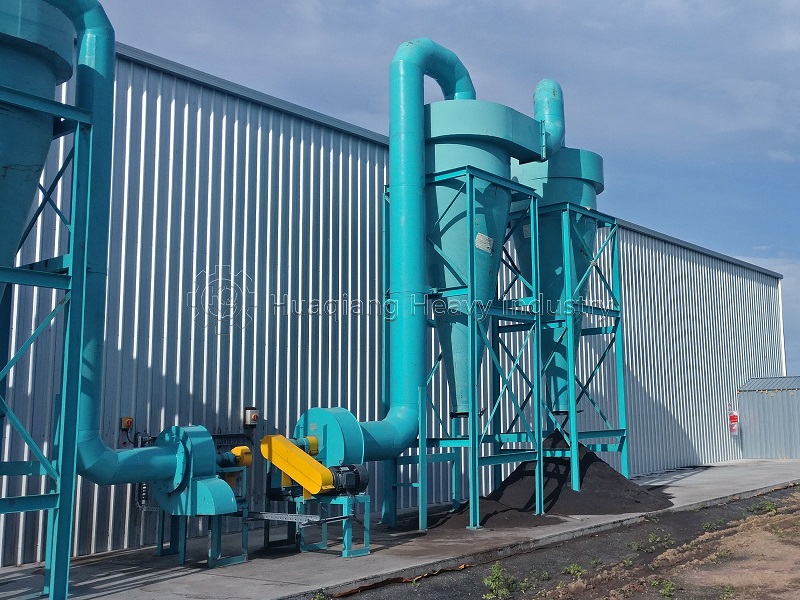
I. Cyclone Dust Collector – Primary Pre-Separation Device
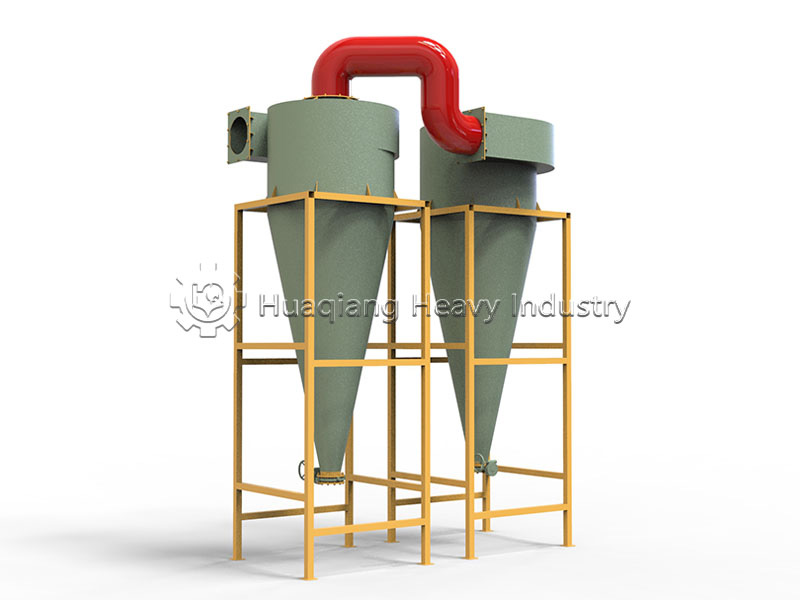
Cyclone dust collectors operate on the principle of centrifugal sedimentation. Dust-laden gas enters the cylindrical body at high speed tangentially, generating strong rotation. Under centrifugal force, the dust is thrown against the wall of the collector, slides down the wall, and is discharged from the bottom dust collection hopper. The purified gas is then drawn upwards from the central exhaust pipe. Its advantages lie in its simple structure, lack of moving parts, high temperature resistance (withstanding temperatures above 400℃), and extremely low maintenance costs. Its disadvantages are limited efficiency in capturing fine dust (especially particles smaller than 5μm), and it is often difficult to meet emission standards when used alone. Therefore, cyclone dust collectors are more suitable as primary pretreatment to remove coarse dust particles from the high-temperature flue gas at the dryer outlet, reducing the load on subsequent baghouse dust collectors.
II. Baghouse Dust Collectors – High-Efficiency Fine Filtration Core Equipment Baghouse dust collectors are currently the mainstream core equipment for dust control in the fertilizer industry. Dust-laden gas enters the housing and passes through fiber fabric filter bags. Dust is trapped on the surface of the filter bags, forming a dust cake layer, while clean gas passes through the filter bags and is discharged. Its dust removal efficiency can reach over 99%, and the exhaust dust concentration can be controlled below 10mg/m³, far exceeding the national emission standard (30mg/m³). It is most commonly used in fertilizer dryers, coolers, screening machines, and packaging machines. However, it is important to note that the filter bag material must be selected based on the flue gas temperature and humidity. Generally, polyester needle-punched felt or aramid filter media with a temperature resistance of 120℃–150℃ are recommended, and a pulse-jet automatic cleaning system is required to prevent wet dust from clogging the bags.
III. Exhaust Fan Negative Pressure Collection – System Power Guarantee The exhaust fan is installed at the rear end of the dust collection equipment. It creates a negative pressure environment in the ductwork and dust-generating points by drawing dust-laden gas dispersed in various production stages into the dust collection system. A reasonable system design must ensure that the air volume, air pressure, and ductwork layout are matched, and intelligent control is achieved using variable frequency speed regulation.
IV. Recommended Supporting Measures In addition to the core dust collection equipment, the following comprehensive control measures should be adopted: install sealed hoods or dust collection hoods at each dust-generating point to suppress dust diffusion at the source; add a spray dust suppression system in the raw material pretreatment section to increase the surface moisture content of materials and reduce dust; regularly clean the workshop floor and equipment surfaces to prevent secondary dust generation; establish a dust collection equipment inspection system to ensure that pulse valves and filter bags are in good working condition. Only by adhering to the four-pronged governance strategy of “sealing + collection + purification + recycling” can we achieve a win-win situation for clean production and resource recycling.