
In fertilizer production, energy costs typically account for 20%-30% of total variable costs. With rising electricity prices and increasing pressure to reduce carbon emissions, more and more production companies are focusing on a key indicator—Energy Efficiency Indicator (EEI). This article defines EEI and proposes three proven improvement paths to help production lines achieve the dual goals of cost reduction and emission reduction.
What is Energy Conversion Efficiency (EEI) in Fertilizer Production?
Energy Conversion Efficiency (EEI) refers to the total energy consumed (converted to standard coal equivalent) in producing one ton of finished fertilizer. The core calculation formula is:
EEI (kgce/t) = Total Energy Consumption (kg standard coal equivalent) ÷ Finished Product Output (tons)
Where total energy consumption includes: electricity (1 kWh = 0.1229 kgce), coal/natural gas heat consumption, and auxiliary fuels such as diesel. According to industry statistics, the baseline EEI (Exhaustive Energy Consumption) for domestic compound fertilizer production lines is approximately 25-45 kgce/t (including coal-fired hot air furnace and motor power consumption). The steam granulation + drying process is in the 40-45 range, while the roller extrusion process, which eliminates drying, can reduce it to the 10-15 range.
Improvement Path 1: Process Transformation – From Wet to Dry Process
2.1 Path Principle
In traditional steam granulation (drum granulation + hot air drying), the drying stage accounts for 60%-70% of energy consumption. If the process is changed to roller extrusion granulation (dry process), the drying and cooling processes are completely eliminated, thus eliminating heat consumption at its source.
2.2 Data Verification
Drum + Drying Process: EEI approximately 40-45 kgce/t (including coal-fired hot air furnace and motor power consumption)
Roller Extrusion Process: EEI approximately 10-15 kgce/t (motor power consumption only)
Energy Saving Range: 60%-70% Taking a compound fertilizer production capacity of 50,000 tons per year as an example, the dry process can save 1250-1500 tons of standard coal annually. Based on a coal price of 800 yuan/ton, this translates to annual fuel cost savings of 1-1.2 million yuan.
2.3 Applicable Conditions: Raw material moisture content ≤12%, no requirement for spherical particle appearance, and no heat-sensitive additives (such as live bacteria). Completely applicable to organic fertilizers and some low-concentration compound fertilizers.
III. Improvement Path Two: Equipment Upgrade – Variable Frequency Drive + High-Efficiency Motor
3.1 Path Principle: Many fertilizer production lines suffer from the “overpowered” phenomenon: fans, conveyor belts, and elevators operate at constant speed using industrial frequency, but the actual production load is often only 60%-80%. By installing variable frequency drives and upgrading to high-efficiency motors, power consumption can be significantly reduced.
3.2 Data Verification
Adding a frequency converter to a 55kW induced draft fan: reducing the average operating frequency from 50Hz to 38Hz, shaft power is proportional to the cube of the frequency (P ∝ f³), theoretically saving approximately (1 – (38/50)³) = 56%.
Replacing the old Y-series motors with YE4 Level 1 energy-efficient motors: increasing efficiency from 90% to 96%, saving approximately 6% in electricity, with a payback period of approximately 1.5-2 years.
Comprehensive measured data: After fully installing frequency converters (fans, elevators, belt conveyors) and replacing high-efficiency motors on a 10-ton-per-hour compound fertilizer production line, the power consumption per ton of product decreased from 38kWh to 28kWh, reducing EEI by approximately 25%.
3.3 Implementation Key Points
Prioritize upgrading high-power, long-running equipment: hot air furnace induced draft fans (55-90kW), granulator main motors (45-75kW), and dryer drives (15-30kW). Frequency conversion upgrades for low-power equipment are less economical. IV. Improvement Path Three: System Collaboration – Waste Heat Recovery and Return Material Optimization
4.1 Waste Heat Recovery and Utilization
Path Principle: The exhaust gas temperature of the rotary dryer is approximately 80-120℃, containing a large amount of recoverable heat.
Implementation Method: Install an air-to-air heat exchanger to preheat the combustion air entering the hot air furnace with the exhaust gas, saving 5%-10% of fuel. Introduce the 60-80℃ hot air discharged from the cooler into the dryer’s feed end or use it for raw material pre-drying, further reducing the main heat source load.
4.2 Return Material Ratio Optimization
Path Principle: The circulation, crushing, and regranulation of returned materials (non-conforming particles returned for regranulation) consume additional energy. Reducing the return material ratio directly reduces ineffective work.
Implementation Methods: Optimize granulator parameters (speed, tilt angle, liquid spray volume) to increase the first-pass granulation rate from 65% to 80%. Adjust the screen mesh size of the screening machine to reduce fine powder entrained in the finished product section. Data Verification: Reducing the return material ratio from 1:1 (1 ton of return material/1 ton of finished product) to 0.6:1 can lower the total power consumption of the entire line by 15%-20%, corresponding to an EEI reduction of approximately 8-10 points.
Based on the production line parameters provided by Huaqiang Heavy Industry, after implementing the above three measures in combination, the EEI of a 50,000-ton-per-year compound fertilizer line can be reduced from 42 kgce/t to below 18 kgce/t, resulting in annual comprehensive energy cost savings of approximately 800,000-1.2 million yuan. In an increasingly mature carbon trading market, EEI optimization will also bring potential carbon asset returns.
Extending Energy Efficiency Across the Fertilizer Value Chain
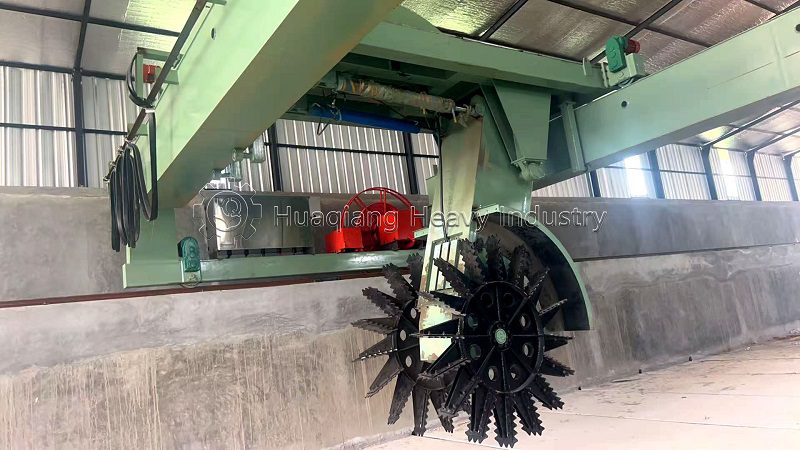
While the three improvement paths outlined above deliver measurable EEI reductions for compound fertilizer manufacturing, the broader imperative of sustainable production extends naturally into the organic fertilizer sector. In the organic fertilizer production process, fermentation represents an equally energy-intensive phase where aeration efficiency directly determines cycle duration and thermal losses. Deploying advanced fermentation composting turning technology—whether through a large wheel compost turner for high-volume windrow operations, a versatile windrow composting machine for mid-scale facilities, or a robust chain compost turning machine for continuous trough systems—ensures uniform oxygen distribution and accelerates thermophilic decomposition, effectively shortening the active fermentation period by 20–30%. When these optimized fermentation composting technology for organic fertilizer outputs are subsequently processed via modern fertilizer granulation technology, such as roller extrusion or disc granulation tailored to low-moisture fermented substrates, the entire production chain avoids the thermal burden of conventional drying. By integrating intelligent turning equipment with efficient granulation systems, producers can drive EEI below 15 kgce/t even in organic operations, achieving the same dual goals of cost reduction and carbon mitigation that define next-generation fertilizer manufacturing.