
When selecting a disc granulator, it is common to estimate output based on the surface area of the disc—assuming that doubling the diameter (which quadruples the area) should also quadruple the output. However, scaling up a disc granulator is not a simple geometric exercise. Increasing the disc diameter alters the material’s movement trajectory, residence time, bed thickness, and frictional heat generation; therefore, output cannot be linearly extrapolated from surface area.
Increasing the disc diameter first affects the linear velocity at the disc’s edge. Disc granulation relies on the rolling and agglomeration of material on an inclined surface. If the diameter increases while the rotational speed remains constant, the linear velocity at the edge rises significantly. This causes material to be thrown further, alters the “curtain” of material, and often results in fine particles being ejected from the disc, which actually lowers the granulation (pelletizing) rate. Conversely, if the rotational speed is reduced to maintain a consistent linear velocity, the material undergoes fewer rolling cycles, requiring more time to reach the desired particle size—thereby negating potential gains in output. Consequently, the rotational speed and tilt angle parameters used for smaller discs cannot simply be applied to larger ones; they must be recalibrated.
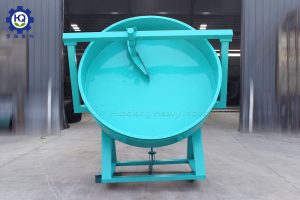
The height of the disc rim and the tilt angle must also be redesigned when the diameter is increased. If the rim height remains unchanged as the diameter grows, the material bed becomes relatively thinner, residence time decreases, and the resulting particles tend to be too small. If the rim is too high, the material accumulates to a greater depth, increasing the load on the disc surface and the required drive torque. The same applies to the tilt angle: larger discs possess greater inertia, necessitating a more robust tilt-adjustment mechanism and a more rigid frame. Otherwise, the disc may wobble during operation, leading to inconsistent particle sizes.
For disc granulators used in the production of bio-organic fertilizers, there is an additional constraint: temperature. Since these machines process materials containing functional microorganisms, the temperature throughout the granulation process must generally be kept below 55°C. As the pan diameter increases, the linear velocity at the pan rim rises, leading to greater frictional heat—both between the material and the pan surface, and among the material particles themselves. If the material’s residence time within the pan also increases, this heat accumulation becomes even more pronounced. Consequently, large-scale disc granulators for bio-organic fertilizer require lower rotational speeds, enhanced heat dissipation from the pan surface, or specialized low-temperature coatings; simply increasing the pan diameter is not a viable strategy for boosting production capacity.
Furthermore, the drive system and foundation cannot be scaled up proportionally. A larger pan diameter results in significantly higher off-center torque when filled with wet material, necessitating a complete re-evaluation and selection of the gearbox, main shaft bearings, and anchor bolts. If the foundation lacks sufficient rigidity, the periodic vibrations generated during the operation of a large pan can be transmitted to the feeder and the material-return conveyor belt. This causes the material discharge point to shift, which in turn compromises the stability of the granulation process.
The correct approach to equipment selection follows the reverse order: first, define the target particle size, material moisture content, and required batch capacity; next, determine the pan diameter, rim height, tilt angle, and rotational speed; and finally, verify the drive power and foundation load requirements. The pan diameter is an outcome, not a starting point. A formulation that yields stable results in a smaller pan often requires new trial runs and parameter adjustments when transitioned to a larger one. The production capacity of a disc granulator stems from the precise alignment of pan parameters with the state of the material—it is not merely a simple multiple of the pan’s surface area.