
Efficiency is Not a Single Choice
When choosing granulation equipment, “which is more efficient?” is the most common question users ask. However, efficiency is not a single indicator—it includes both “explicit efficiency” such as single-machine output and pelletizing rate, and “implicit efficiency” such as energy consumption, return on investment, and operational stability. Disc granulators and roller extrusion granulators represent two different technical routes: wet and dry processes. Their efficiency depends entirely on the characteristics of your raw materials and your production goals.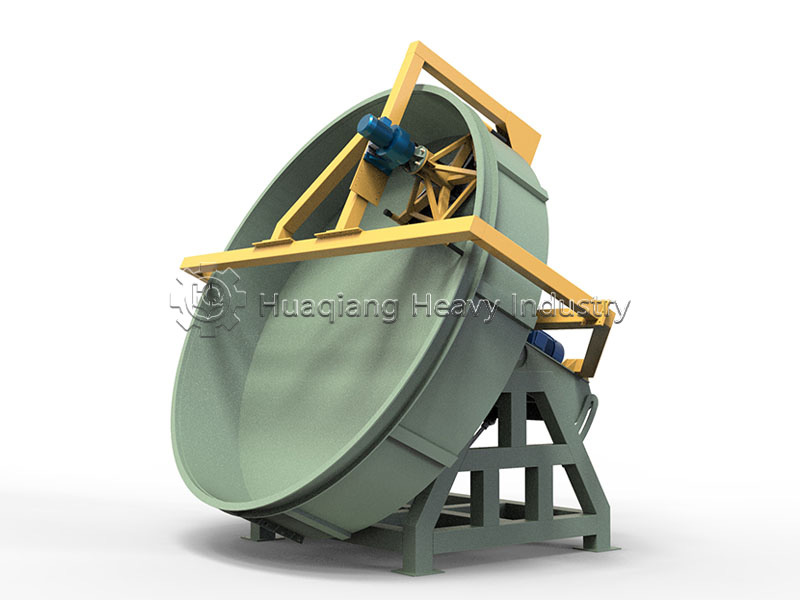

Disc Granulators: Wet Rolling, Appearance Wins
The working principle of a disc granulator is similar to “rolling dumplings.” A disc tilted at 35° to 55° rotates at a constant speed. Material with a moisture content of 25% to 40% (with the addition of a binder) is gradually rolled into balls within the disc under the action of centrifugal force, friction, and gravity. Particle size is controlled by adjusting the disc rotation speed and the height of the discharge baffle; the pelletizing rate can reach over 93%.
From an efficiency perspective, the advantages of disc granulators are: a single machine can produce 0.5 to 5 tons per hour, suitable for small to medium-sized production lines with an annual output of less than 100,000 tons; the equipment has a simple structure, low investment threshold, and can be operated by one person; the finished granules are spherical with a smooth and round surface, strong market appeal, and high market acceptance.
However, disc granulators also have significant drawbacks: the wet process means that a drying process must be followed after granulation to remove excess moisture from the granules, which brings additional energy consumption and equipment investment; the granules have relatively low compressive strength (approximately 10-15N), are prone to pulverization during long-distance transportation, and often require coating equipment.
.jpg)
Double roller press granulators: dry extrusion, energy saving is key. Double roller press granulators follow a dry process. Two opposing rotating extrusion rollers directly press the powder into thin sheets under a high pressure of 20 to 30 MPa, which are then crushed, screened, and granulated. No water needs to be added during the entire process, and no subsequent drying is required.
The efficiency of roller granulators is reflected in: hourly output of 2 to 20 tons, suitable for large-scale production lines with an annual output of over 100,000 tons; eliminating the drying stage, saving over 60% of energy consumption, with electricity consumption per ton of fertilizer being about 50% lower than the “disc + dryer” combination; granule compressive strength reaching 20 to 30 Newtons, resistant to storage and transportation damage, suitable for slow-release fertilizers and other products with high strength requirements; no binder required, resulting in significant long-term operating cost advantages.
However, roller granulators have higher initial investment and require a hydraulic system; granules are irregularly cylindrical or flattened round, with a less rounded appearance than those from disc granulators; they are less adaptable to high-moisture, high-viscosity materials and are prone to clogging.
Core Conclusion: Choose the machine according to the material to maximize efficiency.
The efficiency difference between the two types of equipment is essentially a matter of “compatibility.” The judgment standard can be simplified to: Is your material’s moisture content over 25%, belonging to high-moisture fermentation materials (such as chicken manure, cow manure, sludge)? → Choose a disc granulator. Dry processing is difficult to implement under these conditions; material will stick to the rollers, preventing normal production.
Is your material’s moisture content below 20%, classifying it as dry or low-moisture material (such as compound fertilizer, mineral powder, or ammonium bicarbonate)? → Choose a double-roller extrusion granulator. Dry processing saves on drying time, energy consumption, and maintenance, resulting in outstanding long-term operating benefits.
.jpg)
For companies with specific needs, a “disc + double-roller” combination solution can be used: high-moisture materials are first granulated using a disc, then shaped by double-roller extrusion, balancing granule appearance and strength.
The efficiency comparison between a disc granulator and a double roller press granulator is not about which is universally better, but which is more suitable for your specific raw materials and production goals. A disc granulator (a key member of the organic fertilizer granulator series) is ideal for wet granulation of high-moisture materials (25%-40%), producing round, aesthetically pleasing granules suitable for retail markets. However, it requires a drying step, increasing energy costs. A double roller press granulator (a fertilizer compactor) achieves fertilizer granules compaction through high mechanical pressure, eliminating drying and saving over 60% energy. This fertilizer compaction technology is ideal for dry materials (<20% moisture) and high-strength granules. For a complete npk fertilizer production line, a rotary drum granulator is the standard choice for high-volume spherical granules. A roller press granulator production line focuses on dry compaction. For organic fertilizers, an organic fertilizer disc granulation production line offers a cost-effective wet process. The key decision factor is raw material moisture: >25% → disc granulator for wet processing; <20% → roller press for dry compaction. High-moisture materials will stick to rollers, making dry processing impossible. For companies with specific needs, a “disc + roller” combination can balance granule appearance and strength. Understanding the trade-offs between disc granulator and fertilizer compactor technologies is essential for optimizing fertilizer compaction efficiency. The core principle is not “following the latest technology” but “finding the right fit” for your specific raw material characteristics and product positioning.
The core principle for selecting equipment is not “following the latest technology,” but “finding the right fit.” Understanding your raw material characteristics and product positioning is crucial for making a truly efficient choice between disc and double-roller extrusion granulators.