
Disc granulators have become the mainstream equipment for small and medium-sized organic fertilizer plants due to their simple structure, controllable granulation, and low investment cost. However, many operators find that the particle size of the same material varies greatly and is difficult to stabilize. In fact, controlling particle size is not mysterious—by mastering three key variables—disc angle, rotation speed, and spray droplet fineness—flexible switching from 1mm microparticles to 8mm large particles can be achieved in production.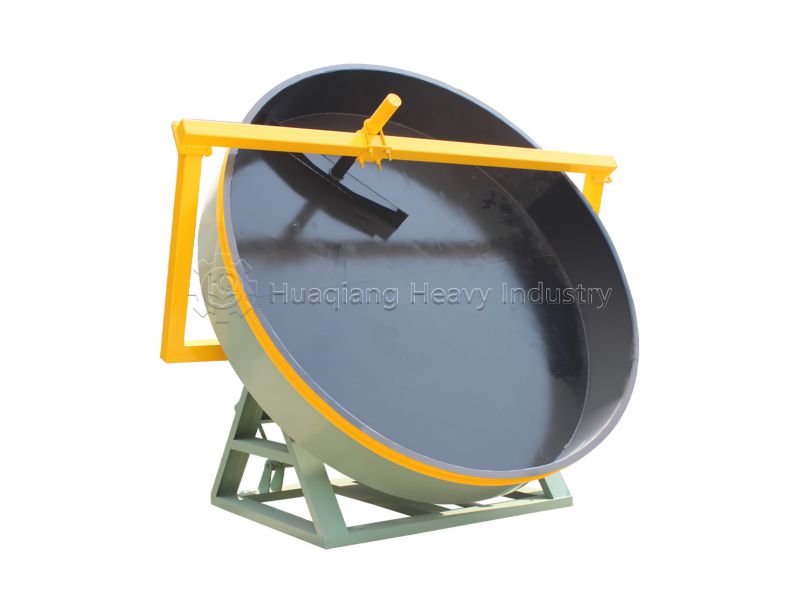
I. Disc Angle Adjustment: Determining Particle Residence Time
The disc inclination angle is the “coarse adjustment switch” for controlling particle size. The smaller the inclination angle, the longer the rolling path of the material within the disc, causing small particles to continuously adhere to the powder and grow larger; the larger the inclination angle, the faster the material slides down, the shorter the residence time, and the smaller the output particles.
Specific values: Generally, the inclination angle adjustment range for disc granulators is 35°-55°.
For producing 4-6mm standard organic fertilizer particles, an inclination angle setting of 42°-45° is most suitable.
To obtain 6-8mm large particles (suitable for fruit trees and forestry base fertilizer), adjust the tilt angle to 38°-40° and appropriately increase the spray volume.
For 1-3mm microparticles (for lawns or seedling substrates), increase the tilt angle to 48°-50° and use rapid discharge.
Adjustment Tips: After each tilt angle adjustment, allow the equipment to idle for 2-3 minutes to observe whether the material flow in the disc is uniform. Avoid adjusting by more than 5° at a time, as this will cause a sudden change in particle size distribution.
II. Influence of Rotation Speed: Controlling Centrifugal Force and Separation Efficiency
The disc rotation speed determines the centrifugal force on the material and the stratification behavior of particles of different sizes. If the speed is too low, the material will not tumble sufficiently, resulting in poor mixing of powder and mother pellets, and the particles will appear as “mud clumps.” If the speed is too high, the centrifugal force will be too great, causing small particles to be thrown directly out of the disc, while large particles will be broken up.
Recommended Rotation Speed Range: For discs with a diameter of 2-2.5m, the rotation speed should be controlled at 12-18 rpm.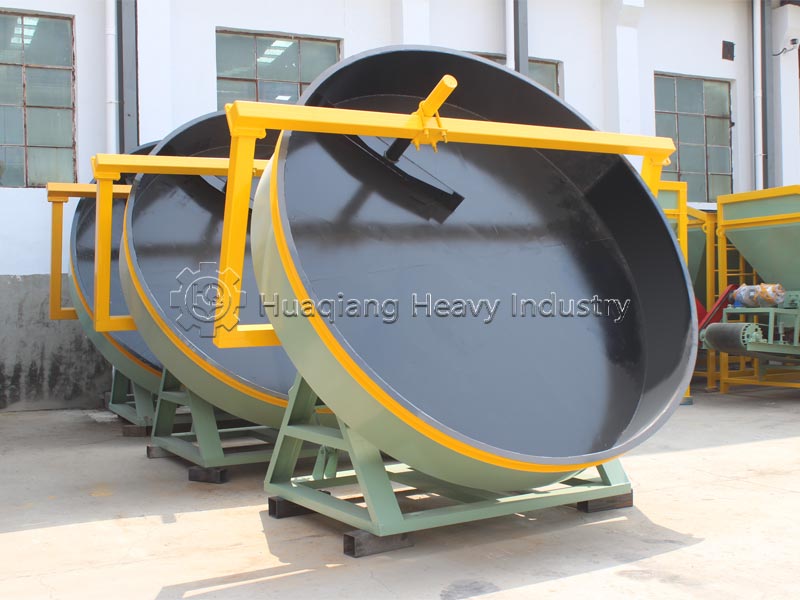
Low rotation speed (12-14 rpm): Thick material layer, gentle particle impact, suitable for producing large particles (6-8mm) or highly viscous chicken manure organic fertilizer.
Medium rotation speed (15-16 rpm): Generally used for producing 4-6mm particles, with the highest granulation rate.
High rotation speed (17-18 rpm): Smaller particles (2-4mm), smooth surface, suitable for products requiring high flowability.
Dynamic judgment: Observe the state of the mother balls in the pan. If “wavy stratification” occurs—large particles roll towards the edge of the pan, while small particles remain in the center—the rotation speed is appropriate. If the material slips or does not stratify, the rotation speed should be increased appropriately.
III. Spray water droplet fineness: Affects nucleation and growth rate. The atomization effect of water (or binder solution) directly determines the particle formation method. If the water droplets are too coarse, “wet nuclei” will form locally, resulting in uneven particle size and a pitted surface; if the water droplets are too fine, there are too many nucleation points, leading to a surge in particle number, but each particle will not grow large.
Atomization Requirements: High-pressure fan-shaped nozzles (working pressure 0.4-0.6 MPa) are recommended to control water droplet diameter at 100-200 micrometers. At this fineness, the water mist can evenly cover the material curtain, uniformly wetting the surface of each granule, allowing powder to adhere layer by layer, resulting in round and uniformly sized particles.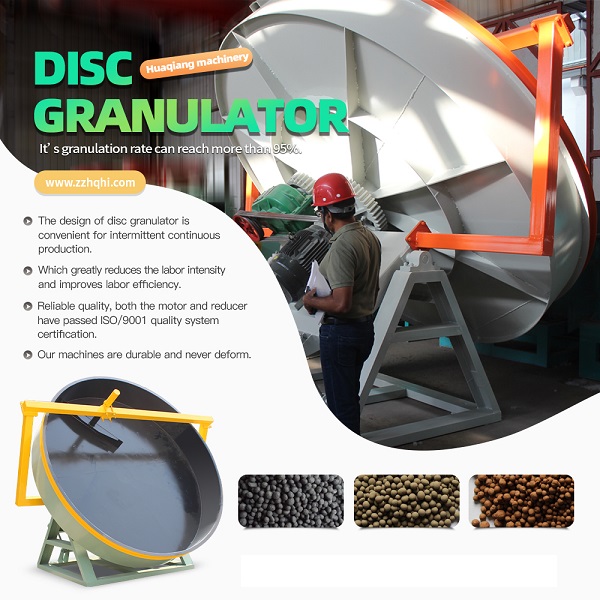
Spraying Strategy: Use intermittent spraying instead of continuous spraying. Spray for 10-15 seconds, then pause for 20-30 seconds to allow the wet particles time to roll and compact. Simultaneously, install the nozzle slightly above the center of the disc, avoiding the discharge area.
Liquid Assistance: For organic fertilizers, water alone has limited effect. Adding 2%-3% sodium humate or molasses to the water can improve the binding force of liquid bridges, making the particles easier to grow and less prone to breakage.
IV. Example of Three-Parameter Coordinated Adjustment
Assuming the current finished granules are too small and dusty:
Reduce the tilt angle from 46° to 43° (extend residence time);
Reduce the rotation speed from 18 rpm to 15 rpm (reduce centrifugal force, allowing granules to grow larger within the disc);
Check if the nozzles are clogged. If atomization is poor, clean or replace them, and finely adjust the water pressure to 0.5 MPa.
After adjustment, run for 10-15 minutes to see a significant increase in granule size and improved uniformity.
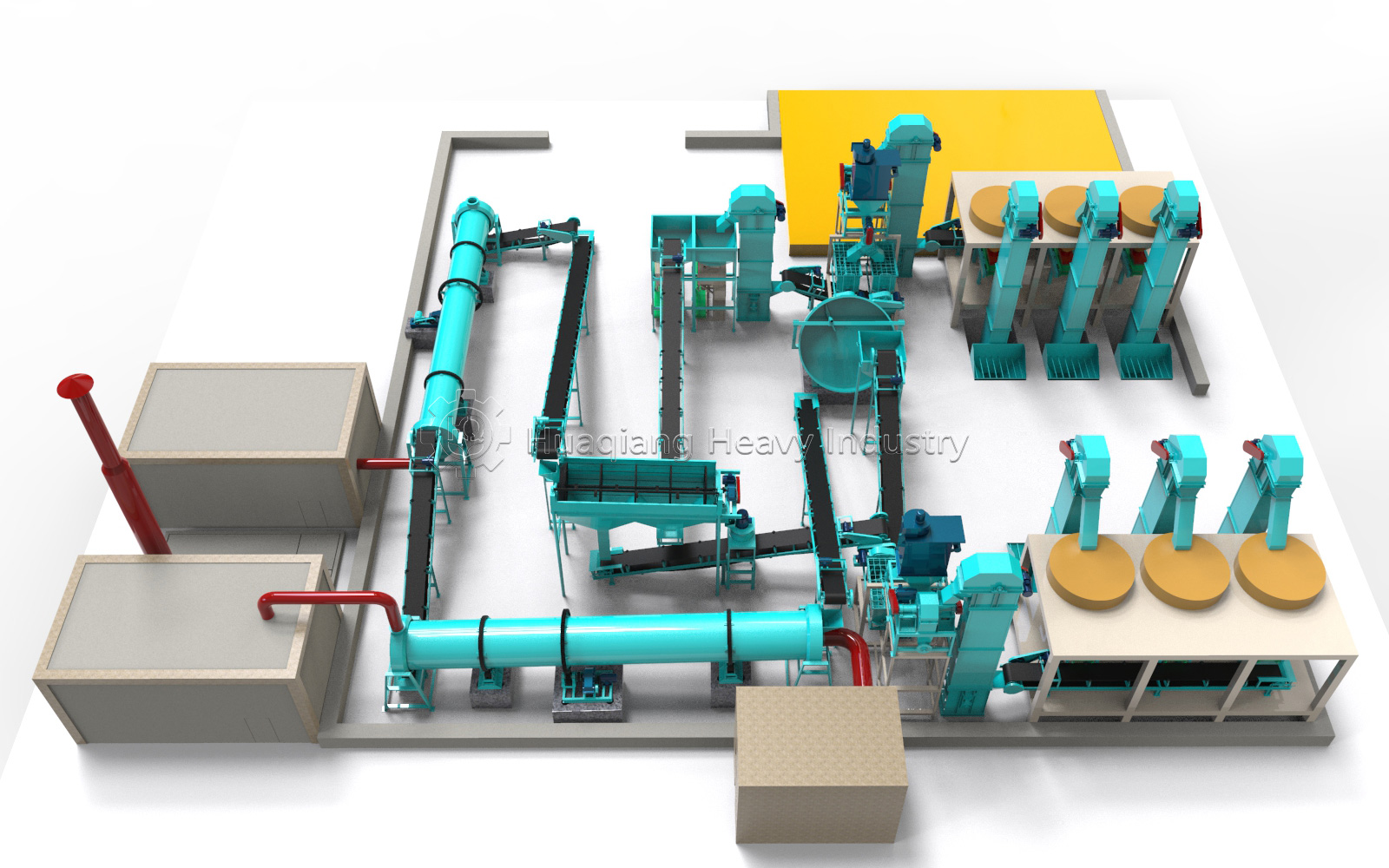
Mastering the triad of disc angle, rotation speed, and atomization fineness transforms a standard disc granulator machine into a precision instrument capable of delivering consistent particle size distributions across diverse organic formulations. While individual parameter optimization yields immediate quality improvements, sustainable competitive advantage emerges only when this fertilizer granulator machine expertise is embedded within a broader organic fertilizer disc granulation production line that synchronizes upstream material preparation with downstream screening and packaging. The physical fertilizer granules compaction dynamics inherent in disc granulation—where controlled rolling and layered powder adhesion create dense, spherical particles—offer distinct advantages over alternative agglomeration methods for applications requiring rapid disintegration and root-zone nutrient release. For operations scaling beyond small-batch flexibility toward industrial throughput, integrating a rotary drum granulator alongside disc units enables hybrid production architectures where drum systems handle high-volume compound formulations while disc lines manage premium organic specialty products with frequent formula changes. Ultimately, the maturity of organic fertilizer production granulation is measured not by single-machine performance, but by the seamless orchestration of material rheology, process parameters, and equipment selection into a unified system that consistently converts variable raw biomass into market-ready granular fertilizers with predictable agronomic performance.
Particle size control in a disc granulator is not based on intuition, but on the precise coordination of disc angle, rotation speed, and atomization fineness. It is recommended that operators record material properties, parameter settings, and finished product particle size data each time, gradually forming their own “parameter comparison table.” Mastering this method allows even traditional equipment to produce top-quality organic fertilizer granules. We specialize in the R&D and manufacturing of organic fertilizer granulation equipment. Our disc granulators support fully adjustable parameters for tilt angle, rotation speed, and atomization system, along with on-site debugging guidance from a professional technical team—ensuring consistent granule size and controllable quality in every disc.