
In traditional fertilizer granulation processes, the drying and cooling system is the most energy-intensive, space-consuming, and environmentally demanding part of the entire production line. The emergence of the new twin-roll extrusion granulator, with its “no room temperature drying required” technical feature, is redefining the efficiency limits of small- and medium-scale fertilizer production lines.
The Innovative Logic of the Process Flow: Unlike rotary drum granulation, which relies on liquid-phase bonding, extrusion granulation uses a physical dry granulation principle. The material is forced under extremely high pressure between two counter-rotating rollers, compressed into hard flakes, and then enters the crushing and grading stage to form granules. Since no additional moisture is added during the entire process (utilizing only the material’s own moisture content), the product does not need to go through a lengthy drying process after granulation and can be directly screened and packaged.
Moisture Requirements and Precise Control: This process requires extremely low moisture content in the raw materials, typically strictly controlled within the golden range of 5% to 10%. If the material is too dry, the granules are difficult to form and easily pulverize; if it is too wet, it will cause the rollers to stick. This stringent requirement for moisture content forces factories to implement more precise raw material storage management, thereby improving the overall stability of the process.
Energy Efficiency and Cost Savings: From an economic perspective, the no-drying process can save factories approximately 30%-45% on electricity costs and completely eliminates the purchase of coal, natural gas, or biomass fuels. This not only means a significant reduction in the cost per ton of fertilizer production, but also provides a natural advantage in environmental inspections by eliminating the need for hot air furnaces and exhaust gas dust removal systems. Furthermore, this technology effectively protects the activity of microbial agents or heat-sensitive nutrients, making it an ideal equipment solution for producing high-end functional fertilizers.
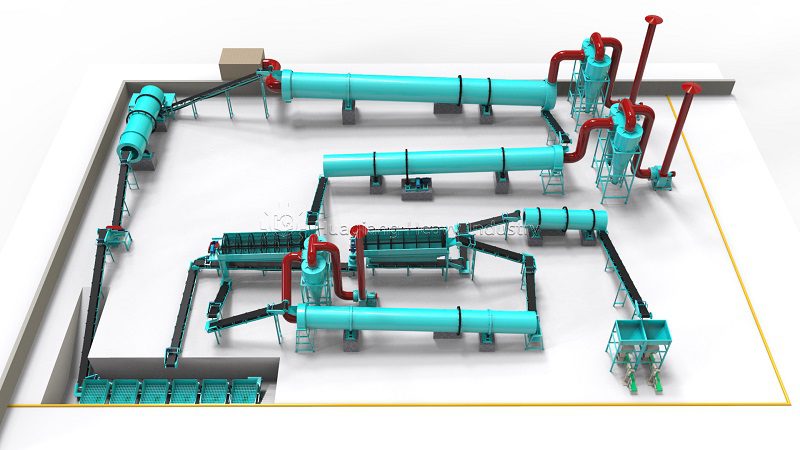
A Paradigm Shift in Sustainable Fertilizer Manufacturing
The adoption of room-temperature dry extrusion represents a fundamental reimagining of the conventional fertilizer production process, challenging long-held assumptions that high-temperature thermal treatment is indispensable for achieving marketable granule quality. By eliminating the energy-intensive drying stage entirely, this innovation streamlines the fertilizer manufacturing process into a compact, environmentally compliant workflow that dramatically reduces both capital expenditure and operational carbon footprint. Within the broader granulation process in fertilizer industry, double-roller extrusion technology occupies a unique niche where physical compaction replaces liquid-phase bonding, thereby preserving thermolabile bioactive compounds and microbial inoculants that would otherwise degrade under conventional thermal regimes. For organic fertilizer operations upstream, integrating advanced fermentation composting turning technology with precision moisture management ensures that raw materials enter the extrusion line within the critical 5%-10% moisture envelope, directly influencing granule integrity and minimizing roller adhesion. The elimination of the fertilizer drying and cooling machine from the process chain not only slashes energy consumption by 30%-45% but also removes the most complex emission control point in the entire facility, simplifying regulatory compliance and reducing maintenance overhead. As environmental regulations tighten and energy costs escalate globally, dry extrusion granulation is poised to transition from a niche alternative to a mainstream fertilizer manufacturing process architecture, particularly for small and medium enterprises seeking to produce premium functional fertilizers without the burden of thermal infrastructure. Ultimately, this technology exemplifies how process innovation—rather than incremental equipment improvement—can redefine the economic and ecological boundaries of sustainable agriculture.