
Needs Research: The First Step in Customization
The core of a customized organic fertilizer production line lies in “tailor-made” solutions—the production line scale, equipment configuration, and process route should all revolve around the user’s specific needs. Before designing the solution, at least three basic questions need to be clarified: How much raw material is processed daily? What type of raw material is it (chicken manure, cow manure, straw, sludge, or mixed waste)? Is the final product powdered organic fertilizer or granular organic fertilizer? Clarifying this basic information will ensure the subsequent design stays on track.
Raw Material Characteristics Determine Process Selection
Different raw materials have significantly different moisture content, fiber content, and viscosity, directly affecting equipment selection. Taking chicken manure from a chicken farm as an example, fresh chicken manure has a moisture content of over 75% and a high nitrogen content, requiring the addition of auxiliary materials such as rice husks and mushroom residue to adjust the carbon-nitrogen ratio and moisture. The fermentation cycle is approximately 20-30 days, requiring frequent turning every 1-2 days. Cow manure, on the other hand, has a high fiber content and a loose structure, allowing for more relaxed fermentation conditions, higher windrow stacks, and less frequent turning.
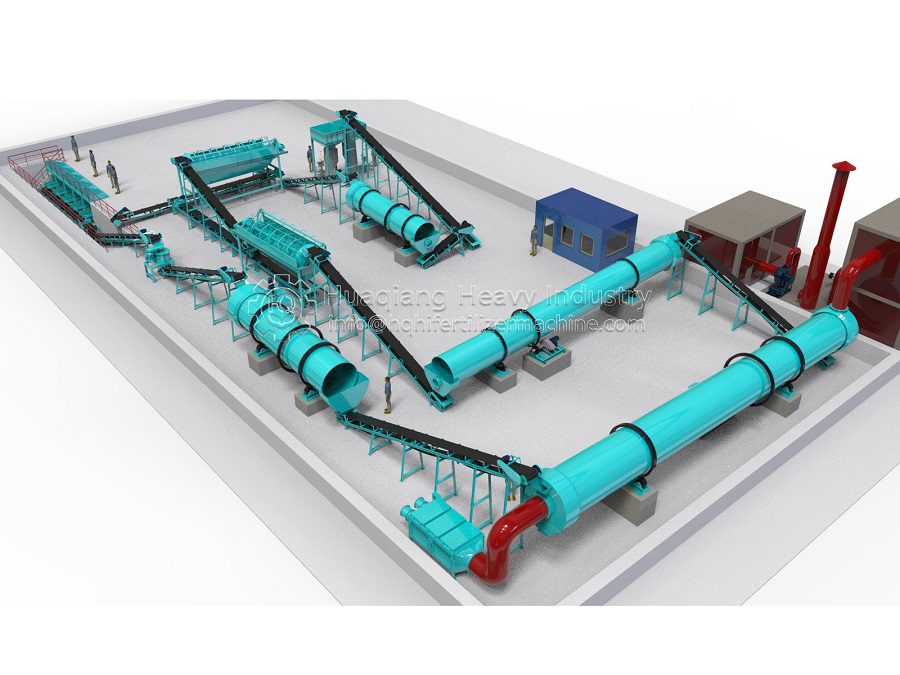
For raw materials primarily composed of straw, a semi-wet material crusher or a large hammer mill is required in the crushing stage to shorten long fibers to 3-5 cm before fermentation. Ignoring this step can double the fermentation cycle, and fiber entanglement during granulation can cause equipment blockage.
Capacity Matching and Expansion Reserves
Capacity design must consider both current demand and development expectations for the next three years. Common capacity specifications include three types: small lines with an annual output of 3,000-5,000 tons, suitable for family farms or small cooperatives, with economical configurations for fermentation and granulation equipment; medium-sized lines with an annual output of 10,000-20,000 tons, requiring automatic batching, turning machines, and granulation systems, which is currently the mainstream choice; and large lines with an annual output of over 30,000 tons, where a large-span hydraulic turning machine is recommended, and rotary drum or roller extrusion is recommended for granulation, coupled with automatic packaging and palletizing.
For start-up projects with limited funds, a pragmatic approach is to build in two phases: the first phase should focus on fermentation and crushing, primarily for selling powdered organic fertilizer; granulation and packaging modules can be added once the market has opened up. This avoids initial equipment downtime and results in healthier cash flow.
Site and Environmental Requirements
In terms of site layout, the fermentation area should be located away from residential areas and upwind of the prevailing wind direction. The ground should be hardened and equipped with drainage ditches to prevent leachate contamination. The drying and screening processes should be equipped with cyclone dust collectors or bag filters, and the exhaust stack height should be no less than 15 meters. If built near residential areas, natural gas or biomass pellets are recommended as the heat source for drying to avoid complaints about coal-fired flue gas.
Furthermore, anti-freezing and drainage design must be included in the planning—outdoor water pipes and sprinkler pipes in northern regions should be insulated or equipped with electric heating to prevent freezing and cracking in winter.

Budget Allocation and Return on Investment Reference
The investment allocation for a customized production line generally follows these proportions: fermentation equipment (turning machine, aeration system) accounts for approximately 25% of the total investment, crushing and mixing equipment accounts for 15%, granulation system accounts for 25% (this item can be omitted if granulation is not required), drying, cooling, and screening accounts for 20%, and packaging and environmental protection account for 15%. Customization isn’t about piling on more equipment; it’s about spending every penny on the most suitable configuration while meeting production capacity and quality requirements. It’s recommended to communicate with several equipment suppliers during the solution design phase, provide raw material samples for trial runs, and then make a comprehensive decision based on the trial results and quotations.
After determining the raw material characteristics and capacity requirements, the next step is selecting the right organic fertilizer production equipment. The journey begins with organic fertilizer raw material processing equipment, such as a half-wet material crusher machine, which prepares the fermented compost to the ideal particle size. This prepared material is then ready for the granulation stage, the essence of organic fertilizer production granulation. Within the organic fertilizer granulator series, several options exist. For producing high-quality, spherical granules, a complete organic fertilizer disc granulation production line is a classic and effective choice, representing a key type of organic fertilizer production granulation equipment. For operations seeking a compact, efficient solution, a new type two in one organic fertilizer granulator can combine the final stages of conditioning and initial granulation. The choice depends on the user’s specific needs, budget, and production scale. For small-scale lines (3,000-5,000 t/year), a disc granulator is often sufficient. For medium-scale lines (10,000-20,000 t/year), a new type organic fertilizer granulator may be more suitable. For large-scale lines (>30,000 t/year), a combination of equipment or a two-in-one granulator might be optimal. The key is to match the organic fertilizer production granulation equipment to the raw material characteristics—high-fiber materials may require a new type granulator, while powdery materials work well with a disc granulator. Customization ensures that every piece of organic fertilizer production equipment is optimized for the specific application, leading to higher efficiency, better product quality, and a faster return on investment.