
A complete organic fertilizer production line needs to transform fermented and decomposed livestock and poultry manure, straw, and other organic waste into commercial organic fertilizer. This involves the coordinated operation of equipment in multiple processes. The following describes the core equipment and functions of each stage according to the production process.
Fermentation Equipment
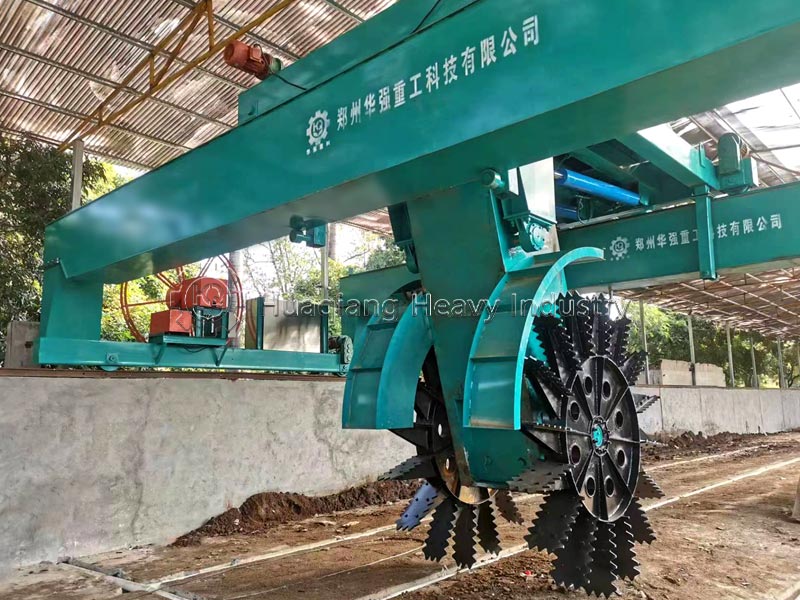
Fermentation is the first and most crucial step in organic fertilizer production. The compost turner is the core equipment for aerobic fermentation, its main function being to periodically turn the compost pile to provide sufficient oxygen for microorganisms, while simultaneously regulating the temperature and moisture content of the pile.
Depending on the fermentation process, compost turners are divided into several types: Trough-type compost turners are installed on fixed fermentation troughs, operate smoothly, consume low energy, and are suitable for large and medium-sized continuous production; Baton-type compost turners straddle strip-shaped compost piles, requiring no civil engineering, are flexible and mobile, and are suitable for small and medium-sized farms or users with non-fixed sites; Double-helix compost turners use two counter-rotating helical shafts, resulting in a large turning depth and high uniformity, suitable for raw materials with high fiber content. Large-scale wheeled compost turners are suitable for large-scale windrow fermentation, with a single operation width exceeding 6 meters.
In addition, the fermentation process may also be equipped with: auxiliary material silos (for storing straw, rice husks, and other conditioning materials), material mixers (for uniformly mixing manure with auxiliary materials), and aeration systems (ventilation ducts buried at the bottom of the trough in trough-type processes).
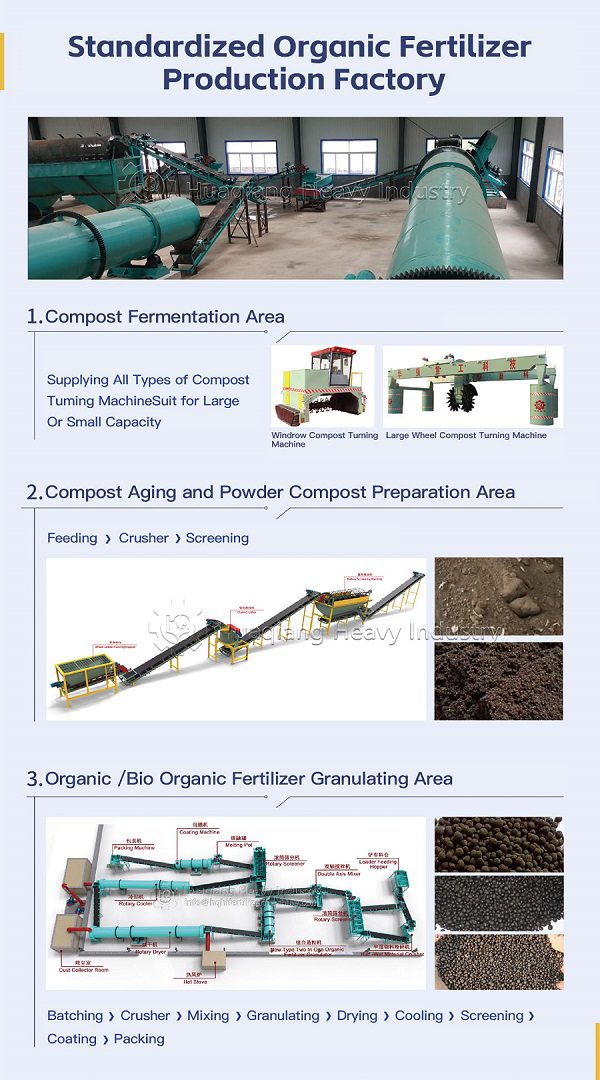
Crushing and Mixing Equipment: Fermented and matured materials often exhibit caking or lumps, requiring crushing equipment for dispersing. Semi-wet material crushers are specifically designed for fermentation materials with a moisture content of 25%-40%, employing a dual-rotor counter-rotating structure with blades that combine shearing and tearing functions, minimizing clogging. For dried materials, chain crushers or hammer mills can be used, achieving a fineness of over 80 mesh.
Mixing equipment is used to uniformly blend various raw materials. Horizontal ribbon mixers offer high throughput and high mixing uniformity, suitable for large-scale production; vertical disc mixers are compact in structure and provide thorough unloading, suitable for small to medium batch production. The mixing process is typically arranged after crushing and before granulation, and can also be used for adjusting the carbon-nitrogen ratio before fermentation.
Granulation and Drying Equipment
Granulation equipment converts powdery materials into granules, facilitating storage, transportation, and application. Disc granulators have a simple structure, produce round granules with a granulation rate of 70%-85%, and are suitable for small and medium-sized organic fertilizer plants. Newer organic fertilizer granulators use a wet-mixing tooth structure, which can directly process high-fiber, high-moisture fermented materials, achieving a granulation rate of 85%-95%. Drum granulators have a large single-machine capacity, suitable for large production lines with an annual output of over 30,000 tons. For organic-inorganic compound fertilizers, a roller extrusion granulator can also be used for dry granulation.
The wet granules after granulation need to be dried and cooled. A rotary drying drum provides high-temperature hot air through a hot air furnace, reducing the material’s moisture content from around 30% to below 15%. A rotary cooling drum uses natural or forced ventilation to lower the material temperature to below 40℃, preventing clumping after packaging. Drying and cooling equipment is typically arranged in series, with heat sources including coal, natural gas, or biomass fuels.
Screening and Packaging Equipment: Screwing equipment is used to classify the cooled granules. Vibrating screens or rotary screens separate the granules into three grades: fine powder (undersize) is returned to the granulator for reuse; oversized particles (oversize) are crushed and reused; and qualified particles (2-5mm) proceed to the next process. Screwing accuracy directly affects the product’s appearance and quality.
Coating Equipment (rotary coating machine): Qualified granules are coated with anti-caking agents or functional coating materials to improve surface properties. For bio-organic fertilizers, functional microbial agents can be added during the coating process.
Finally, the finished product is weighed and bagged using an automatic quantitative packaging scale. Modern packaging systems can automatically load bags, quantitatively fill them, sew or heat-seal the bags, and palletize them, with weighing errors typically controlled within ±0.2%.
Auxiliary equipment also includes: conveyors (belt belts or bucket elevators) connecting various devices, dust collectors (cyclones + water baths or pulse bag filters) for dust collection, and electrical control systems (manual or PLC automatic control).
The complete organic fertilizer production line integrates various organic fertilizer production equipment. The journey begins with organic fertilizer raw material processing equipment, such as a half-wet material crusher machine, which prepares the fermented compost to the ideal particle size. This prepared material is then ready for the granulation stage, the essence of organic fertilizer production granulation. Within the organic fertilizer granulator series, several options exist. For producing high-quality, spherical granules, a complete organic fertilizer disc granulation production line is a classic and effective choice. For operations seeking a compact, efficient solution, a new type two in one organic fertilizer granulator can combine the final stages of conditioning and initial granulation. For a bio organic fertilizer production line or a bio-organic fertilizer production line for pig manure, gentle granulation methods are crucial to preserve microbial activity. The integrated system of organic fertilizer production equipment includes composting, crushing, mixing, granulation, drying, cooling, screening, and packaging. The choice of granulator—disc, drum, or two-in-one—depends on the production scale and raw material characteristics. For small to medium-scale lines, a disc granulator is a popular choice for its low investment and perfectly round particles. For larger lines, a drum granulator or a two-in-one machine may be more suitable. The key is to select the right organic fertilizer production equipment to create a seamless, efficient, and profitable manufacturing system.
The above equipment constitutes a complete organic fertilizer production equipment system. Users can select appropriate equipment combinations to create a production line suitable for their needs based on raw material characteristics, target capacity, and product positioning. For specific machine parameters and configuration options, please contact us. We can also provide raw material samples and offer free trial runs to demonstrate the results firsthand.