
The granulator is the core equipment of the entire organic fertilizer production line, directly determining the granule quality, production cost, and capacity. Faced with different types of granulators on the market, how do you choose the most suitable model for your project? This article compares four mainstream organic fertilizer granulators to help you make the right decision.
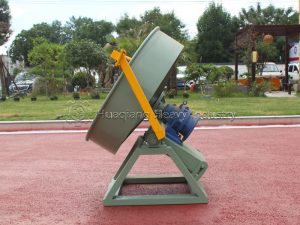
Disc Granulator: Low Investment, Quick Start-up
The disc granulator is the first choice for small and medium-sized organic fertilizer enterprises. Its working principle is that the material is rolled and agglomerated into granules under the rotation of an inclined disc, with a granulation rate of about 80%. The advantages of this organic fertilizer granulator are its simple structure, intuitive operation, and low maintenance cost, making it especially suitable for small-scale production lines with an annual output of 3,000-10,000 tons. The disc inclination angle and speed are adjustable, enabling the production of products with different particle sizes. The disadvantages are limited single-machine output and strict requirements on the moisture content of the material, generally needing to be controlled between 30% and 35%. For users with limited funds and those in the early stages of market development, the disc granulator is a cost-effective choice.
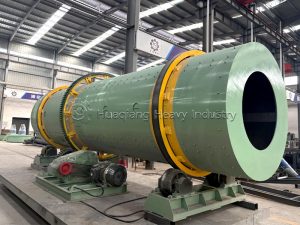
Rotary Drum Granulator: High Capacity, Continuous Production
The rotary drum granulator is a core piece of equipment in large-scale organic fertilizer production lines. Materials are heated and humidified by steam within the drums, forming granules through mutual compression. This organic fertilizer granulator can produce 15-30 tons per hour, making it particularly suitable for continuous production exceeding 50,000 tons per year. The rotary drum granulator is highly adaptable to raw materials, especially suitable for high-nitrogen compound organic fertilizer production, producing well-rounded granules with a stable granulation rate exceeding 90%. Disadvantages include large equipment size, high investment, and the need for auxiliary facilities such as boilers. For large-scale, highly industrialized enterprises, the rotary drum granulator is the preferred choice for achieving stable production capacity.
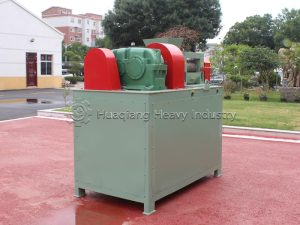
Double Roller Press Granulator: Dry Process, Energy Saving and Environmentally Friendly
The double roller press granulator uses a dry cold-pressing process. Materials are forcibly compressed into blocks between two rollers, then crushed and granulated to obtain granules. The biggest advantage of this organic fertilizer granulator is that it requires no drying or only low-temperature drying, making it particularly suitable for the production of bio-organic fertilizers with added beneficial functional bacteria, avoiding damage to the bacteria caused by high temperatures. Extrusion granulation reduces energy consumption by 30%-40% compared to wet granulation and produces no wastewater, meeting clean production requirements. The granules are irregular flakes or columns with high density and compressive strength. The disadvantage is that the granules are not as rounded as those produced by disc granulators, and it requires higher material particle size uniformity. For companies with energy-saving and environmental protection requirements and producing high-end bio-organic fertilizers, the double-roller extrusion granulator is a very suitable option.
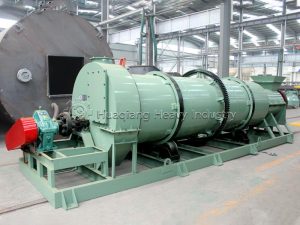
New Type Two-in-One Organic Fertilizer Granulator: High Versatility and Stable Operation
The new two-in-one granulator combines the advantages of drum and disc granulation, adopting a dual-stage granulation structure that ensures both production capacity and improved particle uniformity. This organic fertilizer granulator has a wide adaptability range for material moisture (25%-40%), and can stably granulate both fresh manure fermentation materials and high-carbon fiber raw materials. The equipment adopts a fully enclosed structure, resulting in low dust emissions. Key components are wear-resistant treated, extending their service life by more than 30% compared to ordinary models. For production enterprises with diverse product types and complex raw material sources, the two-in-one granulator provides a more flexible solution.
Five Core Factors for Granulator Selection
Choosing an organic fertilizer granulator requires comprehensive consideration of five key factors. First, raw material characteristics: high-moisture materials are suitable for rotary drum or disc granulation, while low-moisture materials are better suited for extrusion granulation. Second, production capacity: for annual production below 10,000 tons, disc granulators are suitable; for 10,000-50,000 tons, consider a two-in-one or extrusion granulator; and for over 50,000 tons, rotary drum granulators are recommended. Third, particle requirements: for a smooth, rounded appearance, choose rotary drum or disc granulators; for particle strength, choose extrusion granulators. Fourth, investment budget: disc granulators have the lowest investment, while rotary drum granulators have the highest single-line investment but lower unit production cost. Fifth, operating costs: extrusion granulators do not require drying, resulting in significant long-term energy cost advantages.
Proper selection not only ensures stable production line operation but also maximizes investment returns while maintaining product quality. It is recommended that users, after determining their production process, fully communicate with the equipment manufacturer regarding raw material parameters and expected output to obtain a personalized configuration plan.
The selection of the right granulator is the centerpiece of any organic fertilizer production equipment line. The process begins with organic fertilizer raw material processing equipment, such as a half-wet material crusher machine, which prepares the fermented compost to the ideal particle size. This prepared material is then ready for the shaping stage. Within the organic fertilizer granulator series, several options exist. For producing high-quality, spherical granules, a complete organic fertilizer disc granulation production line is a classic and effective choice. For operations seeking a compact, versatile solution, a new type two in one organic fertilizer granulator can combine the final stages of conditioning and initial granulation. The selection guide—comparing disc, drum, and roller press machines—provides a framework for matching the granulator’s capabilities to the specific production scale, raw material properties, and desired final product characteristics. Understanding the unique strengths of each technology in the organic fertilizer granulator series is essential for building a production line that transforms organic waste into a consistent, high-value granular product efficiently and cost-effectively.