
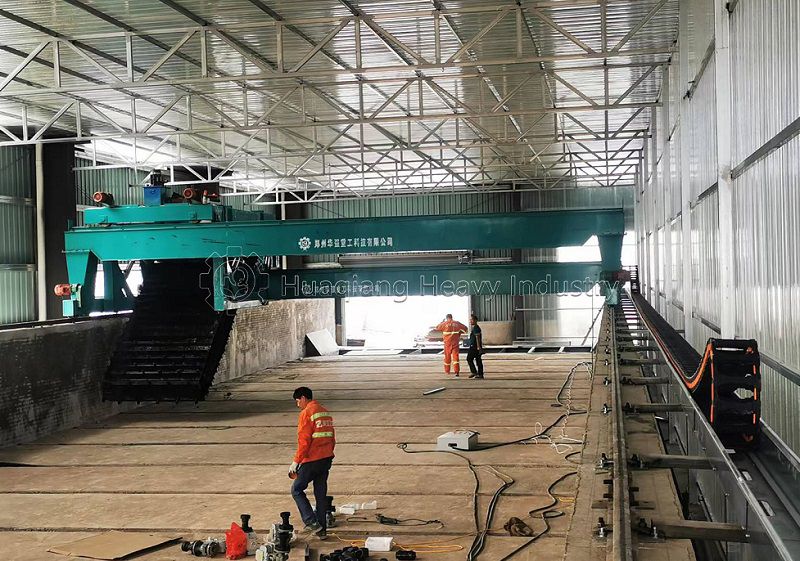
On September 29, 2026, the organic fertilizer plant’s trough fermentation workshop completed the installation and no-load/load testing of a chain plate compost turner. The workshop has three troughs arranged side-by-side. This testing focused on trough No. 1: 6m wide, 42m long, with an effective turning depth of 1.5m, designed to process 15 tons of chicken manure mixture with a moisture content of 55%-65% per day. The actual testing time for one turn of a single trough was approximately 25 minutes. During the testing period, the temperature difference between the upper and lower layers of the compost pile was ≤3℃ 24 hours after turning, and the main unit current remained stable within 70%-80% of the design value, without triggering overload protection.
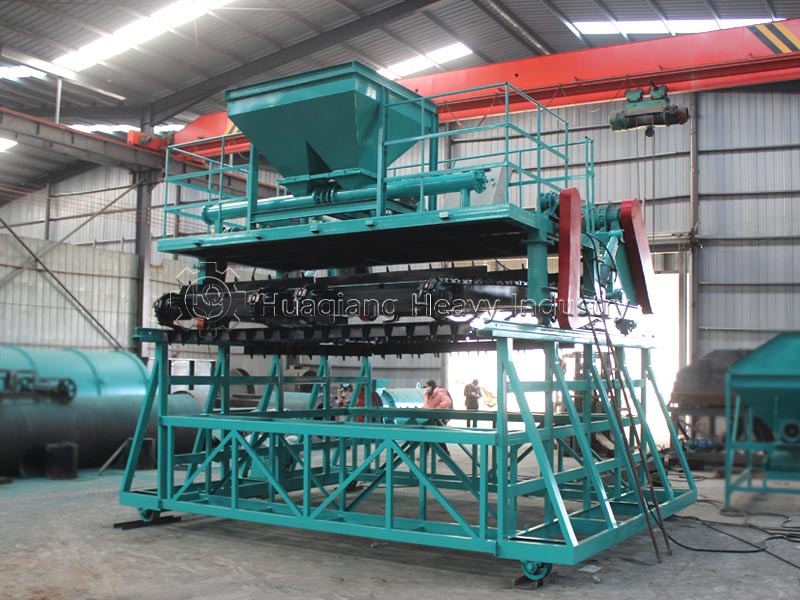
I. Project Background: Why a Chain Plate Turner Was Chosen Instead of a Tracked Turner for This Workshop
The plant’s raw material is fresh chicken manure from nearby egg farms, with an incoming moisture content of approximately 75%-80%. After adjustment with auxiliary materials, the manure enters the fermentation tank, and the moisture content of the mixture is controlled at 55%-65%. This moisture range is higher than the suitable upper limit for most windrow fermentation processes; directly piling it into windrows would lead to leachate leakage and compaction and oxygen deficiency in the piles.
The workshop had already completed the civil construction of the concrete fermentation tank in the early stages of the project. The tank is 6 m wide and 1.8 m deep, with a reserved access road at the end of the tank. The condition of “existing tank” directly ruled out the tracked route—tracked turners are suitable for windrow sites without tanks, but in a workshop with existing tanks, additional site leveling and reconstruction of the windrow area would be necessary. The chain plate turner travels along the guide rail at the top of the tank, and the turning device operates across the width of the tank, resulting in a higher compatibility with the existing civil construction.
Another decision variable is the uniformity of turning. Chicken manure mixtures are highly viscous, easily forming anaerobic nuclei at the center of the windrow stack. The trough-type confinement prevents material from spilling to the sides, and the turning device can cover the entire cross-section of the trough. This is why “reducing bottom-level anoxic conditions” was prioritized in the selection of this project.
II. Equipment Configuration Parameters: Chain Plate Turner Specifications for a 6m Trough Width
The core parameters configured on-site are shown in the table below. It should be noted that the turning width of the chain plate turner must match the trough width, usually allowing for installation allowance for the guide rails and frame. Therefore, the turning width corresponding to a 6m trough width is slightly smaller than the trough width itself.
| Parameter Item | On-site Configuration Value | Description |
|---|---|---|
| Applicable tank width | 6 m | Concrete fermentation tank, tank depth 1.8 m |
| Turning width | approx. 5.6–5.8 m | Matched with tank width with reserved frame margin |
| Effective turning depth | 1.5 m | Hydraulic lifting adjustable, non-bottom-touch operation |
| Tank length | 42 m | Effective fermentation length of single tank |
| Travel mode | Top tank rail travel | Reciprocating operation along tank length |
| Time for one full pass on single tank | approx. 25 min | Including turnaround time at both ends |
| Designed daily capacity | 15 t/d | Chicken manure mixture with moisture 55%–65% |
| Turning frequency | 1–2 times/day | Matched with 15–20 d fermentation cycle |
| Tank shifting mode | End-of-tank shifting mechanism | Switchable among three tanks |
Regarding the “15 tons per day” figure: This figure refers to the amount of mixture entering the fermentation tank, not the output of the finished organic fertilizer. After fermentation, the organic matter decomposes and moisture evaporates, resulting in a significantly lower finished product quality than the feed quality. Therefore, the finished product output should not be used to determine the turner specifications.
III. On-site Commissioning Records: Three Verified Parameters
Commissioning was conducted in two steps: no-load and load. The unloaded phase primarily verified the walking, lifting, and limit functions. During the loaded phase, chicken manure mixture with approximately 60% moisture content was loaded into tank 1, with the material layer thickness approaching the designed turning depth. Two consecutive round trips were then performed.
Turning Depth and Current: When the turning device descended to 1.5 m, the main unit current stabilized at 70%-80% of the design value without significant fluctuations. Further descent to approximately 1.7 m resulted in a significant increase in current, approaching the overload protection threshold. The operator immediately raised the turning device. This field observation validated an operational principle: the turning depth should not be aimed at “touching the bottom.” The tank depth of 1.8 m is a civil engineering parameter, while 1.5 m is the effective operating depth of the equipment under the current material conditions.
Turning Uniformity and Temperature Difference: After turning, three cross-sections were taken along the length of the tank. The temperature of the upper, middle, and lower layers was measured at each cross-section. A retest was conducted after 24 hours. The temperature difference between the upper and lower layers at the same cross-section was ≤3℃. In contrast, the small-scale turning and turning equipment used in the factory before the renovation had an effective depth of only 0.8 m. The bottom layer was chronically in a low-temperature, oxygen-deficient state, with a temperature difference between the upper and lower layers often exceeding 8°C.
Single tank operation time: With a tank length of 42 m, a single turn of turning and turning, plus reversing at both ends, takes approximately 25 minutes in actual measurements. Based on 1-2 turns per day, rotating between the three tanks, the operation time for one turn of each of the three tanks per shift is approximately 75-90 minutes. The remaining time can be used for auxiliary material mixing and discharge preparation.
IV. Two common misconceptions exposed by this project
Misconception 1: Selecting the turning and turning width based on a 6 m tank width. An installation margin needs to be allowed between the turning and turning width and the tank width; the actual width is usually slightly smaller than the tank width. If the model is selected based on the full tank width, the frame and guide rails will interfere with the tank wall, requiring rework during installation.
Misconception 2: Treating the turning and turning depth as a fixed value. The effective depth of the same equipment varies under different material moisture content and material layer thickness. During on-site commissioning, the system was stable at 1.5 m, but approached overload at 1.7 m. This indicates that depth should be an operating parameter adjusted according to current and material conditions, rather than a fixed number written into the operating procedures. This is the significance of hydraulic lifting – it allows for real-time depth adjustment, rather than requiring equipment replacement.
V. FAQ: Frequently Asked Questions about Chain Plate Turners
Q1: Can a 6 m wide chain plate turner be used to create a deep trench exceeding 2 m?
Yes, but it requires a dedicated deep trench model and a larger motor. This project has a trench depth of 1.8 m and an effective turning depth of 1.5 m, which is a standard configuration. When the target depth exceeds 1.8-2.0 m, the chain plate structure and lifting stroke must be recalculated. A conventional model cannot be used forcibly lowered; otherwise, the current and structural load will exceed the design range.
Q2: How long does it take to switch between three trenches on one machine? Will they wait for each other?
The switching mechanism in this project completes the switching at the tank end, with a switching time far shorter than the single-tank turning time (25 minutes). The rotation of the three tanks will not create a waiting bottleneck. What truly needs scheduling is the turning frequency: if all three tanks simultaneously enter the high-temperature period and require daily turning, a single machine can still complete the task within a single shift; if the fermentation cycles are staggered, the operational margin is even greater. The bottleneck for a machine with multiple tanks is usually in scheduling, not in the switching speed.
Q3: Will the chain plate turning machine stick to the chicken manure mixture with a moisture content of 60%?
There will be some adhesion, but the forced shearing action of the chain plate turning is more effective at breaking up sticky lumps than windrow turning. The key to controlling adhesion lies in two points: the moisture content of the mixture should not exceed 65% for an extended period, and timely inspection of accumulated material on the chain plate and frame after turning. If adhesion continues to worsen, the auxiliary material ratio and mixing uniformity should be checked first, rather than simply reducing the turning frequency.