
When selecting organic fertilizer granulation equipment, there is a fundamental dividing line that is even more critical than standard equipment specifications: the input moisture content range. For the same type of composted livestock manure, a moisture content of 25%–35% is suitable for disc agglomeration; if it drops below 5%, dry extrusion is the only viable option; meanwhile, production lines facing moisture fluctuations between 25% and 45% require an integrated forming solution to accommodate this variability. The organic fertilizer disc granulator, double-roller press granulator, and new-type two-in-one organic fertilizer granulator correspond to the distinct process logics associated with these different moisture ranges.
The disc granulator imposes the strictest requirements on raw material moisture content, with an optimal pelletizing range of 25% to 35%. The disc tilt angle is adjustable between 35° and 55°, and for a disc with a 2.2-meter diameter, the rotation speed is controlled at 18–22 revolutions per minute. Driven by the combined forces of friction, centrifugal force, and gravity, the material rises along the inner wall of the disc before rolling back down; atomized water sprays moisten the fine powder layer by layer to induce agglomeration, and granules meeting size specifications overflow from the disc rim. Granules produced via this wet agglomeration method exhibit excellent sphericity; however, the recycle rate (material returned to the process) typically ranges from 10% to 20%, and the granules have a relatively high moisture content, necessitating the inclusion of drying and cooling systems for safe storage.
The double-roller press granulator operates at the opposite end of the moisture spectrum, requiring an input moisture content of no more than 5% and a feed particle size of 0.6 mm or less. Two high-strength rollers rotating in opposite directions compress the dry powder into a dense sheet at ambient temperature; the bonding force between particles arises from molecular interactions such as van der Waals forces, adsorption, and crystal bridge formation. This dry granulation pathway eliminates the drying and cooling stages required for wet granulation, reducing overall energy consumption by 30% to 50%; it covers an installed power range of 7.5 to 45 kW and offers a production capacity of 1 to 15 tons per hour. Granule density increases by 1.5 to 3 times, resulting in virtually no pulverization during truck loading, transport, or multi-layer stacking.
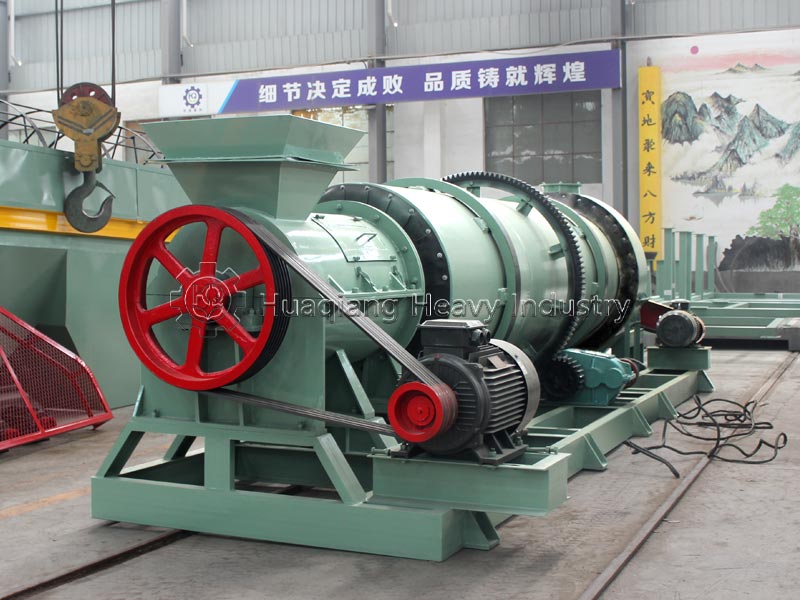
A distinct gap exists between these two pathways: when raw material moisture content fluctuates between 25% and 45%—and the plant cannot precisely pre-dry each batch—the process window for disc granulation is too narrow, while roller extrusion fails to meet the requirement for dry powder feed. The design logic of the new “two-in-one” organic fertilizer granulator aims to fill this gap. It integrates mixing, granulation, preliminary screening, and material recycling into a single drum unit. Taking the YSL2-80/150 model as an example, it offers an hourly output of 5 to 8 tons and an installed power of 60.5 kW, achieving a pelletization rate exceeding 90% and keeping recycle loss under 3%. At the front end, a twin-screw mixing assembly homogenizes the raw materials with a mixing uniformity coefficient of variation (CV) ≤ 5%. The middle section—a two-stage granulation zone—utilizes high-speed mechanical agitation and friction to complete the processes of pellet formation, rounding, densification, and polishing. The rear screening assembly automatically separates qualified granules; unqualified granules are crushed and immediately recycled for re-granulation, creating a closed-loop system. This integrated design eliminates the need for material transfer between multiple machines, reducing energy consumption by 20% to 30% and equipment procurement costs by 30% to 50% compared to traditional modular granulation setups.
Selecting the right pathway comes down to a preliminary question: what is the moisture content of your raw material after it leaves the fermentation tank? If the moisture content is a stable 25% to 35% and drying facilities are available, the superior sphericity offered by disc granulation makes it a compelling option. The advantages of roller compaction—specifically regarding energy efficiency and granule strength—are most pronounced when the raw material is a dry powder or has undergone pre-drying. Conversely, if moisture content fluctuates due to batch or seasonal variations, the integrated design of “two-in-one” units absorbs these fluctuations by streamlining material transfer; fewer transfer steps result in greater control over the material’s state. The first step in equipment selection is never comparing price quotes, but rather verifying whether the raw material’s initial state falls within the moisture content range required by the chosen process.