
In NPK compound fertilizer production, every process, from raw material processing to granulation and drying, contributes to the value of the final product. The final stage of the production line—the automatic quantitative packaging machine—truly transforms this value into marketable goods. It is responsible for accurately weighing qualified granules, quickly bagging them, and sealing them, directly determining outbound efficiency and customer experience. A high-precision, high-speed packaging machine can truly unleash the capacity of the entire production line.
The Core Value of the Packaging Machine in the Production Line
The packaging process may seem simple, but it is a crucial node affecting production efficiency and operating costs. Manual packaging suffers from large weighing errors, slow speed, and health hazards from dust. Automatic packaging machines offer three key benefits: precise quantitative control (error within ±0.1%-0.5%), avoiding raw material waste due to over-packing or customer complaints due to under-packing; dustproof sealing (dust extraction devices at the packaging opening effectively control dust diffusion and improve the workshop environment); and significantly increased efficiency (single-machine packaging speed can reach 6-12 bags/minute, 3-5 times faster than manual packaging, greatly reducing labor costs). Types and Applicable Scenarios
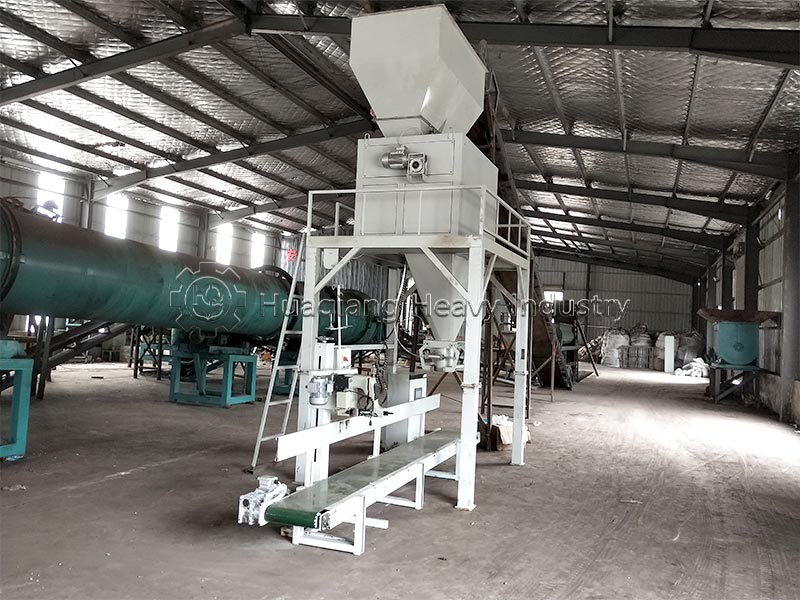
For the characteristics of NPK compound fertilizer granules, our company provides a double-hopper quantitative packaging scale, suitable for woven bags or paper-plastic composite bags with specifications ranging from 10-50kg. The equipment adopts a gravity feeding and dual-scale alternating working mode: material enters the weighing hopper from the buffer hopper, the sensor monitors the weight in real time, and automatically closes the gate and unloads when the preset value is reached. The dual scales operate alternately without weighing interruptions, achieving continuous packaging. For powdery or easily dusty materials, a screw feeder packaging machine can be selected for better sealing.
Core Advantages: Accuracy, Speed, Stability
The high-precision weighing system is the heart of the packaging machine. It adopts an imported cantilever beam sensor with a resolution of 1/10000, combined with intelligent instruments and three-stage feeding (fast, medium, slow), ensuring that the weight deviation of each bag is ≤±0.2%. For a 50kg specification, the deviation does not exceed 100 grams, far exceeding the conventional 1% error level in the market. The rapid bag clamping device works in conjunction with the pneumatic sealing system. The operator only needs to place the bag and trigger a switch; the equipment automatically completes the entire process of bag clamping, filling, weighing, bag dropping, and sewing. With a stable speed of 6-12 bags/minute, it easily matches the needs of production lines with an hourly output of 10-20 tons.
Integration with upstream equipment: The packaging machine is located after the screening machine in the production line. Qualified particles fall from the discharge port of the drum screen into a buffer hopper. The hopper is equipped with high and low level sensors: when the material level reaches the high level, the screening machine can automatically slow down or stop to prevent material overflow; when the material level drops to the low level, the screening machine resumes feeding. This linkage design ensures that the packaging machine always operates under stable material pressure, and the weighing accuracy is not affected by material fluctuations. For products requiring film coating, the coating machine should be installed between the screening machine and the packaging machine.
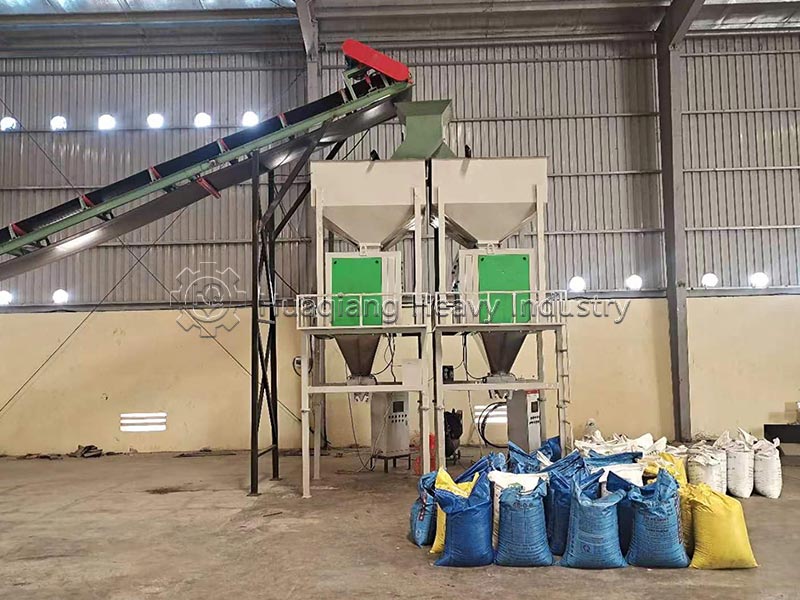
Routine maintenance of automatic packaging machines focuses on three areas: sensor calibration (monthly verification with standard weights to ensure weighing accuracy); seal replacement (heating strips and insulation cloths are consumable parts and should be inspected every 2-4 weeks, replaced promptly when worn); and dust removal and cleaning (the suction pipes at the packaging opening should be cleaned every shift to prevent dust accumulation from affecting suction power). The electrical control cabinet must be kept dry, and wiring terminals should be checked regularly for looseness.
Suitable Scenarios: NPK, Organic Fertilizer, and Blended Fertilizers The automatic quantitative packaging machine is not only suitable for NPK compound fertilizer granules but also for granular or powdery materials such as organic fertilizers, bio-organic fertilizers, and blended fertilizers (BB fertilizers). By simply changing the feeding method (gravity/spiral) and sealing mold (woven bag/paper bag/ton bag), one machine can meet the packaging needs of multiple product categories.
The automatic packing machine is the final critical link in any fertilizer production line, transforming bulk product into a market-ready commodity. In a complete npk fertilizer production line, it follows the finishing stages of screening, drying, and cooling. For a bio organic fertilizer production line, the process is similar: after granulation, often with a disc granulator, the product is stabilized. The granules first pass through a rotary drum screening machine to ensure uniformity, then a fertilizer dryer machine and fertilizer cooler machine for stabilization. For a pure blending line, the material, after precise mixing with an npk blending machine, proceeds directly to packaging. Regardless of the production path—whether a granulated NPK, a bio-organic product, or a simple blended fertilizer—the packaging machine provides the same essential function: accurate, high-speed weighing and sealing. Its integration with upstream equipment, such as buffer hoppers and level sensors, ensures a smooth, continuous flow of material. The final, consistently packaged product is the result of the entire production line’s efforts, making the reliability and precision of the fertilizer packing machine as important as any other piece of equipment in the plant.