
Working Principle of Disc Granulators
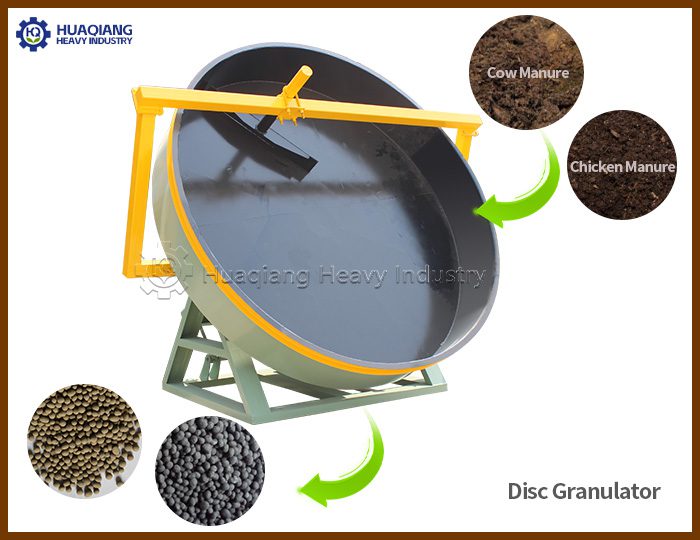
Disc granulators, also known as disc granulators or inclined disc granulators, are among the oldest and simplest granulation equipment used in the fertilizer industry. Their core component is a large-diameter circular steel disc, driven by a motor and reducer to rotate around a central axis. The disc surface is inclined at an angle of 40° to 55° to the horizontal.
During operation, powdery material is continuously fed from above the disc, while a suitable amount of water or binder is sprayed onto the material surface through a spray system. The centrifugal force and friction generated by the disc’s rotation cause the material to undergo complex rolling motion within the disc. Small particles form first as “nuclei,” then continuously adhere to the surrounding powder, gradually growing larger like a snowball. When the particle diameter reaches the target size, it automatically rolls off the edge of the disc and is discharged due to gravity.
The disc’s inclination angle, rotation speed, and spray volume are all adjustable. The smaller the inclination angle, the longer the material stays in the disc, resulting in larger particles; the higher the rotation speed, the stronger the centrifugal force, leading to denser particles but potentially breakage due to impact. Experienced operators can flexibly adjust these parameters based on raw material characteristics to achieve ideal particle size and roundness.
Full Production Line Configuration
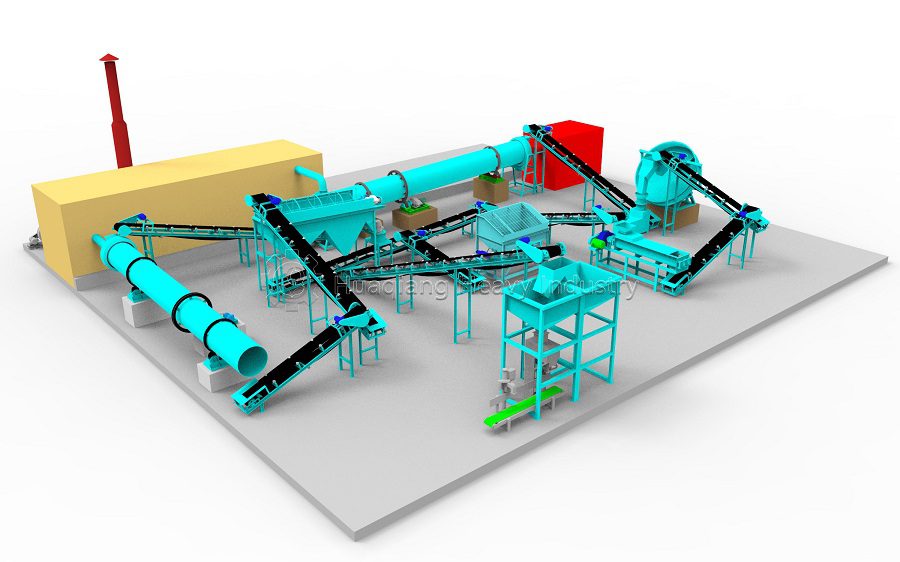
A complete disc granulation production line typically includes the following equipment:
Pre-processing: Chain or hammer mills are used to break up lumps in the raw materials, and horizontal ribbon mixers ensure uniform mixing of various raw materials, providing powder with acceptable fineness and uniform composition for granulation.
Pelletizing Core: The disc granulator is the heart of the entire line. Depending on the capacity, the disc diameter varies from 1.2 meters to 3.6 meters, with a single machine processing capacity corresponding to 1 to 15 tons per hour.
Post-processing: After granulation, the material has a high moisture content and needs to be dried by a rotary drying drum, followed by cooling by a rotary cooling drum. Afterwards, it is classified by a vibrating screen or rotary screen. Qualified particles are sent to a coating machine to be sprayed with an anti-caking agent, and finally enter the automatic packaging system.
Auxiliary systems include a hot air furnace (providing heat for drying), a dust collector (collecting dust), elevators and conveyors (connecting various equipment), and an electrical control cabinet.
Compared to rotary drum granulation lines, disc granulation lines have a simpler configuration, making them particularly suitable for small to medium-scale production.
Up to 80% pelletizing rate: Under suitable conditions, disc granulators can achieve a pelletizing rate of 70%-85%, meaning that most materials can directly form qualified pellets, with only a small amount of fine powder and oversized particles needing to be returned to the system for re-granulation.
Key factors affecting pelletizing rate include:
Raw material fineness: At least 80% of the material should pass through an 80-mesh sieve. Higher fineness results in smoother particle surfaces and faster pelletizing.
Moisture control: The suitable moisture content of the material during granulation is 25%-35%. Too low a moisture content prevents powder adhesion, while too high a moisture content causes the particles to become soft and deformed.
Disc adjustment: An inclination angle of 45°-50° and a rotation speed of 10-15 rpm are the optimal operating range for most organic fertilizer and compound fertilizer raw materials. Spray uniformity: The nozzles should cover the entire material curtain area, avoiding localized over-wetting or under-drying.
A disc granulation production line centered on a disc granulator is a versatile solution for both bio organic fertilizer production lines and small to medium-scale npk fertilizer lines. For a bio-organic fertilizer production line for pig manure, the disc granulator’s gentle tumbling action is ideal for preserving microbial activity. For an npk fertilizer line, the disc granulator can be used for organic-inorganic blends. The complete line includes: pre-processing (crushers, mixers), the disc granulator (core), post-processing (a fertilizer dryer machine, fertilizer cooler machine, rotary drum screening machine), and a fertilizer packing machine. For a roller press granulator production line, a roller press is used instead of a disc granulator for dry compaction. A npk blending machine is used for pure blended fertilizer lines. The disc granulator’s key advantage is its ability to produce round, aesthetically pleasing granules with a pelletizing rate of 70%-85%. Key factors affecting performance include raw material fineness (80% through 80 mesh), moisture content (25%-35%), disc angle (45°-50°), and rotation speed (10-15 rpm). Compared to newer organic fertilizer granulators, disc granulators offer better sphericity and a more appealing appearance. For small to medium-scale production, a disc granulation production line offers a mature, reliable, and cost-effective solution. Its simple operation and maintenance make it a popular choice for many fertilizer plants. For specific applications, such as high-fiber materials or organic-inorganic blends, other options like a new type organic fertilizer granulator may be considered. However, for producing high-quality spherical granules, the disc granulator remains a proven and dependable workhorse.
For organic fertilizer production, the advantage of disc granulators lies in their ability to process fermented materials containing a certain amount of fiber. The granules produced are round and have good disintegration properties, which is beneficial for crop absorption. Compared with newer organic fertilizer granulators, disc granulators produce granules with better sphericity and a more appealing appearance in the market.
A well-designed disc granulation production line requires relatively low investment and is easy to operate and maintain, making it a mature and reliable choice for organic fertilizer plants and small to medium-sized compound fertilizer plants. For details and trial runs, please inquire. Raw material samples can be sent, and free trial runs are supported.