
The fundamental reason why disc granulators have a significantly lower return rate than drum granulators lies in their structure: disc granulators use an open bed where particles roll layer by layer. Qualified particles are promptly discharged from the edge of the disc during rolling, unlike drum granulators which rely on cylinder length and residence time for pelleting and discharge. Less return results in a lower heat load for subsequent drying, thus reducing the cost per ton of fertilizer.
I. Structural Differences in Pelletizing and Discharge Paths
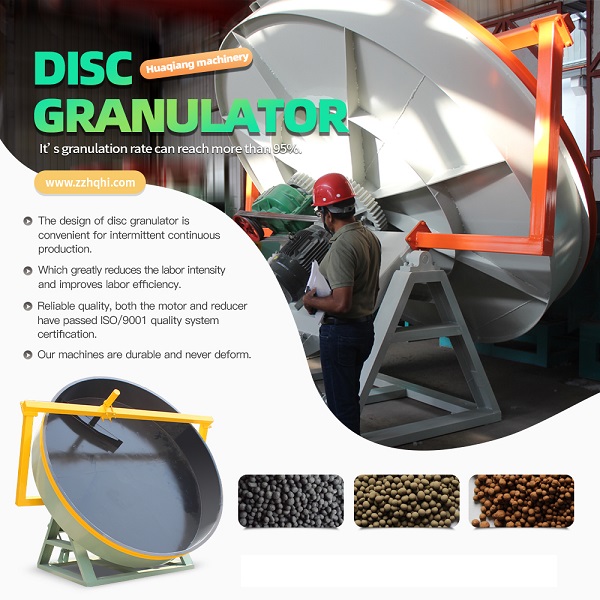
The pelletizing logic of a disc granulator is “layer-by-layer encapsulation.” Powder is continuously fed from above the disc, atomized and moistened by sprayed water. The material rolls along the disc surface under the influence of friction, gravity, and centrifugal force within the inclined disc. Fine powder first forms small nuclei, which gradually grow larger as they adhere to layers of powder during rolling. Crucially, when the particles grow to a certain size, the combined force of gravity and centrifugal force causes them to cross the edge of the disc and naturally overflow. Pelletizing and discharge are two results of the same rolling process; qualified particles do not accumulate indefinitely within the disc.
Rotary drum granulators differ from conventional ones. Material tumbles and agglomerates inside the drum, forming pellets that are then carried to a certain height by lifting plates as the drum rotates, before moving axially to the discharge end. The material spends a longer time inside the drum, and discharge depends on both the drum’s inclination angle and rotation speed. Some qualified pellets continue to tumble inside, potentially becoming oversized or broken, while unqualified fine powder is also discharged with the material flow, leading to a higher return rate.
The disc-type granulator’s “rolling and discharging” ensures timely discharge from an open bed; the rotary drum’s “tumbling and axial movement” results in delayed discharge within a closed drum. These structural differences directly determine the difference in return rates.
II. Calculation of the Impact of Return Rate on the Cost per Ton of Fertilizer
Every percentage point decrease in the return rate means a reduction in the processing capacity of the granulator, conveying equipment, and dryer. Taking a rotary drum production line with a capacity of 5 tons per hour and a return rate of 30% as an example, the actual material throughput for granulation and drying is 6.5 tons/hour. If a disc granulator with a return rate of 20% is used instead, the throughput drops to 6.25 tons/hour, and the material load in the drying stage decreases by approximately 4%.
On a scale of ton-of-fertilizer cost: drying energy consumption accounts for 60%-70% of the total energy consumption in the granulation section. Reducing the return rate from 30% to 20% can reduce drying heat consumption by approximately 5%-8%. For an annual production of 30,000 tons, this translates to savings of tens of thousands of yuan annually in fuel costs alone. Furthermore, reduced return material also lowers power consumption for conveying, equipment wear and tear, and the frequency of manual cleaning. The direct economic value of low return material in disc granulators is reflected in the reduction of drying load and the reduction in the size of downstream equipment, which is a key reason why small and medium-sized production projects prefer disc granulator routes.
III. Disc Edge Height and Residence Time
Disc edge height is an implicit parameter for controlling the return rate in disc granulators. If the disc edge is too low, the material’s residence time within the disc is insufficient, causing fine powder to overflow before it can be fully pelletized, increasing the proportion of fine powder in the returned material. If the disc edge is too high, excessive material accumulation within the disc leads to excessive particle rolling, resulting in larger particle sizes, while qualified particles struggle to overcome the disc edge for discharge. The disc edge height must be matched with the disc diameter, inclination angle, and rotation speed, ideally with the material layer thickness within the disc consistently between 1/3 and 1/2 of the disc depth.
Residence time is determined by both the inclination angle and rotation speed. Increasing the inclination angle or rotation speed shortens the material’s residence time within the disc, accelerating discharge but resulting in insufficient pelletizing time. Decreasing the inclination angle or rotation speed prolongs the residence time, allowing for sufficient particle growth, but reducing output. In actual operation, a state of “stable material flow, uniform particle size, and no accumulation of material overflowing from the disc edge” should be maintained, typically maintaining a return rate of 20%-30%.
IV. FAQ: Can returned material be directly returned to the disc?
Q: Can the returned material from screening be directly sent back to the disc granulator?
Yes, and disc granulators have a good capacity for accepting returned material. Fine powder from the recycled material can serve as the “core seed” for pelleting new material, while coarse particles can also participate in pelleting after crushing. However, two points should be noted: First, the recycled material should be evenly mixed with the new material in a specific ratio before being fed into the pellet mill to avoid excessive localized recycling that could disrupt the material flow within the mill. Second, the moisture content of the recycled material should be close to that of the new material; too dry and it will easily generate dust, too wet and it will easily clump. It is recommended to control the recycled material ratio at 20%-30% and to set up an intermediate buffer silo to ensure the stability of the material entering the mill.
In summary, the low recycled material ratio of disc pelletizers is not accidental, but rather a natural consequence of the open bed structure that allows for layer-by-layer pellet rolling and timely discharge of qualified pellets. Understanding the relationship between the pelleting discharge path, the height of the disc edge, and the residence time is crucial to maintaining a low recycled material ratio and truly translating energy savings into lower fertilizer costs per ton.