
A: Around 65% is ideal — Guidelines for Moisture Content Control in Organic Fertilizer Fermentation
What should the moisture content of the fermentation material be? Around 65% is ideal. This is the most important process parameter in the aerobic fermentation of organic fertilizer. Moisture is both a medium for microbial metabolism and a carrier for nutrient dissolution and heat transfer. Maintaining a moisture content of around 65% provides the optimal living environment for thermophilic aerobic bacteria, accelerates the decomposition of organic matter, shortens the fermentation cycle, and avoids anaerobic odor and nutrient loss.
I. Why is around 65% ideal?
Aerobic fermentation microorganisms need a water film environment to function. At around 65% moisture, the water-to-air ratio in the material’s pores is moderate, which can dissolve nutrients while retaining sufficient oxygen. Practice shows that compost heats up fastest and maintains the highest temperature period for the longest time when the initial moisture content is between 55% and 65%. 65% is close to the upper limit and is suitable for high-organic-matter, loose materials; if the material is sticky and heavy, it can be slightly reduced to 55%–60%. Therefore, around 65% moisture content is the ideal value that balances fermentation speed and aerobic conditions.
II. Hazards of Excessive Moisture Content
When the moisture content exceeds 70%, the voids in the material are filled with water, preventing oxygen from entering. This reduces the activity of aerobic bacteria while anaerobic bacteria proliferate. The result is a slow rise in pile temperature, the production of foul-smelling gases such as hydrogen sulfide and ammonia, a prolonged composting period, and significant nitrogen loss. Simultaneously, increased leachate pollutes the workshop environment, and subsequent drying energy consumption increases substantially.
III. Hazards of Insufficient Moisture Content
When the moisture content is below 40%, microbial metabolism is inhibited, organic matter decomposition is slow, the pile temperature is difficult to rise, and fermentation essentially stops. There is a lot of dust in the material, causing severe dust generation during turning, and a deteriorating operating environment. Even if fermentation is achieved, composting is uneven, and the finished fertilizer’s effectiveness is unstable.
IV. How to Determine if the Moisture Content is Around 65%?
The most practical on-site method is: Squeeze the material into a ball; water should be visible between the fingers but not dripping; the material should crumble when released. If water drips from between your fingers, the moisture content is too high; if the material cannot be clumped together when squeezed and crumbles easily when released, the moisture content is too low. For large-scale production, it is recommended to equip the batch with a rapid moisture meter and sample each batch 2-3 times to ensure accurate data.
V. Matching the 65% Moisture Window with Turning Equipment and Technology
Maintaining the 65% moisture window is not only a matter of adding or removing water; it also depends on the turning equipment and the overall fermentation composting turning technology. A trench-type compost turner is suitable for controlled, fixed-trench fermentation where moisture and temperature can be managed by scheduled turning; a windrow composting machine is more flexible for open windrows and can increase turning frequency when moisture is high. For wider and higher windrows, a large wheel compost turner can provide deeper turning and stronger aeration, helping to evaporate excess water and distribute moisture evenly. On a chicken manure fertilizer machine line, high viscosity and high moisture make dehydration, auxiliary material mixing, and turning frequency especially important, so the turner should be matched to the actual material state rather than operated on a fixed schedule. In this sense, the 65% target is a system-level outcome: the turning technology provides oxygen and evaporation, the equipment provides the working depth and coverage, and moisture adjustment provides the input control.
VI. How to Adjust Moisture Content?
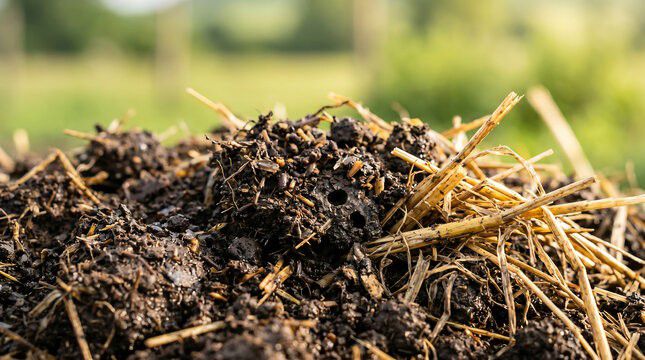
If the moisture content is too high, add dry materials such as dry straw, rice husks, mushroom residue, or dried recycled materials for mixing, or extend the turning and drying time. If the moisture content is too low, spray clean water or add fresh manure or biogas slurry. The turning machine provides oxygen and promotes even moisture distribution and evaporation during the turning process, making it an important piece of equipment for moisture regulation.
VII. Coordination with Turning Process
Moisture control must be combined with turning. When the pile temperature reaches 55℃-65℃, turn the pile every 1-2 days to promote oxygen entry and moisture evaporation. During high-temperature periods, moisture evaporates quickly, requiring timely replenishment of spray. If the material is found to be too dry after turning, add water in small amounts multiple times to avoid adding too much water at once and causing localized anaerobic conditions.
VIII. Summary
The optimal moisture content for fermentation materials is around 65%. Mastering the criterion of “forming a clump when squeezed in your hand, with water seeping between your fingers but not dripping,” combined with turning the compost and adjusting the moisture content, will allow aerobic fermentation to start quickly and thoroughly, producing high-quality organic fertilizer. Regardless of whether a trough-type, tracked, or drum-type compost turner is used, moisture management is a core prerequisite for successful fermentation.