
Insufficient granule strength and pulverization during transport usually indicates a problem not in the dryer, but rather before and during the granulation stage. Prioritize checking the raw material’s maturity and fiber fineness (fibers should be crushed to below 1 mm). Next, check the gap between the extrusion die rollers and the granulation moisture content. Excessive drying temperature can cause a hard surface and a crumbly interior, but the main cause of insufficient density lies in the granulation stage. In other words, pulverization is the “effect,” and insufficient density is the “cause,” and the foundation of density is determined before entering the granulator.
I. Four Causes of Insufficient Strength: Maturity, Fiber Fineness, Die Roller Gap, and Granulation Moisture
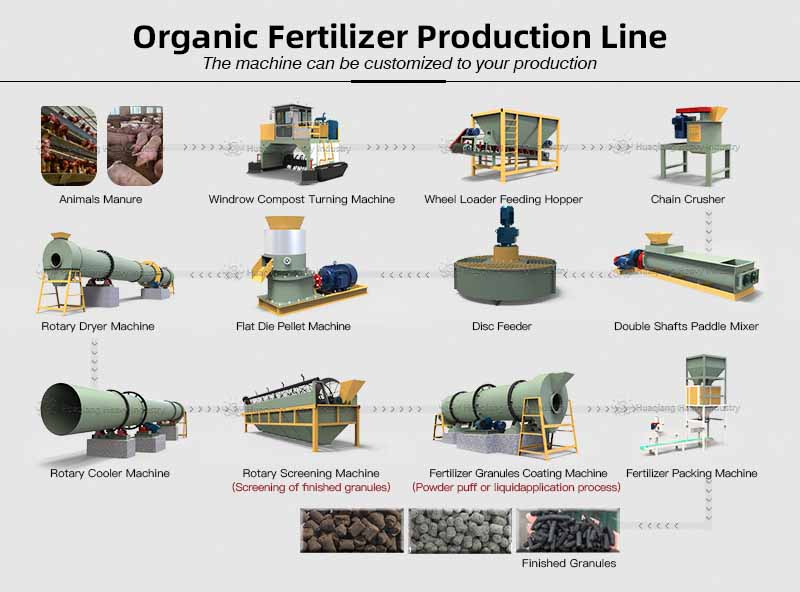
In order of influence, the first thing to check is the maturity of the raw material. Incompletely matured materials have stiff fibers and poor binding properties, lacking an effective “cementing phase” within the granules. Even if they are forcibly formed, their strength will not withstand the bumps and jolting during transport. Well-matured organic fertilizers have natural binding power from the humus itself, providing the first layer of protection for granule strength.
The second is fiber fineness. If high-fiber materials (straw, mushroom residue, etc.) are not properly pulverized, long fibers form “skeletal voids” inside the particles, resulting in fewer contact points and lower density after compaction. Industry practice requires raw materials to be pulverized to a particle size ≤1 mm. Fibers longer than 1 mm result in rough surfaces and significantly weaker strength in the formed products. Shorter fibers are not necessarily better, but coarse fibers exceeding 1 mm directly reduce particle density.
The third factor is the roller gap. Roller extrusion granulation relies on the closing of the ball sockets to compact the material under high pressure. The smaller the gap, the more thorough the compaction, resulting in better density and strength. The roller gap for organic fertilizer raw materials is typically controlled between 0.5 and 1 mm. For initial adjustments to new rollers, a gap of 0.4–0.6 mm can be used. When the gap exceeds the upper limit, the material layer becomes too thick when the ball sockets close, resulting in insufficient edge compaction, loose and thin particles, corner breakage, and powdering. After sieving, the fine powder increases, and the return ratio rises from 1:1 to over 1:1.5. The gap is not necessarily better the smaller it is; a gap below 0.3 mm will cause dry grinding of the roller surface, a surge in current, and even machine stalling and shaft breakage.
The fourth factor is granulation moisture content. The feed moisture content for dry extrusion is generally controlled between 5% and 8%. If the moisture content is too low, the powder lacks bonding force, resulting in insufficient particle strength and breakage upon discharge; if the moisture content is too high, salts absorb moisture and soften, causing sticking and deformation of the rollers. Moisture content and die-roller gap need to be calculated in conjunction; adjusting only one often yields limited results.
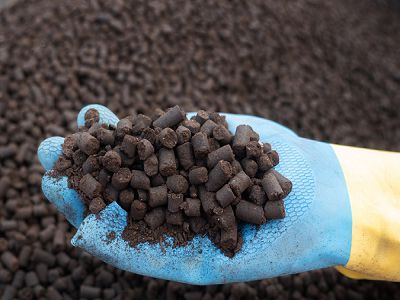
II. The Transmission Logic of Maturity—Fiber Fineness—Density
Particle strength is essentially a function of density, and density is determined by whether the material can be compacted. Maturity determines whether the material has adhesive properties, fiber fineness determines whether the pores can be filled during compaction, and die-roller gap and pressure determine whether the compaction degree is sufficient. The three factors form a unidirectional transmission chain: insufficient decomposition → lack of binder phase → loose internal particle structure; excessively coarse fibers → numerous pores in the skeleton → insufficient compaction under the same pressure; excessively large gaps → pressure cannot be transmitted to the particle center → compacted surface, loose core.
Transportation pulverization occurs concentratedly during loading, unloading, and jolting because low-density particles contain numerous micropores and unbonded fiber ends. These structural defects are barely maintained during static stacking, but once subjected to impact and friction, cracks propagate from the pores, and the particles shatter into powder along the defect surfaces. The reference value for drop testing is: from a height of 1.5 meters to a concrete surface, the breakage rate of qualified particles should be ≤5%; when the crushing strength is below 10N, the transport breakage rate can soar to over 40%.
III. Applicable Conditions for Two-Stage Granulation
Two-stage granulation (extrusion molding + rounding and shaping) addresses the problem of “shape and surface densification,” not the problem of “insufficient intrinsic strength.” Columnar granules produced by roller or flat die extrusion have prominent edges and rough surfaces. A two-stage pelletizing machine, using two connected cylinders, first roughly shapes and removes the edges, then finely polishes and compacts them, further densifying the internal structure of the granules and simultaneously improving hardness and roundness, thereby reducing breakage rates during storage and transportation.
However, two-stage pelletizing has clear limitations. If the pre-fermentation is insufficient, the fibers are coarse, or the gap between the die rollers is too large, the granules’ “base” is loose. Pelletizing can only smooth the surface and cannot solidify the core—the continuous friction inside the pelletizing cylinder may even further break down already brittle granules, resulting in an increased return rate instead of a decrease. The prerequisite for two-stage pelletizing to be truly effective is that the incoming granules already possess a basic dense framework; pelletizing is responsible for “shaping + surface densification.” For fertilizer production lines prioritizing the appearance of commercial fertilizers and adaptability to mechanized fertilization, adding a double-stage rounding stage after extrusion is a reasonable quality upgrade. However, for scenarios where strength is the primary objective and appearance requirements are not high, adjusting the composting, fineness, and die roller gap to the correct levels is more direct than adding a rounding stage.
IV. FAQ: What are the national/industry standards for strength?
Q: Which standard should be followed for granule compressive strength? How many Newtons is considered acceptable?
Standards are divided into two levels: “legal minimum” and “industry practice threshold,” which should not be confused. NY/T 525-2021 “Organic Fertilizers” stipulates a granule diameter of 2-5 mm, uniformity ≥80%, and compressive strength ≥2N. This is the legal minimum requirement for organic fertilizer products, but it is far from sufficient to guarantee the integrity of the granules during transportation. GB/T 18877-2020 “Organic-Inorganic Compound Fertilizers” and JB/T 10907-2010 “Compound Fertilizer Granulators” both require a granule compressive strength ≥15N. In industry practice, high-quality granules must withstand a vertical pressure of ≥15N (disc granulation) or ≥20N (extrusion granulation); below 10N, the breakage rate during transportation exceeds 40%. It’s important to note that GB/T 35113-2017 is a standard for stabilized fertilizers, not a universally applicable standard for granule strength assessment. During actual acceptance, the compressive strength index in the product’s execution standard should be used as the benchmark, combined with a drop test (breakage rate ≤5% after a 1.5-meter free fall).
For insufficient granule strength and pulverization during transportation, the troubleshooting sequence should be: first check the maturity and fiber fineness, then check the gap between the die rollers and moisture content, and finally assess whether two-stage granulation is necessary. Adhering to the minimum requirements of the execution standard is crucial; in practice, the criteria for on-site judgment are whether the granules break upon drop and do not collapse when squeezed by hand. Only then can the pulverization problem be prevented at its source—the density of the granulation stage.