
The Production Line, Batching, and Mixing Processes: Three Key Control Points for Bulk-Blended Fertilizers
The reliability of bulk-blended (BB) fertilizers is often mistakenly attributed solely to how well the mixer performs. In fact, the NPK Blending Fertilizer Production Line, the multiple silos single-weigh static batching system, and the BB fertilizer mixer production process are at three different levels: the entire line defines the process boundaries, the batching system locks in the formulation accuracy, and the mixing process determines the uniformity and anti-stratification ability. Instead, it processes pre-existing, high-quality granular raw materials—such as urea, diammonium phosphate (DAP), and potassium chloride—by accurately weighing them according to a specific formula, blending them, and packaging the result. Its primary advantage is the ability to switch formulas by adjusting control parameters rather than through mechanical modifications, making it ideal for regional blending stations and customized fertilizer services. However, its scope is strictly defined: the raw materials must be granular and physically compatible. The production line cannot convert powders into granules, nor can it rectify inconsistencies in the quality of the raw materials themselves.
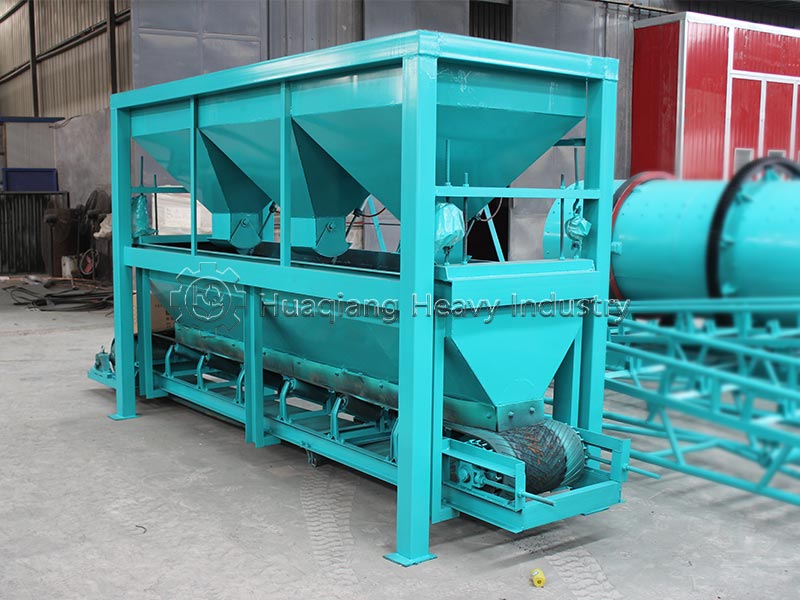
At the batching level, the focus is on “ensuring the formula ratios remain precise.” A static batching system—utilizing multiple silos for different raw materials—discharges ingredients sequentially into a single, high-precision weigh hopper. Because weighing occurs while the materials are relatively stationary, the process is unaffected by fluctuations in conveyor speed or the impact of falling material, typically keeping ratio errors within a range of ±0.2%. The true value of this system lies not in the speed of weighing, but in the “reproducibility” of every single batch. Yet, static weighing has prerequisites: the flow characteristics of the materials must be stable; otherwise, irregularities in the feeding rate can introduce errors during the weighing phase. Furthermore, if there is too great a disparity in particle size among the raw materials, subsequent vibration during transport may lead to secondary segregation.
At the mixing process level, the concern is: “Will the ingredients separate again after blending?” The core performance indicators for a bulk-blended fertilizer mixing process go beyond simply maintaining a coefficient of variation (for uniformity) of less than 5%; they also encompass the rate of particle breakage and the product’s resistance to segregation. The bulk density of urea is approximately 0.75 g/cm³, while that of potassium chloride is nearly 1.98 g/cm³. The mixing process typically employs low-speed convection, allowing particles to shift positions without being fractured by high-shear forces. Furthermore, the difference in the mean particle size among the various components should ideally be kept within 1 mm; otherwise, no amount of extended mixing time can prevent segregation—where lighter particles rise and heavier ones settle—during transport. This process can be achieved using equipment such as horizontal twin-shaft paddle mixers or drum mixers, though the process requirements must always take precedence over the specific type of machinery.
The selection process should follow a three-tiered hierarchy: first, ensure the entire production line is compatible with the state of your raw materials and the frequency of formula changes; second, verify that the proportioning system can consistently maintain precise ratios; and finally, confirm that the mixing process achieves an optimal balance between uniformity, particle breakage rates, and the prevention of segregation. Comparing the price of an entire production line as if it were a single piece of equipment leads to an underestimation of integration costs, while evaluating a proportioning system based on criteria meant for a mixer results in a misdiagnosis of the root cause of any issues. Stable output in blended fertilizer production relies on each of these three control points effectively maintaining its own operational parameters.