
A frequently overlooked principle in the selection of fertilizer production equipment is that the raw materials—not the equipment itself—should dictate the choice of machinery. NPK blending lines, roller press granulation lines, and disc-based organic fertilizer systems are designed for distinct raw material states—finished granules, dry powders, and moist fermented materials, respectively—and their underlying process logics are largely non-interchangeable.
NPK blending lines process pre-existing, high-quality granules, such as urea, diammonium phosphate (DAP), and potassium chloride (MOP). These lines do not involve granulation, drying, or the addition of water; their function is limited to precise proportioning and thorough mixing. The primary challenge here is not the mixing process itself, but rather preventing segregation (stratification) afterward. With a bulk density of approximately 0.75 g/cm³ for urea versus nearly 1.98 g/cm³ for potassium chloride, significant disparities in particle size can cause lighter particles to rise and heavier ones to sink due to vibrations during transport. Consequently, blending lines require high batching precision—typically within a margin of ±0.2%. Furthermore, pre-screening raw materials to ensure compatible particle sizes is far more effective than simply extending the mixing duration. This approach is ideal for fertilizer blending facilities that frequently switch between different formulations, provided that the raw materials are already granular and physically compatible.
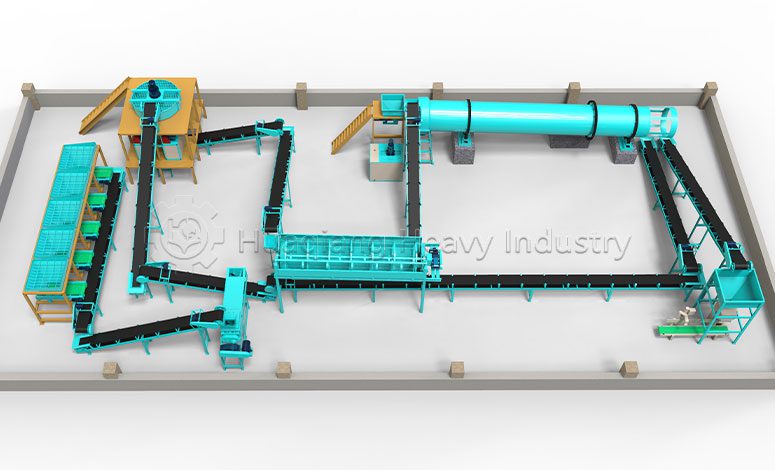
Roller press granulation lines utilize a “dry” process to handle powdered raw materials. A pair of counter-rotating rollers compresses the powder into a dense sheet, which is subsequently crushed and screened into granules. This process requires no water and generates no heat, thereby eliminating the need for the drying stage essential to “wet” granulation methods. This route is particularly valuable for formulations with high urea content—which may deliquesce upon contact with water—or those containing low-melting-point components that could liquefy when exposed to heat. However, the operational parameters are strict: the feed material typically must have a particle size of 0.6 mm or less, and the moisture content must fall within a narrow, specific range. Failure to meet these criteria can lead to slippage between the rollers or an inconsistent material layer, both of which significantly compromise the uniformity of granule strength. It delivers on its promises only when working with “prepared dry powder.”
The organic fertilizer disc granulator takes a different approach: it relies on the material’s own rolling motion to achieve agglomeration. As the disc rotates at an incline, the powdered material is subjected to centrifugal force, friction, and gravity, causing it to tumble repeatedly. With the help of a controlled amount of moisture—or the inherent stickiness of the material itself—the fine particles layer upon one another, gradually growing into granules. This method can achieve a granulation rate of over 93%. Its primary advantage is low energy consumption; fermented organic matter can often be granulated without the need for additional binders. However, the resulting granules tend to have a high moisture content, necessitating a subsequent drying stage. Furthermore, the particle size distribution is naturally variable, requiring a system for managing “recycled” (oversized or undersized) material. This process is best suited for sticky, fermented, moist materials where the commercial appearance of the granules is a priority—it is not intended for dry powders or finished, ready-to-use granules.
The logic for selecting among these three approaches ultimately hinges on a single preliminary question: in what state does the raw material emerge from the preceding process—as finished granules, dry powder, or moist, fermented material? Granules are handled via blending/re-granulation, dry powders via compaction, and moist materials via rolling (disc granulation). No single method can accommodate all three states, and no piece of equipment designed for one approach can perform the tasks for which another was engineered.