
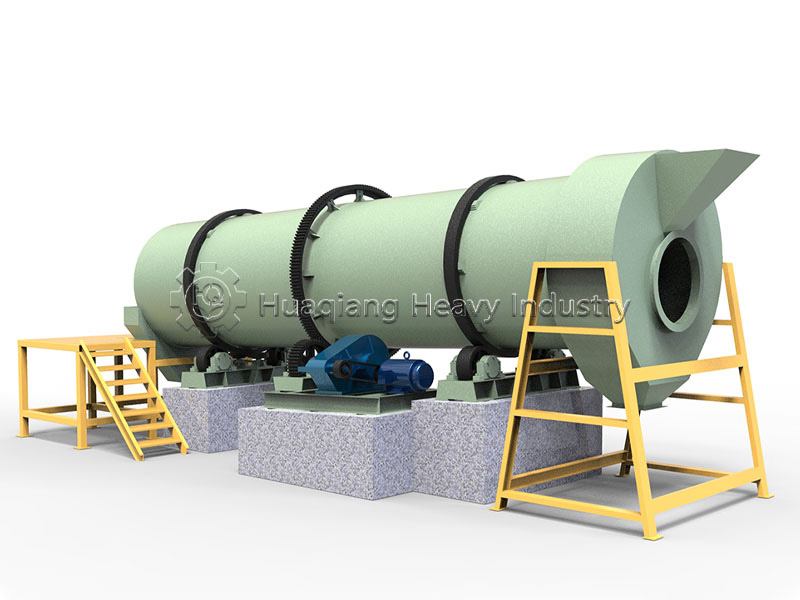
The layout of the lifting plates and baffle rings in the internal structure of a rotary drum granulator directly determines the tumbling pattern of the material bed inside the drum and the density of the particles. Even with the same formula and rotation speed, significant differences in particle strength often stem not from the formula, but from the internal structure.
For compound fertilizer production lines, the rotary drum granulator is often treated as a “black box” — operators adjust the formula, steam pressure and rotation speed, but rarely open the drum to examine what happens inside. In practice, the shape of the lifting plates, the height of the baffle rings, and the length-to-diameter ratio together decide whether the granules come out dense, round and strong, or loose, rough and easy to break. This article breaks down how these three internal structural parameters work and how to adjust them when upgrading an existing line.
I. How the Lifting Plate Formation Shapes the Material Bed and Particles
The lifting plates in a rotary drum granulator perform the core functions of “lifting—scattering—forming a material curtain.” As the drum rotates, the lifting plates lift the material to a certain height and then scatter it, forming a continuous material curtain. Through repeated scattering and tumbling, the particles gradually become denser, and their surface tends to be smoother. Different lifting plate forms result in different material bed trajectories and varying extrusion forces on the particles.
Common lifting plate forms include straight plates, folded plates, and combined plates. The folding angle of the folding lifting plates is typically between 90° and 180°. This angled design allows the material to be lifted to a higher position before being concentrated and scattered, resulting in a denser material curtain and more thorough collision and compression between particles, which is beneficial for improving density. Combined lifting plates consist of flat plates and inclined plates. The flat plates are responsible for lifting, while the inclined plates are responsible for guiding the flow. Their combination prevents material from accumulating at a single point on the cylinder wall, resulting in a more uniform material curtain distribution.
If the lifting plate angle or arrangement is improper, the material lifting height will be insufficient, the material curtain will be sparse, and the particles will only “slide” rather than “tumble” inside the cylinder, naturally resulting in low density. In practice, the rotation speed and lifting plate arrangement need to be matched and adjusted: when the cylinder wall surface is too smooth and the material slips and does not roll, appropriately adjusting the rotation speed and adding small lifting plates is often more direct and effective than simply changing the formula.
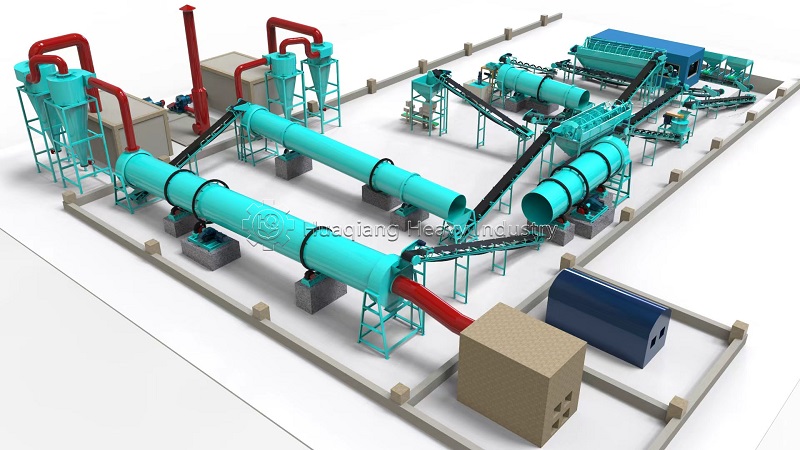
II. Constraints of Baffle Ring Height and Filling Rate on Density
The baffle ring is a key structure for controlling the material inventory and residence time inside the cylinder. The filling coefficient of a rotary drum granulator is generally controlled at 25%–30% of the total drum volume, and the height of the discharge end baffle ring is typically 18%–22% of the drum diameter. This height directly determines the thickness of the material retention within the drum.
If the baffle ring is too low, the material’s residence time inside the drum is insufficient, and the granules are discharged before they have enough time to fully tumble and compact, resulting in loose granules with low strength. If the baffle ring is too high, with a filling rate exceeding 30%, the material layer is too thick, and the lifting plates cannot effectively lift the material. The bottom layer of material is compressed and agglomerated for a long time, leading to uneven particle size and adhesion to the walls.
The middle baffle ring also serves a zoning function: the area near the feed end is the mixing and granulation zone, and the area near the discharge end is the polishing zone. The granulation zone focuses on pelleting, while the polishing zone focuses on rolling and finishing the particle surface. The two zones are separated by the baffle ring, allowing the granules to obtain additional compaction opportunities before discharge. The baffle ring height needs to be set in conjunction with the rotation speed and tilt angle; changing only one often yields limited results.
III. The Linkage Between L/D Ratio and Dryer L/D Ratio
The L/D ratio of a rotary drum granulator not only affects its own granulation effect but also creates a linkage constraint with the selection of the downstream dryer. In industry practice, the L/D ratio of rotary drum granulators is typically 3.0 or higher, with a 5:1 L/D ratio design recommended. Compared to the traditional 4:1 model, this can increase the material residence time by approximately 15%, achieving a nitrogen, phosphorus, and potassium mixing uniformity of 98.5%.
A longer residence time means more opportunities for granules to tumble and compact within the drum, but this also alters the moisture content and temperature of the discharged granules. If the residence time in the granulation section is extended while the dryer remains configured according to its original specifications, a mismatch may occur: “drier granules at the discharge, insufficient dryer heat load” or “wetter granules at the discharge, overloaded dryer.” Therefore, the adjustment of the rotary drum granulator’s L/D ratio should be calculated synchronously with the dryer’s L/D ratio and hot air parameters to avoid the drying section becoming a bottleneck after the granulation section has been optimized. A mismatch between the power of the granulator and the dryer is a common source of wasted capacity in compound fertilizer production lines.

IV. FAQ: How to Improve the Strength of an Existing Drum Granulator Line?
Q: The existing drum granulation line has low particle strength. Should the renovation focus on the internal structure or the formulation?
It is recommended to first check the internal structure, then evaluate the formulation.
Step 1: Check the lifting plates. If the lifting plates are severely worn, have a single type, or the material curtain is sparse, prioritize replacing them with folded or combined lifting plates to increase the frequency of material tumbling and compaction.
Step 2: Calculate the filling rate. Measure the ratio of the discharge end retaining ring height to the cylinder diameter to confirm if it is within the recommended range of 18%–22%. If it deviates, adjust the retaining ring height.
Step 3: Check the length-to-diameter ratio for matching with the dryer. If the granulator’s length-to-diameter ratio is too small or the residence time is insufficient, consider extending the cylinder or adjusting the rotation speed and tilt angle compensation, provided space allows.
If the strength is still insufficient after optimizing the internal structure, then review the liquid phase content, binder, and raw material fineness in the formulation. In terms of the order of modification, adjusting the lifting plates and baffle rings has the lowest cost and fastest results, and should be the first entry point.
In summary, the particle quality of a rotary drum granulator is the result of its internal structure: the lifting plates determine the material curtain shape, the baffle ring determines the filling rate and residence time, and the length-to-diameter ratio determines the compaction opportunity and works in conjunction with the dryer. Only by coordinating these three internal structural parameters with the formula and rotation speed can a stable structural foundation for particle density and strength be established.