
Pre-dehydration is the key. Reducing the initial moisture content to 25%–30% is the single most effective step to stop a chicken manure fertilizer machine from plugging its die. Nine times out of ten, chicken manure pelleting mold blockage is not caused by the wrong die orifice diameter or insufficient pressure, but by the failure to reduce the initial moisture content before feeding. Fresh chicken manure has a high original moisture content of 70%–80%, with a sticky and muddy texture. Directly feeding it into a flat or ring die pellet mill prevents effective radial pressure from forming within the die orifice under high pressure; instead, it clogs the orifice like a plug, resulting in either soft, unformed material or no pellets at all. The core task of pre-dehydration is to bring the initial moisture content into the appropriate range for the mold, typically stabilizing it at 25%–30%, so the material can be compacted, squeezed out, and released easily inside the die.
I. The Relationship Between Chicken Manure Moisture and Mold Blockage
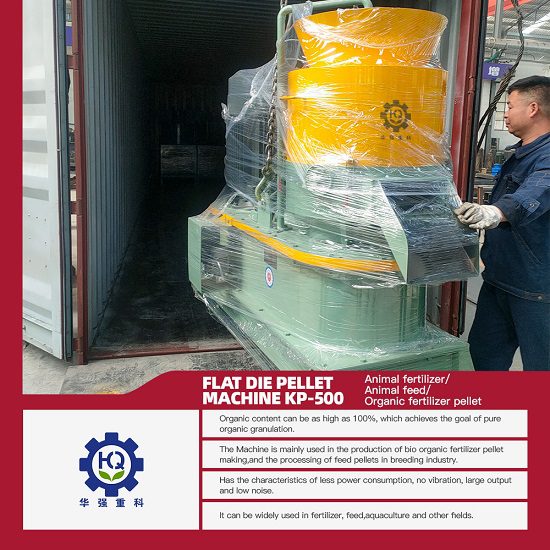
Flat die pelleting machine and ring die extrusion pelleting machine are dry forming processes that rely on mechanical pressure to force powder into the die orifice. The industry-standard feed moisture content range is 10%–20%, with an optimal range of 12%–18%. Flat dies and ring dies, due to their longer die holes, have a slightly higher tolerance for moisture, but it should still not exceed 18%. Chicken manure is a highly viscous fine powder; once the moisture content exceeds the 25%–30% threshold, the material’s flowability inside the die holes drops sharply, the adhesion force exceeds the extrusion force, and clogging becomes inevitable.
A more hidden problem is “dry on the outside, wet on the inside.” Chicken manure that has been sun-dried or simply dehydrated may appear dry on the surface, but still contains abundant free water inside. After entering the machine, it can cause localized sticking and clogging of the die holes. Operators may mistakenly believe it is a machine malfunction, repeatedly adjusting the pressure rollers and changing the die, but without success. Therefore, moisture control cannot rely on feel; it must be precisely measured with a moisture meter to control the final moisture content. This is the first line of defense against die clogging in any fertilizer flat die pellet machine.
II. Dewatering, Remixing, and Drying: How to Combine Three Pre-processing Solutions
Pre-processing dewatering is not a single action, but a set of combined logic. Mechanical dehydration is the top priority: a screw extruder can reduce the moisture content of fresh chicken manure from over 80% to a solid material range of 50%–65%, quickly removing most of the free water and creating conditions for subsequent fermentation or direct granulation.
For routes that go directly to extrusion granulation, further moisture reduction is often required after mechanical dehydration. In this case, remixing with dry material is the most flexible method: add 5%–10% straw powder, sawdust, or well-rotted recycled material to the dehydrated, jelly-like chicken manure. Use the specific surface area of the dry material to absorb excess moisture, while improving the material’s fiber skeleton, bringing the moisture content entering the die closer to the 18%–25% extrusion window.
Drying (air drying or low-temperature drying) is a supplementary method, suitable for situations where the moisture content is severely excessive or cannot be stably controlled during the rainy season. However, dried chicken manure is highly hygroscopic and will soften quickly if piled in the open. Granulation should be completed within 4–8 hours after dehydration to avoid a cycle of “dehydration followed by dampness, dampness followed by blockage.” The relationship between the three methods is as follows: mechanical dehydration as a base, remixing with dry materials for fine-tuning, and drying as a final step; relying on any one method alone is difficult to maintain stability.

III. The Matching of the Die Conical Orifice and Demolding
After the moisture content is reduced to the appropriate level, whether the granules can be successfully extruded depends on the matching between the die geometry and the material state. The die orifice of the flat die extrusion granulator uses a specially designed taper, combined with an adjustable pressure roller gap (0.1–0.5 mm), to create sufficient radial pressure inside the die orifice for high-moisture materials. The particle density can reach 1.1–1.3 g/cm³, producing a dense structure that is not easily broken after extrusion.
The function of the conical orifice is to gradually build a pressure gradient during extrusion, allowing the material to transition from “loose powder” to “compact column,” rather than being instantly “blocked” at the orifice opening. When the moisture content of the material entering the die falls within the suitable range of 18%–25%, the compression ratio of the conical orifice works together with the plastic deformation of the material, resulting in smooth demolding. When the moisture content is too high, the material “slips” rather than “compacts” inside the orifice, and even the best taper cannot compensate for the viscosity caused by excessive liquid phase. In other words, the conical orifice solves the problem of “tight compression,” while pre-dehydration solves the problem of “flow,” and both are indispensable.
IV. FAQ: How to Clean the Mold Without Damaging the Hole After It Gets Stuck?
Q: The mold hole is already clogged. How can I clean it without damaging the hole wall?
Mechanical unblocking is the first choice; avoid forceful hammering or brute-force drilling. After stopping the machine and disconnecting the power, remove the die and manually unblock it with a drill bit slightly smaller in diameter than the mold hole — for example, a φ4 mm mold hole with a φ3.8 mm drill bit. Slowly rotate and advance the drill bit along the axis of the hole, without applying lateral force.
For blockages with strong viscosity and minor drying, soak the mold in 50°C hot water for about 1 hour to soften the material before cleaning with a soft brush or copper needle. The copper needle’s hardness is lower than the mold steel, so it is less likely to scratch the hole wall. High-pressure water jet backflushing (pressure above 10 MPa) is suitable for auxiliary cleaning of through holes, but ensure the water pressure direction is coaxial with the channel to avoid impacting the chamfered opening from the side. After cleaning, dry the die hole with compressed air and check for scratches or burrs on the hole wall. For new dies or dies after cleaning, use an oil-based abrasive to press under low pressure for more than ten minutes to improve the smoothness of the hole wall, preparing for smooth demolding next time. Remember one principle: mold cleaning is about “clearing,” not “expanding.” Any operation that increases the hole diameter will cause irreversible damage to the mold’s service life.
In summary, the solution to die jamming in a chicken manure fertilizer machine is not repeated adjustments inside the pelletizer, but drawing the moisture down to the appropriate range before feeding. Mechanical dehydration removes free water, remixing with dry material finely adjusts the moisture content, and the conical orifice and pressure rollers handle the final compaction and demolding. By stabilizing the moisture content of the material entering the die at 25%–30%, mold jamming is transformed from a “frequent failure” into a “preventable process deviation.”