
When purchasing granulation equipment, production capacity figures are the most immediately apparent metric. However, what truly determines whether a production line can operate stably in the long term is often the equipment’s “feed window”—that is, its tolerance range regarding the moisture content, fineness, and stickiness of the raw materials. While capacity dictates how much can be produced in a day, the feed window determines whether that production can actually be achieved smoothly.
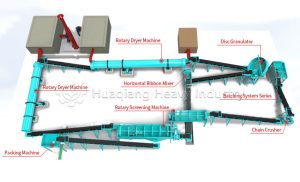
Disc Granulation Production Lines: A Narrow Window Requires Robust Pre-processing. The core of a disc granulation production line is the disc granulator, where materials roll and agglomerate on an inclined rotating disc, relying on their own moisture content. The requirements for the input material are specific: moisture content is typically controlled between 25% and 35%, fineness should exceed 60 mesh, and the material must have moderate stickiness. If the moisture content is too low, fine powder will scatter, and the granulation rate will drop; if it is too high, the material will stick to the disc, and granules will clump together. Insufficient fineness results in rough granule surfaces and inadequate structural strength. A narrow feed window means that the upstream processes—crushing, mixing/conditioning, and moisture control—must be highly stable; otherwise, the disc will immediately “sound an alarm” through issues like material sticking to the disc or an increase in the volume of recycled (rejected) material. The advantages of this line include excellent granule sphericity and relatively low investment costs—provided that the upstream processes are capable of preparing the material to the required specifications.
New “Two-in-One” Organic Fertilizer Granulators: A Wider Window Through Integration. The “two-in-one” organic fertilizer granulator integrates both mixing and granulation into a single main unit. Because the material moves from the mixing zone to the granulation zone almost instantaneously, it has minimal exposure to the ambient environment and is less affected by external temperature and humidity. This type of equipment can handle a broader moisture range—roughly 25% to 45%—offering greater compatibility with high-moisture organic materials and maintaining a stable granulation rate of over 90%. However, a wider window does not mean there are no limits; if the upstream semi-wet crushing process fails to achieve sufficient fineness, or if the moisture content of the fermented material is severely uneven, even a “two-in-one” system will produce granules of inconsistent sizes. Its value lies in reducing moisture fluctuations during intermediate transport stages, making a “wide operating window” truly viable.
Double-roller extrusion granulation technology features the narrowest operating window, but in exchange, it offers the low energy consumption characteristic of a dry process. This method relies on high pressure to compress powdered material into dense sheets, which are subsequently crushed and screened. It requires the feed material to have a stable moisture content—typically between 8% and 15%—and a particle size generally no greater than 0.6 mm. If the moisture content is too high, the material will stick to or coat the rollers; if it is too low, fine powder will accumulate on the roller surfaces, hindering proper material intake. Although the operating window is narrow, the process is entirely dry—requiring neither the addition of water nor subsequent drying—which results in significantly lower energy consumption compared to wet granulation methods. The trade-off is the necessity for a reliable upstream drying and pulverization system to ensure the material’s condition remains strictly within the required operating parameters.