
When selecting equipment, many people ask, “What pressure (in MPa) should this machine be set to?” However, the pressure setting for a double-roller press granulator is not a fixed value to be looked up in a table; rather, it is a dynamic range determined by the material’s characteristics, fineness, moisture content, and the target granule strength. Treating pressure as a fixed value often leads to either insufficient compaction or the formation of cracks in the granules.
Insufficient pressure: Granules “look well-formed but crumble at the slightest touch.” A fertilizer roller press machine uses a hydraulic system to apply compressive force to two rollers, transforming loose powder into a dense, compacted sheet (briquette) within the roller gap. If the pressure is too low, the internal bonding force within the granules remains weak. While they may appear fine on the surface, their compressive strength is often only 10–15 N, leading to a significant increase in the rate of powdering (fines generation) during packaging and transport. A more subtle issue is that insufficient pressure results in thicker compacted sheets with loose edges; when these are crushed, the proportion of fine powder increases, leading to a higher volume of “recycled material” (fines sent back to the start of the process). This consumes the production line’s capacity, effectively preventing the granulator from operating at its full, intended throughput.
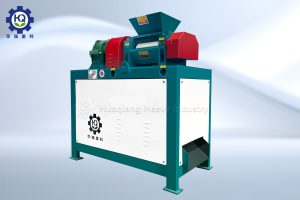
Excessive pressure: Granules appear dense but contain internal micro-cracks. When the pressure exceeds the material’s densification limit, internal stress cannot be dissipated. Upon exiting the machine, the granules may look smooth on the surface, but they are riddled with internal micro-cracks. These cracks expand during subsequent drying or storage; when exposed to water, the granules do not disintegrate uniformly but instead fracture into fragments along these existing cracks. The core of double-roller press granulation technology is not “the higher the pressure, the better,” but rather finding the precise balance between material densification and stress relief.
Pressure must be carefully coordinated with moisture content and material fineness. For instance, at a setting of 15 MPa, a material with 8% moisture content might yield dense, smooth granules, whereas increasing the moisture content to 14% could cause the material to stick to the rollers and result in a tacky, poorly formed compacted sheet. When the particle fineness is reduced from 0.6 mm to 0.3 mm, the specific surface area increases, causing the particles to become more compact under the same amount of pressure; consequently, the pressure must be lowered to prevent over-compaction. Therefore, pressure settings must be dynamically adjusted based on the state of the material, rather than relying on a single, fixed set of parameters.
Disc granulation for bio-organic fertilizers and the blending of BB (bulk-blend) fertilizers follow a different logic. Disc granulation does not rely on high-pressure forming; instead, it utilizes the rolling and agglomeration of material on an inclined rotating disc. In this process, the concept of “pressure” does not apply—it is replaced by variables such as the disc’s inclination angle, rotational speed, and the volume of liquid sprayed. BB fertilizer blending, meanwhile, involves no change to the physical form of the particles; it is strictly a physical mixing process, where the goal is to achieve a coefficient of variation (CV) of ≤5% for mixture uniformity—again, with no concept of “pressure” involved. Applying a “pressure-based” mindset—appropriate for roller compaction—to disc granulation or BB fertilizer blending is akin to trying to use a wrench to turn a screwdriver; it is the wrong tool for the job, and the more force you apply, the worse the outcome will be.