
In the fertilizer industry, errors fall into two categories: those that can be rectified and those that cannot. If the proportions in a blended fertilizer are incorrect, the issue can be fixed by re-weighing and re-mixing the ingredients—provided the raw materials remain intact and the granules are not crushed. Conversely, if a batch of bio-organic fertilizer is not fully fermented, or if the drying temperature is too high—killing off the functional microorganisms—the entire batch is beyond saving. NPK blending production lines and bio-organic fertilizer granulation systems (such as disc granulators) represent two fundamentally different approaches to fault tolerance: the former deals with “reversible formulas,” while the latter safeguards “irreversible life.”
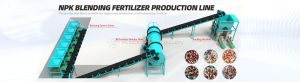
The reversibility of a blending line is predicated on the fact that the raw materials themselves remain unchanged. NPK blending systems process pre-existing, finished granules—such as urea, diammonium phosphate (DAP), and potassium chloride—without the need for granulation, drying, or the addition of water; the process is limited to precise weighing and thorough mixing. During the proportioning stage, multi-bin static weighing ensures that each ingredient is measured individually, keeping deviations within a very tight margin. In the mixing stage, low-speed convective action allows granules of varying densities to intermingle without compromising their original physical structure. Because the entire process is a purely physical combination, an incorrect formula can simply be adjusted and re-run; the raw materials are never rendered useless. NPK blending lines systematize this reversible logic: switching from a rice-specific fertilizer to a vegetable-specific one requires only a change in the control system’s formula settings, with no major modifications to the equipment itself. The primary risks here are “inaccurate proportioning” or “segregation during transport”—not the total loss of the entire batch.
Bio-organic fertilizer production—utilizing equipment like disc granulators—operates on an entirely different logic. It does not process finished granules, but rather organic matter that has undergone fermentation and decomposition. Disc granulation is merely the final stage in the bio-organic fertilizer production line; the ability to produce high-quality granules depends entirely on the preceding steps—ensuring complete fermentation, achieving the optimal moisture content, and ensuring that the fibers have been sufficiently softened. More importantly, the core value of bio-organic fertilizer lies in its living functional microorganisms. Because these microbes are “alive,” the process is highly sensitive: if the fermentation temperature is insufficient, unwanted, opportunistic microorganisms will take over; conversely, if the drying temperature is too high, the functional microbes will perish in large numbers. Once such errors occur, they cannot be rectified simply by re-weighing the ingredients. While a disc granulator allows for adjustments to its tilt angle and rotational speed to accommodate different materials, it cannot recover the loss of microbial viability caused by a failed fermentation stage or excessive heat during drying. The margin for error does not reside within the equipment itself, but rather in the strict adherence to operational protocols across the entire production line.
The fundamental distinction between these two approaches lies in the difference between “physically reversible” and “biologically irreversible” processes. In a blending line, the primary risks involve ingredient precision and the prevention of material segregation—issues that can be corrected by re-blending. In a bio-organic fertilizer production line, the risks are concentrated in the fermentation and drying stages; a failure here often means the entire batch must be discarded. Therefore, the first step in selecting equipment is not to compare price tags, but to determine which type of risk you are prepared to manage. If you serve a market that demands frequent formula changes, the reversibility of a blending line offers invaluable flexibility. If, however, you are producing bio-organic fertilizer, then every single process—both upstream and downstream of the disc granulator—requires even greater attention and rigor than the granulator itself. Reversible formulations rely on precision for success, while irreversible biological processes depend on strict operational discipline for survival.